Unit 1 Ex3: The Photograph As Document: Project 4: The Gallery Wall, Documentary As Art: Public Order

Look at some more images from this series on the artist’s website.
• How do Pickering’s images make you feel?
• Is Public Order an effective use of documentary or is it misleading?
Make some notes in your learning log.

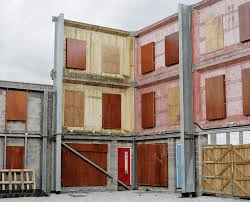
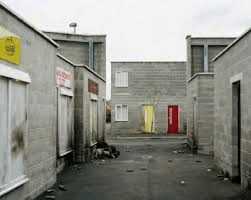
Pickerings images are of desolate fake urban areas where the police practice how they would deal with a violent riot situation. The images are after their training and there are no people in her work which I find quite disconcerting, the areas, although they look deprived are rather clean and clinical which also creates a sense of unease.

I don’t think Public Order is an effective piece of documentary since this training area assumes that riots only happen in urban areas when we know that they also take place in the countryside and different environments to what is described in these images.

I would imagine that since it is a training area that a documentary series of images would be more meaningful if they included people and what they use this area for, it would be less ambiguous and would not leave the viewer to construct the meaning as much as they would in this series.

“Behind Flicks Nightclub 2004” These images don’t make me feel comfortable, they are disconcerting
The lack of people in all these images creates ambiguity which is not documentary

Unit 1 Research: The Photograph As Document: Project 4: The Gallery Wall, Documentary As Art

Look online at Paul Seawright’s work, Sectarian Murders.
• How does this work challenge the boundaries between documentary and art? Listen
to Paul Seawright talk about his work at: http://vimeo.com/76940827 [accessed
24/02/14]
• What is the core of his argument? Do you agree with him?
• If we define a piece of documentary photography as art, does this change its meaning?

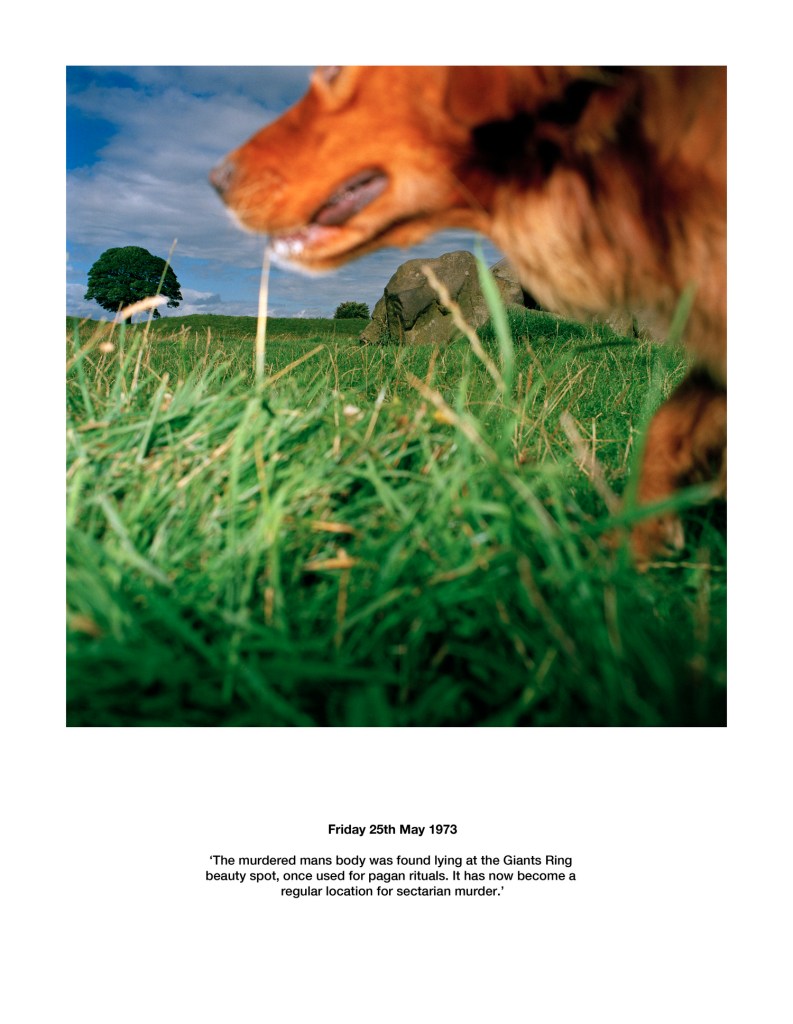
Paul Seawright revisited the scenes of Sectarian murders that took place in the 1970’s and photographed the area in present times, this challenges the boundaries between documentary and art because the images are not obvious in what they mean and the viewer has to come up with the meaning. A documentary photograph would include different elements and subjects within the image and would be taken without thoughtful composition. For example, the photograph below is an area where a murder took place but a dog has been photographed, this is art because if it was a documentary photo the dog would not have been included in the image and it would have possibly been at a wider angle than this.

The core of Seawright’s argument is that if an image is too explicit it is journalistic and if the image is too ambiguous it becomes meaningless to the viewer so the photographer has to strike a balance between the two. The image needs to be ambiguous enough to leave space for the viewer to derive meaning – it needs to be visually engaging and give it’s meaning up slowly to the viewer. Once the viewer knows the context they can resonate with all kinds of ideas associated with the image.

I think documentary photo described as art does change its meaning, the word art implies that there is freedom given to the photographer to include elements in the image that are not necessarily directly related to the story so is not true to the story in the purest sense.

Bibliography

Paul Seawright. (2020). Sectarian Murder — Paul Seawright. [online] Available at: http://www.paulseawright.com/sectarian [Accessed 26 Feb. 2020].

Unit 1 Research: The Photograph As Document: Project 2: Photojournalism: Research: Critical Debates Around Journalism

If you’re interested in the critical debates around photojournalism, try and make time to
find out more about at least one of these critical positions during your work on Part One.
Here are some questions to start you off:
1) Do you think Martha Rosler is unfair on socially driven photographers like Lewis
Hine? Is there a sense in which work like this is exploitative or patronising? Does this
matter if someone benefits in the long run? Can photography change situations?
2) Do you think images of war are necessary to provoke change? Do you agree with
Sontag’s earlier view that horrific images of war numb viewers’ responses? Read your
answer again when you’ve read the next section on aftermath photography and note
whether your view has changed. See also: http://lightbox.time.com/2014/01/28/
when-photographs-of-atrocities-dont-shock/#1 [accessed 24/02/14]
3) Do you need to be an insider in order to produce a successful documentary project?

1) Martha Rosler : Work can be exploitative or patronizing if it is taken from a distance and no relationship is developed with the people involved who are the subject of the story. Anthony Luvera, a British socially engaged photographer made work called “Taking Place” about the homeless. The approach was that the subjects were heavily involved in the process by taking their own images, learning photography so picked up a new skill, and through the process creating self worth and a sense of identity again.
As part of this project, questions were asked of local councils about what provisions are made for the homeless and effective change was made at government level that placed a legal obligation on councils to provide information to the homeless about where they can access basic facilities in the town or city they find themselves in. I am inspired by how this project has made a positive change to how the homeless are treated by local councils.

2) Susan Sontag’s  views that the viewer is becoming numb to horrific images was 39 years ago in her book “On Photography” written in 1981. This was true then but even more so today, but my view is that it is the same image in the same media format shown repeatedly that will numb the senses, so rather than the image numbing the senses, it’s the repetitive similarity that numbs the senses.

I agree that images of war are still necessary to provoke change, but people in today’s digital age take on information in a very different way to the way they used to in the 1960s and 1970’s the time period referred to by Susan Sontag’s book “On Photography” he best way to transmit information today is digitally and in sound bite format or a powerful image, or a combination of both, but the image really does have to be something that moves people, something that stands out as being unique or different – the lifeless body of Syrian refugee boy, Alan Kurdi dead on a Turkish beach was a photo that initiated action, it wa’s shocking and as it states in the Daily Sabah’s online article “Few photos shook the collective public conscience like that of the lifeless body of Syrian boy Alan Kurdi washed ashore in Turkey’s western coast”. Several EU countries including the UK and Germany relaxed laws to allow more migrants to enter. I agree that the same images of war will numb the senses, different images or an image that comes from a different angle either in its narrative or the image or both will still invoke a reaction of empathy and could be used as a vehicle for change. The process of making the images can be a vehicle for change too, socially engaged photographers like UK’s Anthony Luvera involves the homeless in taking photographs of themselves and their surroundings and this has helped raise the public and government awareness of the plight of the homeless around the UK. The difference in the image of Alan Kurdi and also Anthony Luvera’s work with the homeless is that the work breaks down stereotypes and forces us to think of the subjects differently, they are portrayed in a more human way that evokes more of an emotional response from the viewer.

Susan Sontag, despite saying that images of war have numbed the senses, she still makes reference to how a still image is more powerful than video which is moving images as moving images cancel each other out, she uses the example of Nick Ut’s photograph of the screaming napalm bombed Vietnamese child having more of an impact than moving images. Given that the Syrian child, Alan Kurdi’s photograph provoked similar outrage several decades on means that photography of this nature is still effective in creating change.

I find it interesting how Susan Sontag discusses the ethical stance of photography and what we think we “have a right to see” – this seems to have shifted significantly over time where more graphic violent images have become more acceptable viewing.

I enjoyed Susan Sontag’s five reasons why photographs fail (Pg : 23 On Photography) I can see how through these five points she may think that images of war can be less effective than initially intended :

i) “A photograph is both a piece of time and of space. By including or
excluding things its arbitrary boarders both create and break relationships. This temporal and spatial dislocation results in social reality being presented
as small discontinuous particles”.

ii) A photograph only shows us the surface, so it has many meanings
and encourages us to deduce or intuit what the reality was like.

iii) Photography can only give us knowledge of the world if we accept the
world as we see it ‘But this is the opposite of understanding, which starts from
not accepting the world as it looks’. Photographs have a use in giving us
mental picture of things, but they always hide more than they reveal. She
quotes Brecht as pointing out that a photograph of the Krupp works show
very little of that organisation. The ‘amorous function’ is based on looks but
understanding is based on functions, which takes place in time and so can
only be explained in time. ‘Only that which narrates can make us understand’

iv) While photographs can arouse conscience this is only a semblance of
ethical or political knowledge because it is always sentimental (whether it be
cynical or humanist).

v) By duplicating the world in such a comprehensive way it has made the world seem more available than it really is

3) I don’t think it is necessary to be an insider to produce a successful documentary project. I think it is how photographs are taken and the narrative the photo, or series of photographs portray. The plight of wildlife and plastic invading their environment is evidence of this, one does not have to live with and get to know the animals or the people, it may help you get the job done quicker and add a richness to the narrative though. With patience and tenacity and fully understanding the issues at hand through research and talking to people who know about the issue at hand, successful work can be created and a desired response achieved. There is a lot more to a documentary project than simply being on the inside of the story, it is choosing the correct series of images, telling the story with different image types, placing the images in the correct medium at the correct time to name a few considerations that all make a successful documentary project.

Bibliography

DailySabah. (2020). West deaf to migrants’ plight four years after Alan Kurdi’s death. [online] Available at: https://www.dailysabah.com/syrian-crisis/2019/09/02/west-deaf-to-migrants-plight-four-years-after-alan-kurdis-death [Accessed 24 Feb. 2020].

Anthony Luvera. (2020). Anthony Luvera: Taking Place – Anthony Luvera. [online] Available at: http://www.luvera.com/taking-place/ [Accessed 24 Feb. 2020].

Exhibition: Nalini: Arpita Shah : 15th Feb 2020: Bradford

Yesterday I visited Impressions Gallery in Bradford to see an exhibition I had heard a great deal about and had a particular interest in for 2 reasons:

1) Arpitah Shah was my tutor for “Expressing Your Vision” and

2) I have a personal connection to this work that focuses on migration, distance and loss. I moved from Africa where I lived till the age of 21 and moved to the UK, dealing with cultural differences and still visiting and talking to family who have remained in Africa.

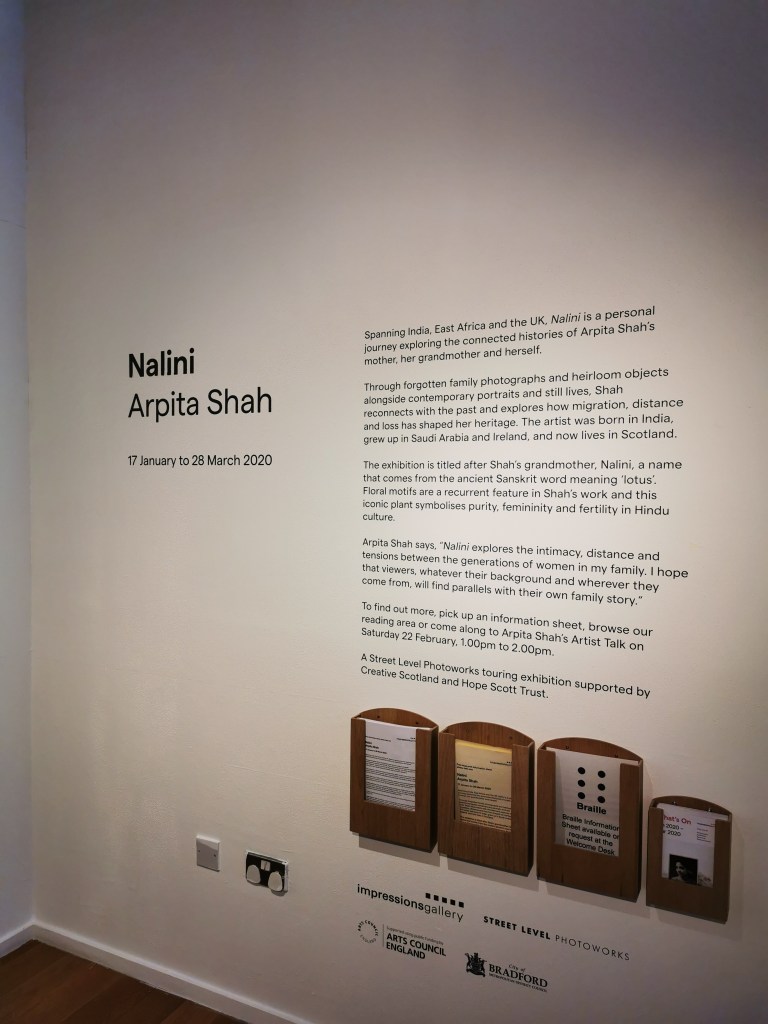
The exhibition is named after Shah’s grandmother, Nalini, a name that comes from the ancient Sanskrit word meaning “lotus” which symbolises purity, femininity and fertility in Hindu culture.

This exhibition has been four years in the making and I love how Arpita has combined so many elements to make exhibition a rich experience for the viewer, some of the ways she has done this :

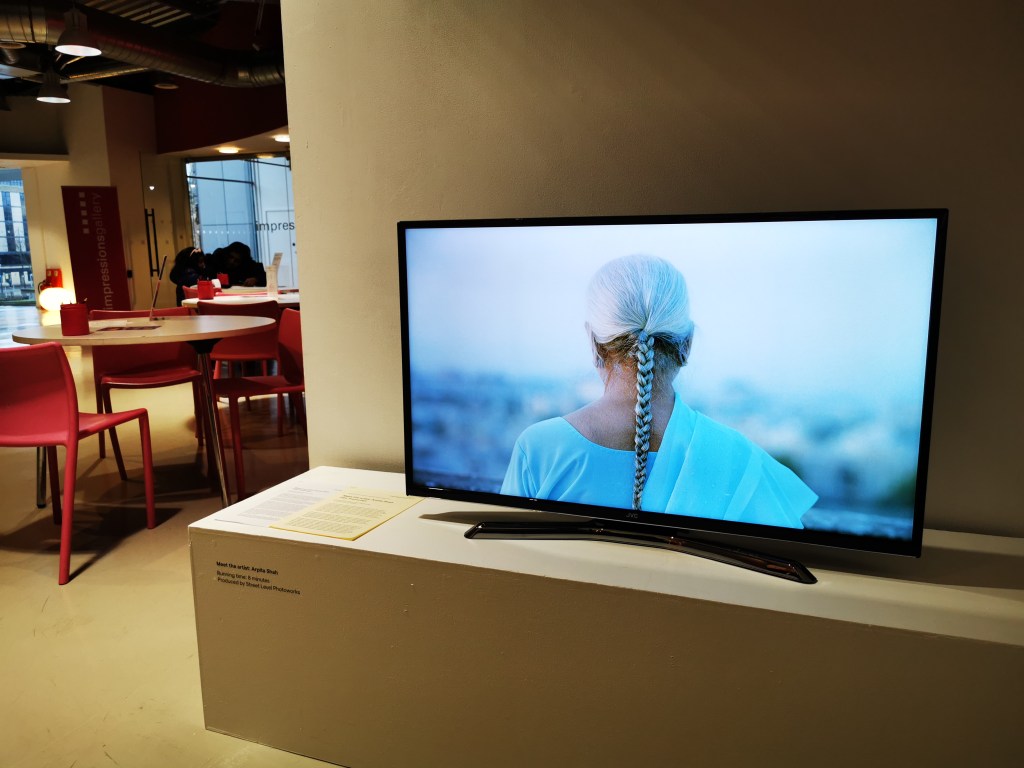
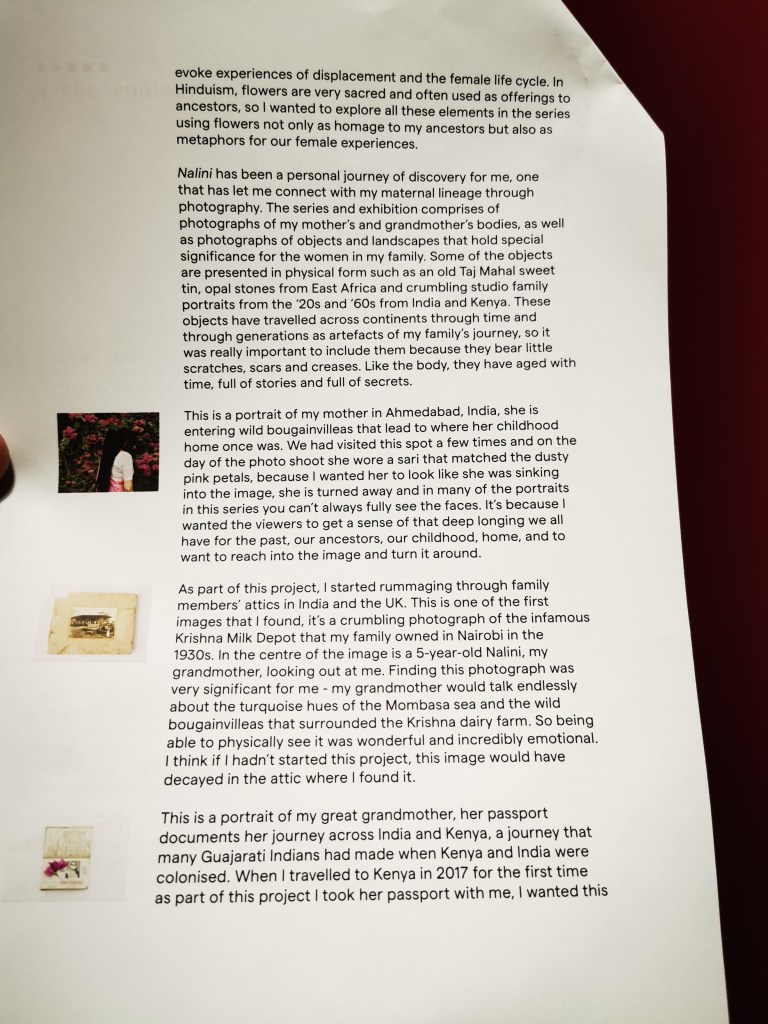
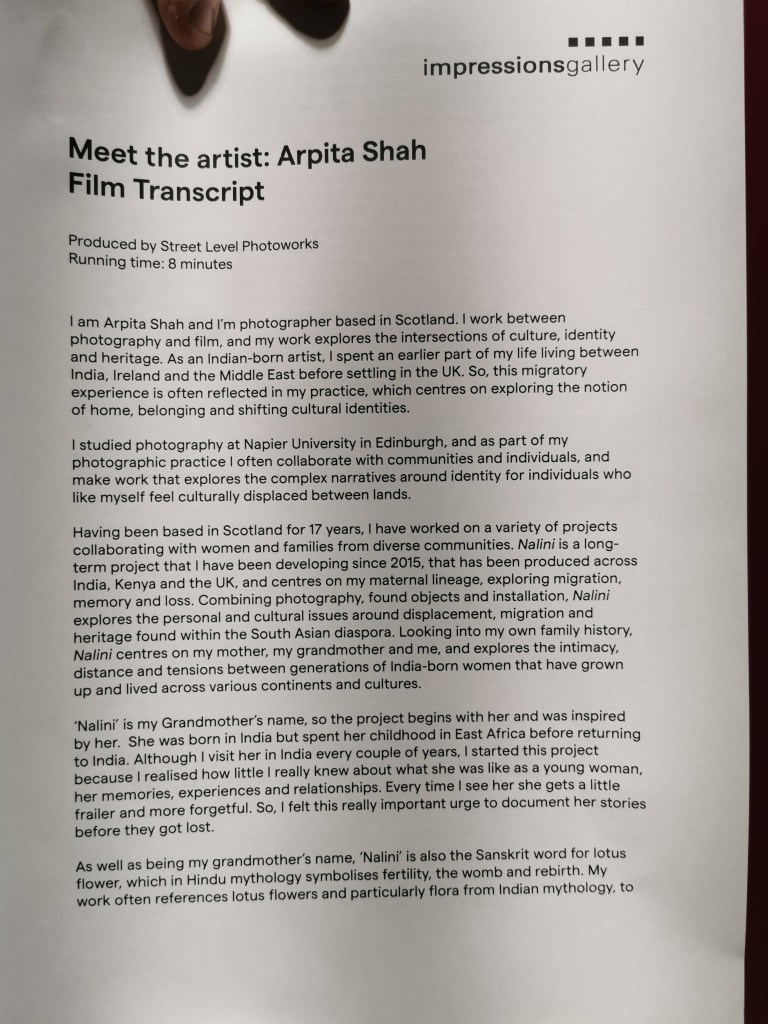
The video at the entrance gives a very good overview of the meaning behind the images she is exhibiting without reading about it, there is also a script of the video which is useful.

The explanatory video at the entrance to the exhibition is really useful to give the visitor a good idea of the thought behind each image and an explanation of the work

There is a children’s area where some of the images have been recreated into images that can be coloured in

The children’s area is a great idea, they can learn about art and heritage while the parents can view the exhibition, a double benefit, win win situation!
One of a number of colouring choices for the children

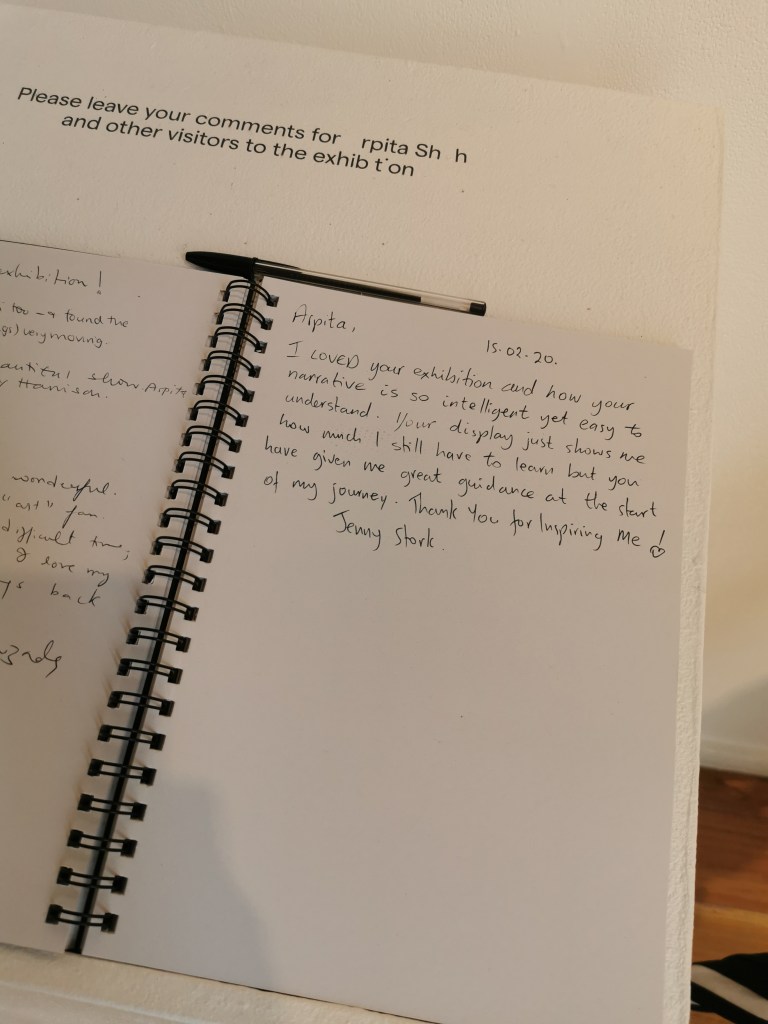
There is a comments book for visitors

The comments book is something I enjoyed at the exhibition and haven’t seen it before at any others I have been to, being new to photography I am not sure if this sort of thing is common ?

There are options for large print and braille

I really like the thought behind the large print and braille versions of informaiton

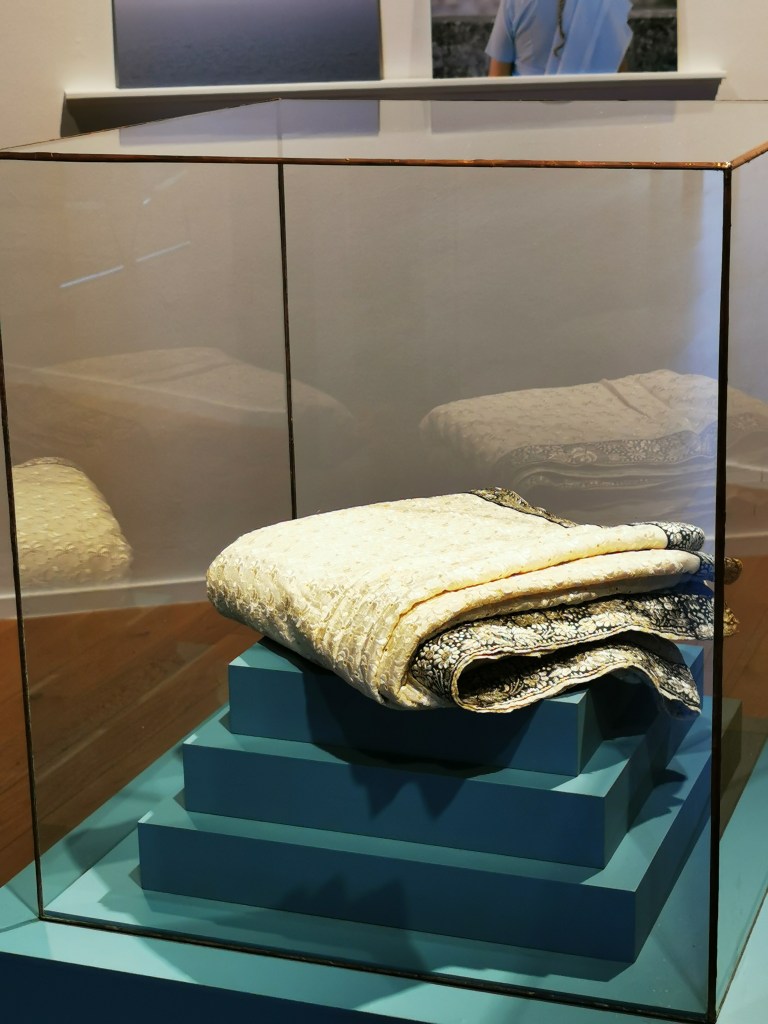
The sari that is almost 200 years old is on display, as well as an old suitcase used to move from India to Kenya, and a display case full of several artefacts that related to the images

This almost 200 year old sari is a wonderful example of connection, tradition and bonds. I think this display should have been next to the old image of Arpita’s grandmother who was wearing it so the connections can be more easily made

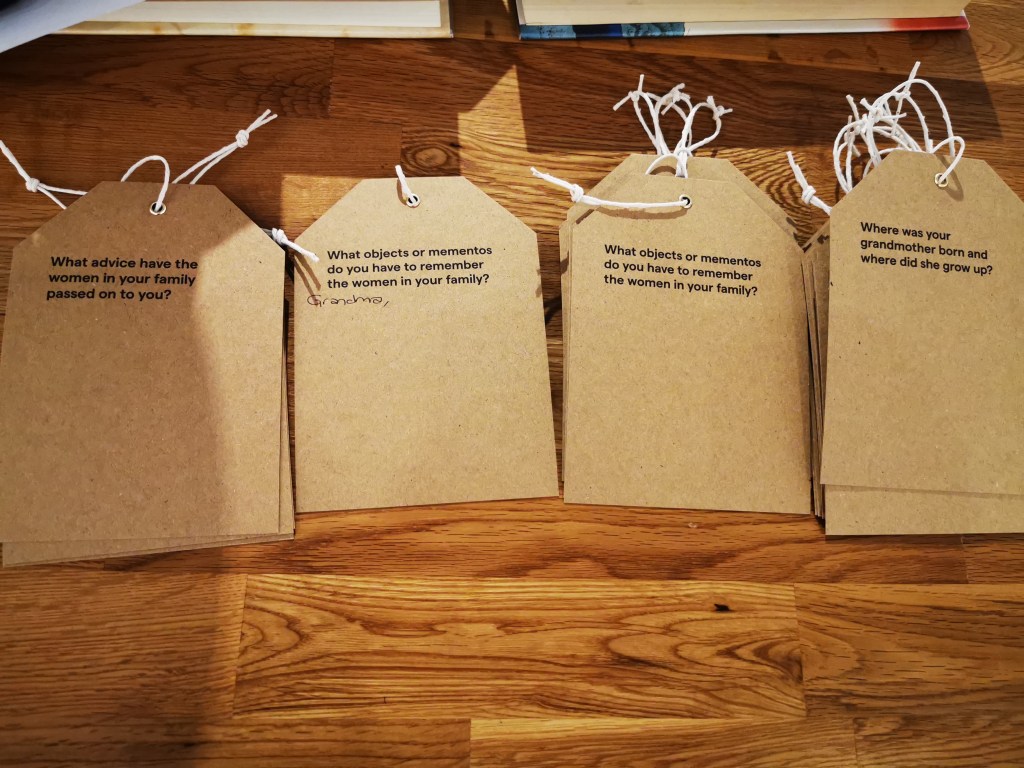
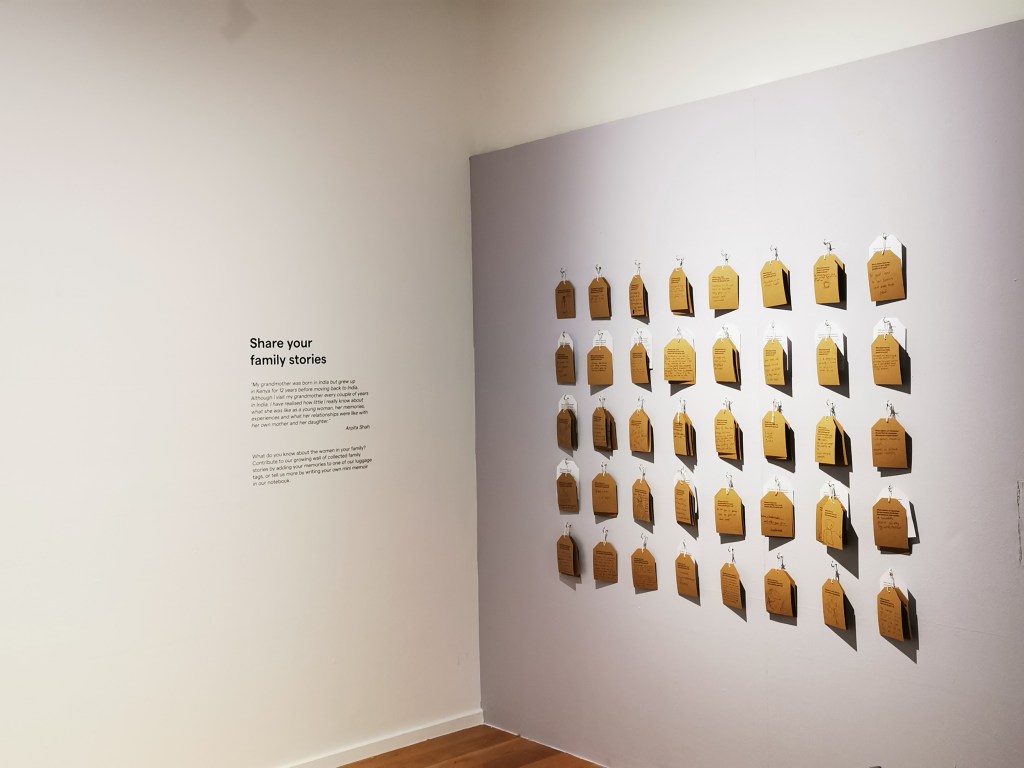
Four different cards for visitors to write about their own mother or grandmother and these are hung up on a wall


Another great idea to add richness to the experience of the visitor
I think these cards are going to be used to create more work, I will have to make a note to find out what happens to these

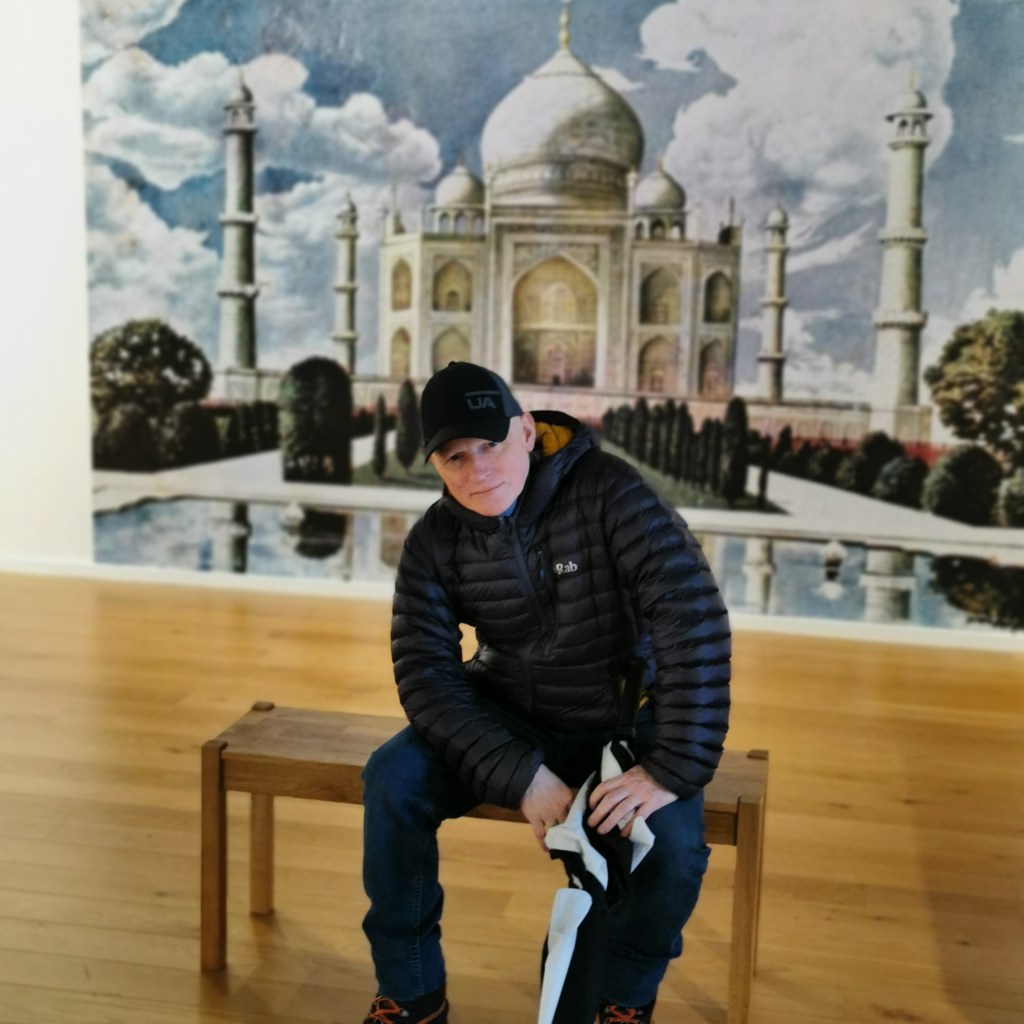
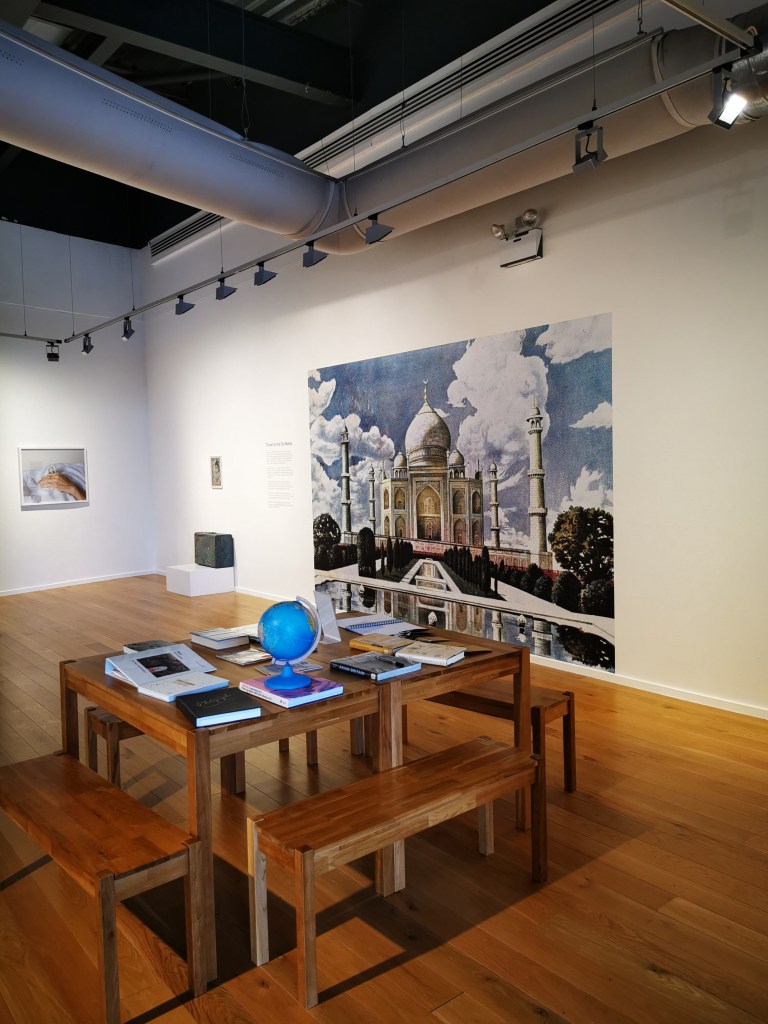
My favourite example of this is the large image of the Taj Mahal that she reproduced from an old tin the family have had for several generations, this is where people are encouraged to have their photograph taken.

The selfie wall, I think the exhibition details and Instagram info could be put on the image so the awareness is increased on social media
Books relating to the subject of migration and families are there for visitors too. This is a great idea and if I had more time I would have loved to read these

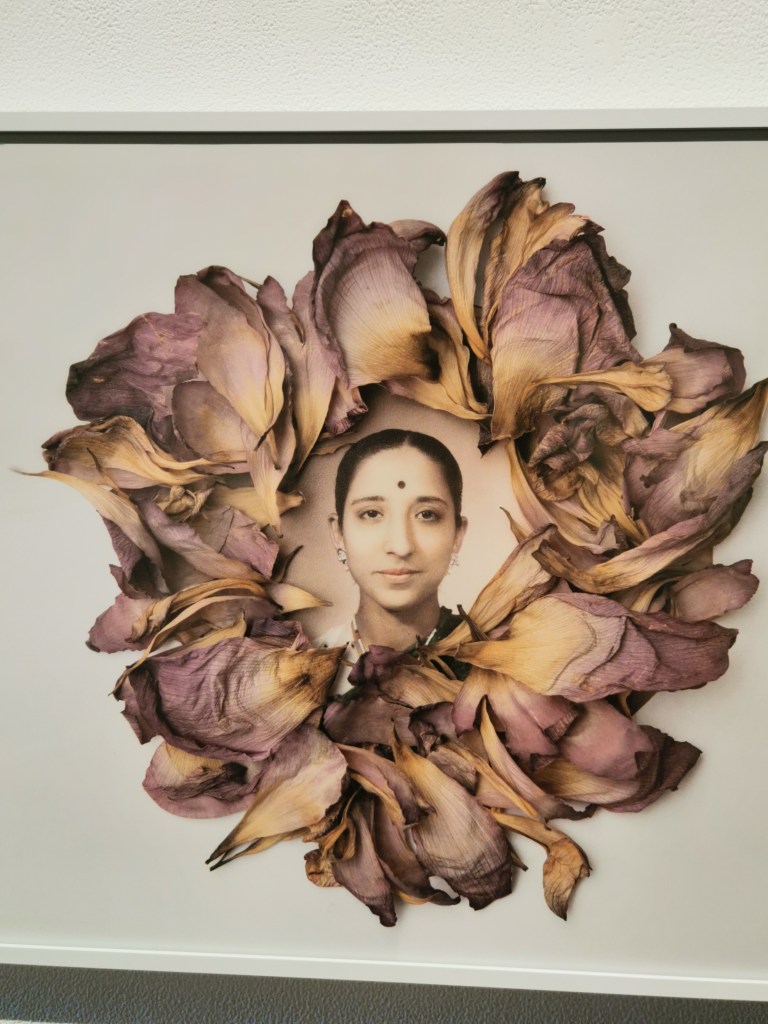
One of my favourite images is the one with the dried lotus flowers around a printed image

Hand tinted image of Nalini and the lotus flower petals surrounding the portrait

My challenge is narrative in my work and this module will hopefully improve my skills. This work in my view is an excellent example of narrative, the story is told very well and the images tell a story that has deep meaning, several layers of meaning which is intelligent.

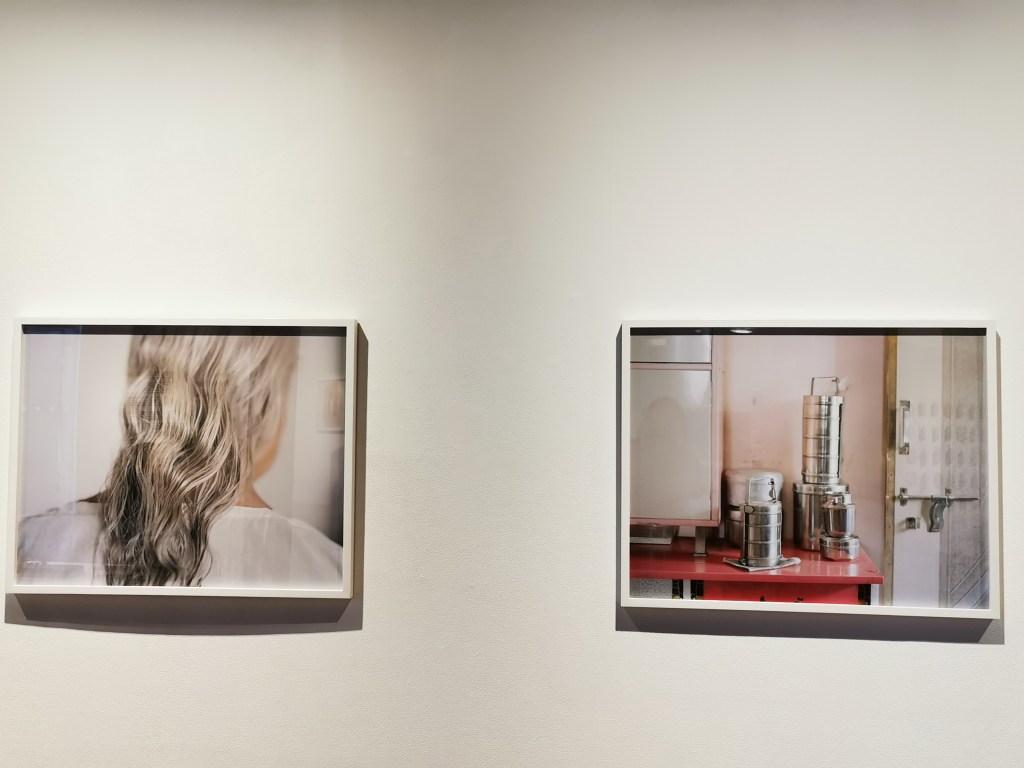
The visual connections between images is very well done too, something I also need to work on and improve.

The visual connection between the silver hair and the kitchen equipment was something I particularly liked.

Conclusion

The exhibition was yet another valuable learning experience for me and shows how much I still have to learn. I realise this exhibition took years to create and a team of people to work on the editing and creating everything I saw here, with this in mind I can’t be too hard on myself when I produce work for assignments. Editing work and choosing images that visually connect as well as the narrative is something I can learn from Arpita’s work. I realise the reasoning why the artist didn’t include any work that showed the face of her mother and grandmother, but for me it would have been nice to see an image of the three generations together to demonstrate the bond they have. With so much work put into developing the narrative, we would have bought a book about the exhibition, this is something I would have done and sold signed editions of a photobook to make more money out of it. This was one of the things my partner and I discussed, how to monetize this work? A photobook would be one way certainly, not sure about further ways or how the artist benefits financially from this work?

Preparation Work : Ex 4: Analysing And Reflecting

This quick exercise is designed to introduce the idea of analysing and reflecting
on the work of others, and to give you some material for your first learning log
entry or blogpost.
Here’s a selection of creative practitioners that you will encounter during this
course unit:
● Elina Brotherus
● Gideon Mendel
● Hannah Starkey
● Nigel Shafran.

  1. Choose one of these names and find a piece of work they’ve produced.
    Remember to reference the works you have chosen using Harvard
    Referencing, so it’s clear what you are looking at, who made it, and when.
  2. Pick one of the pieces and briefly describe it. Consider its qualities by
    trying to describe it. What are the different elements within the work and
    how do these elements work together? What do you think the work is
    trying to communicate? Imagine you’re describing the work to somebody
    over the telephone. Try to do this in no more than 50 words.
    For image based work, what you’re doing here is analysing the formal
    visual language of an image. This is known as visual research or,
    sometimes visual analysis. Writing can be a useful tool in visual analysis,
    but you can also annotate images with notes.
  3. Using the same piece, briefly write about how you relate to this work. Do
    you like it or hate it, find it intriguing, influential or outdated, and if so,
    why? Does the work connect to wider ideas or other creative practitioners?
    In other words, what’s your opinion on this work. Don’t worry about
    ‘getting it wrong’ or ‘missing the point’. Perhaps your reflection raises more
    questions than answers. Again, try to do this in no more than 50 words.
  4. Use the text you’ve generated to create your first blog post or learning log
    entry. You may also want to be self-reflective by considering your
    experience of doing the exercise. Did you find it an easy or difficult task?
    Did it raise any interesting issues or areas you want to develop further?
    Write a sentence or two picking up on any of these points in your learning
    log.

I have chosen Gideon Mendel and his work Freedom or Death

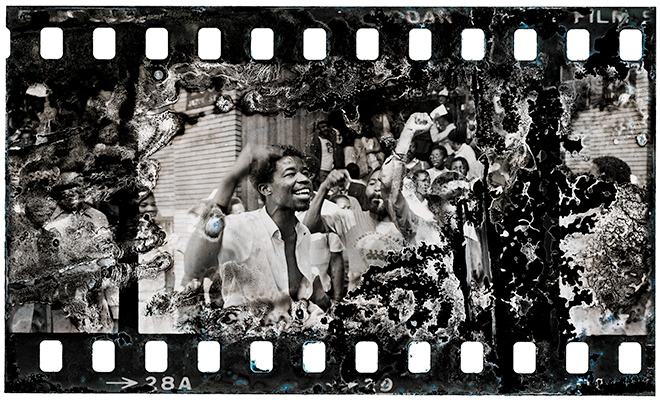
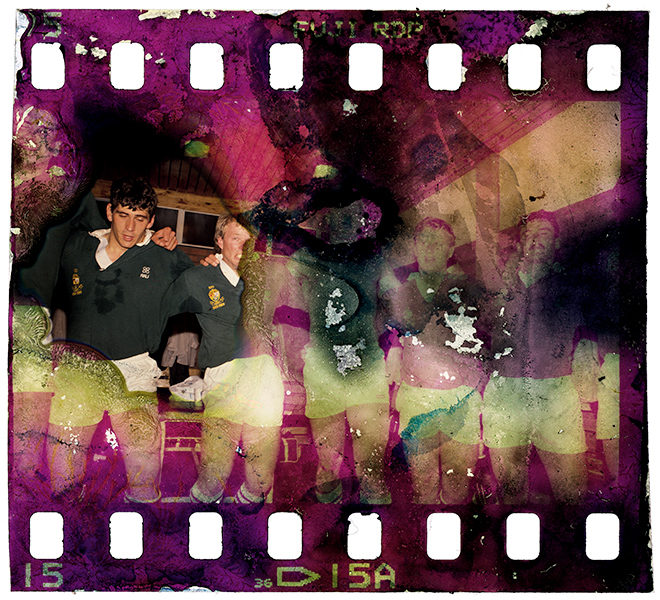
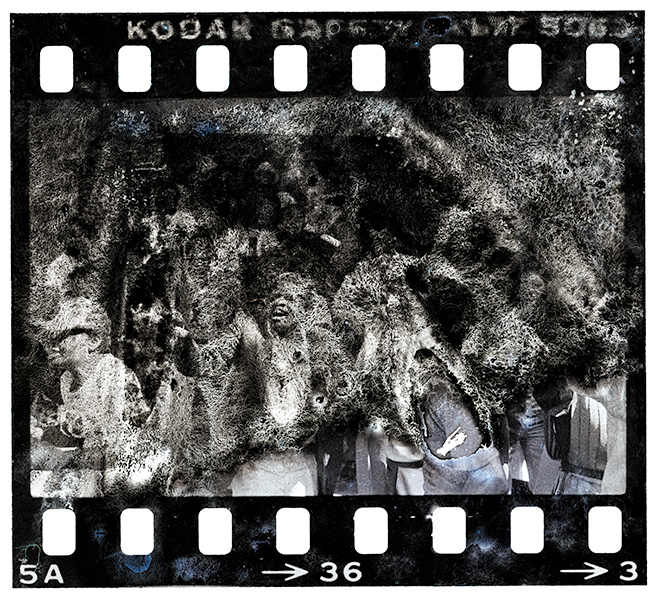
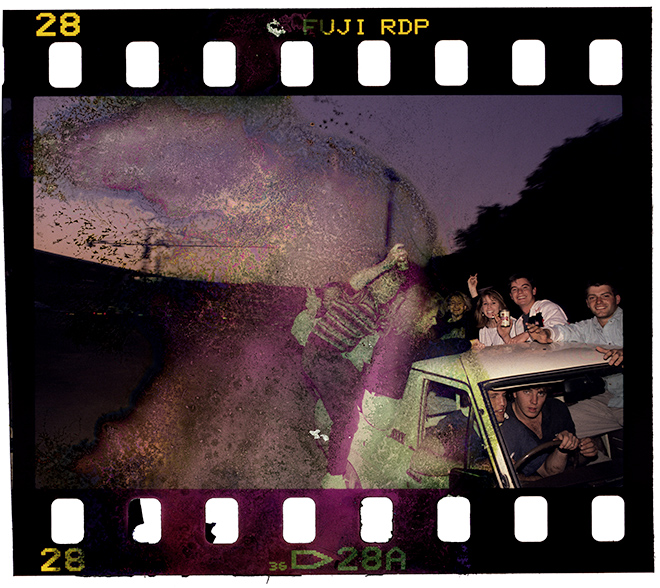
The images were taken during an intense period of war in South Africa from 1985 and 1989 at the start of Gideon Mendel’s photography career. The images depict a struggle for freedom by the indigenous people and the life of the white minority, this can still be visible by the subjects in these distorted images. The images appear abstract because the water damage has created distortions on the image, this adds to the aesthetic quality of the work. Mendel chose to include the negative borders in the images which connects it’s origins and ties in with the narrative about the damaged physical negatives over time.

I like this work because I am drawn the the material affectation of physical prints, this is just a variation on that theme. I like the abstract patterns created by chance to when the negatives were damaged, colourful quality where the damage occurred is attractive to me. I am drawn to this work on a deeper level, growing up in Rhodesia during a similar civil war and also witnessing this struggle first hand in the 1980’s whilst on holiday in South Africa, this work resonates with me on an emotional level. I was first drawn to the physical affectation of the printed image at my first student visit to the Blast festival in West Bromwich in 2019. Nilupa Yasmin takes images and cuts them into strips and weaves them together to create an abstract version as the final outcome. Nilupa Yasmin’s work “Where Can I Find This” was work taken at the Sandwell markets and then cut and woven together.

Nilupa Yasmin’s final outcome of work is physically affected through the process of weaving
Woven images are grouped together to form larger more abstract images which I really like

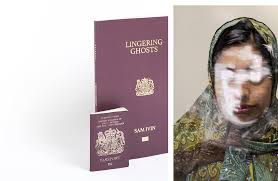
I was also drawn to the work of Sam Ivin, called “Lingering Ghosts” where he scratched out the faces of asylum seekers on printed images, as if to erase their identity, similar to what asylum seekers feel when in limbo, awaiting approval for residency. This work also represents a social struggle by a group of people and I am also drawn to social issues, which connects Gideon Mendel’s work to this I have previously enjoyed.

These scratched out prints produced by Sam Ivin for his work “Lingering Ghosts” are very moving and thought provoking

Sam Ivin’s Lingering Ghosts Work is also socially engaged and symbolises a struggle

Below are some images from Gideon Mendel’s Work “Freedom or Death” that I particularly liked. The captions are what accompanies the images on his website

Protestors outside the Congressof South African Trade Unions (COSATU) House, after a May Day rally in which COSATU demanded the day become a paid holiday and called for a nationwide ‘stay away’ protest by workers. One and a half million workers across the country, along with thousands of school pupils and students observed the call. —Johannesburg, May 1986
Members of the RAU rugby team have a moment of prayer and bonding after winning a gameat the RAU Stadium. —Johannesburg, July 1989
Protestors outside COSATU House. The first of May 1986, marked the 100th anniversary of International Labour Day, also known as May Day. —Johannesburg, May 1986
Students from the Rand Afrikaans University (RAU) celebrate at the end of their annual RAG parade during their first week of university. —Johannesburg, March 1989
Activists during a mass political funeral for youths slain in the so-called ‘grenade incident’ which took place in Duduza Township. Eight activists were killed when an undercover agent gave them booby-trapped hand grenades. —East Rand, Gauteng, July 1985

Their distortion speaking a deeper truth beyond the original documentary format.

Bibliography

Gideonmendel.com. (2020). Damage – Gideon Mendel. [online] Available at: http://gideonmendel.com/freedom-or-death/ [Accessed 13 Feb. 2020].

Blast!. (2020). Nilupa Yasmin — Blast!. [online] Available at: https://www.blastphotofestival.com/artists/nilupayasmin [Accessed 13 Feb. 2020].

SAM IVIN. (2020). Lingering Ghosts — SAM IVIN. [online] Available at: http://www.samivin.com/lingeringghosts [Accessed 13 Feb. 2020].

Preparation Work: Ex3: Identifying Resources

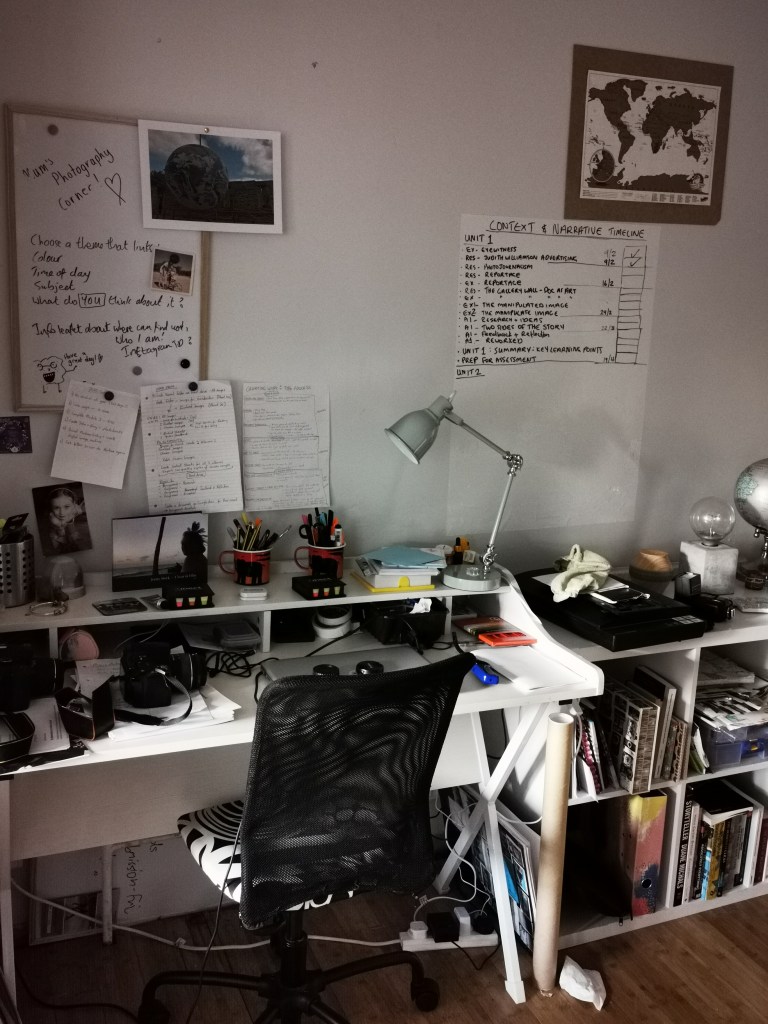
I have checked through the list of resources for this course and I have recently created an area for my studies at home, it has a wall I can use for images I want to live with and consider when making work, I have some temporary flip chart paper that sticks to the wall which I have found extremely useful.

Photoshop is something I need to get to grips with and so I am considering an evening class for this which starts in April.

I don’t currently have lots of space for a portraiture, ideally it would be great to have this space so I have a permanent backdrop set up for this purpose, I will have to think about how I can do this.

I need to sort out my printer as I find this really valuable when sequencing and deciding which photos go together as a seriex. The printer needs to be in this room ideally, it is currently in another room.

My work area for my studies, I have organised my books and equipment so I can find everything easily. I like the whiteboard plastic sheets I can write my work schedule on so I stay focused on completing work to the timescales I have set myself.

Reading List

Essential Reading
● Bate, D (2009) Photography: The Key Concepts. London: Berg.
● Curana, N. & Fox, A (2012) Behind the Image: Research in Photography.
Lausanne: AVA.
● Langford, M. et al (2010) Langford’s Basic Photography (9 th ed.) Oxford:
Focal Press.
● Short, M (2011) Creative Photography: Context and Narrative. Lausanne: AVA.
● Warner Marien, M (2014) Photography: A Cultural History (4th ed.) London:
Laurence King.


Further Reading
● Baker, S (2016) Performing for the Camera. Tate Publishing: London.
● Barthes, R (1977) Image – Music – Text. London: Fontana Press.
● Bate, D (2009) Photography: The Key Concepts. New York: Berg.
● Bate, D (2016) Art Photography. Harry H. Abrams.
● Berger, J (1972) Ways of Seeing. London: Penguin Books.
● Belsey, C (2002) A Very Short Introduction to Poststructuralism. Oxford:
Oxford University Press.
● Bright, S (2011) Art Photography Now (2nd revised edition). London: Thames
& Hudson.
● Bright, S (2010) Auto Focus: The Self-Portrait in Contemporary Photography.
London: Thames & Hudson.
● Brilliant, R (1991) Portraiture. London: Reaktion Books.
● Bull, S (2009) Photography. London: Routledge.
● Bussard, K (2006) So the Story Goes: Photographs by Tina Barney, Philip-Lorca
diCorcia, Nan Goldin, Sally Mann and Larry Sultan. New Haven, CT: Yale
University Press.
● Campany, D (2008) Photography and Cinema. London: Reaktion Books.
● Cotton, C (2009) The Photograph as Contemporary Art (2nd revised edition).
London: Thames & Hudson.
0 Photography 1: Context and Narrative
● Dexter, E. and Weski, T (2003) Cruel and Tender. London: Tate Publishing
● Eijkelboom, H (2014) People of the 21 st Century. Phaidon Press: London.
● Eskildsen, U (2008) Street & Studio: An Urban History of Photography.
London: Tate Publishing
● Eco, U (1989) The Open Work. Cambridge, MA: Harvard University Press.
● Fox, A. & Caruana, N (2012) Behind the Image. Lausanne: AVA Publishing.
● Howarth, S (2005) Singular Images: Essays on Remarkable Photographs.
London: Tate Publishing.
● Hurn, D. and Jay, B (1997) On Being a Photographer: A Practical Guide (3rd
edition). Anacortes, WA: LensWork.
● Jeffrey, I (1981) Photography: A Concise History.
● Jeffrey, I (2009) How to Read a Photograph. London: Thames & Hudson.
● Kozloff, M (2007) The Theatre of the Face: Portrait Photography Since 1900.
London: Phaidon Press.
● La Grange, A (2005) Basic Critical Theory for Photographers. Oxford: Focal
Press.
● Lowry, J, Green, D & Baetens, J (2009) Theatres of the Real. Brighton:
Photoworks.
● Sontag, S (1979) On Photography. London: Penguin.
● Szarkowski, J (1984) Mirrors and Windows: American Photography since 1960.
New York: MoMA.
● Short, M (2011) Context and Narrative. Lausanne: AVA Publishing.
● Williamson, J (2010) Decoding Advertisements: Ideology and Meaning in
Advertising (reissue edition). London: Marion Boyars.
● Wells, L. (2009) Photography: A Critical Introduction (4 th ed.) Abingdon: Routledge

Preparation Work : Ex 2: Managing My Time

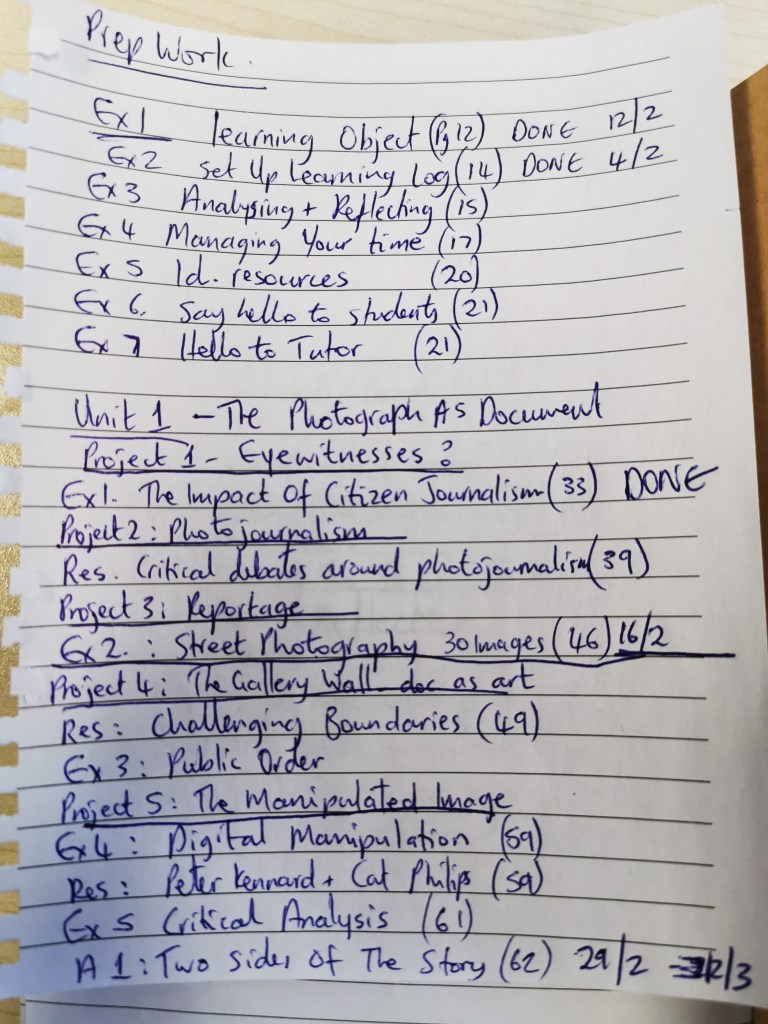
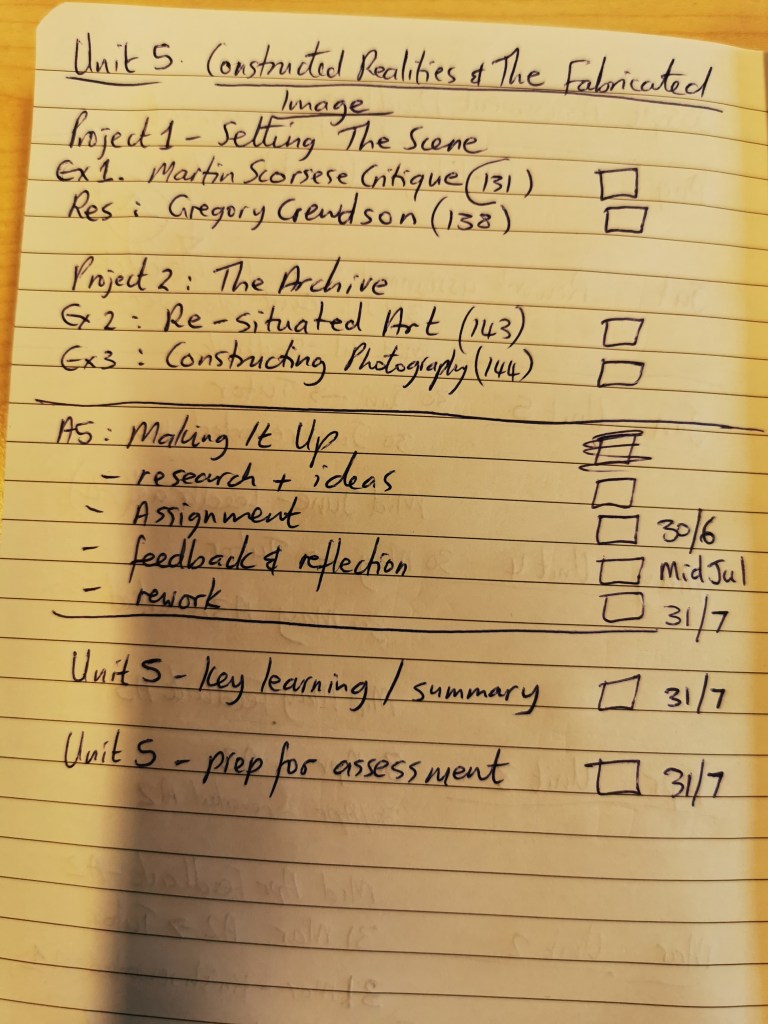
Balancing a job, a family and study needs careful planning to make sure the work gets done. With this in mind I created a list of all exercises, research, assignment work and reflective work for each unit so I can keep track of what needs to be done and tick it off as it is completed. I have put my list of work for my first unit above my desk at home to keep me focused on what needs to be done

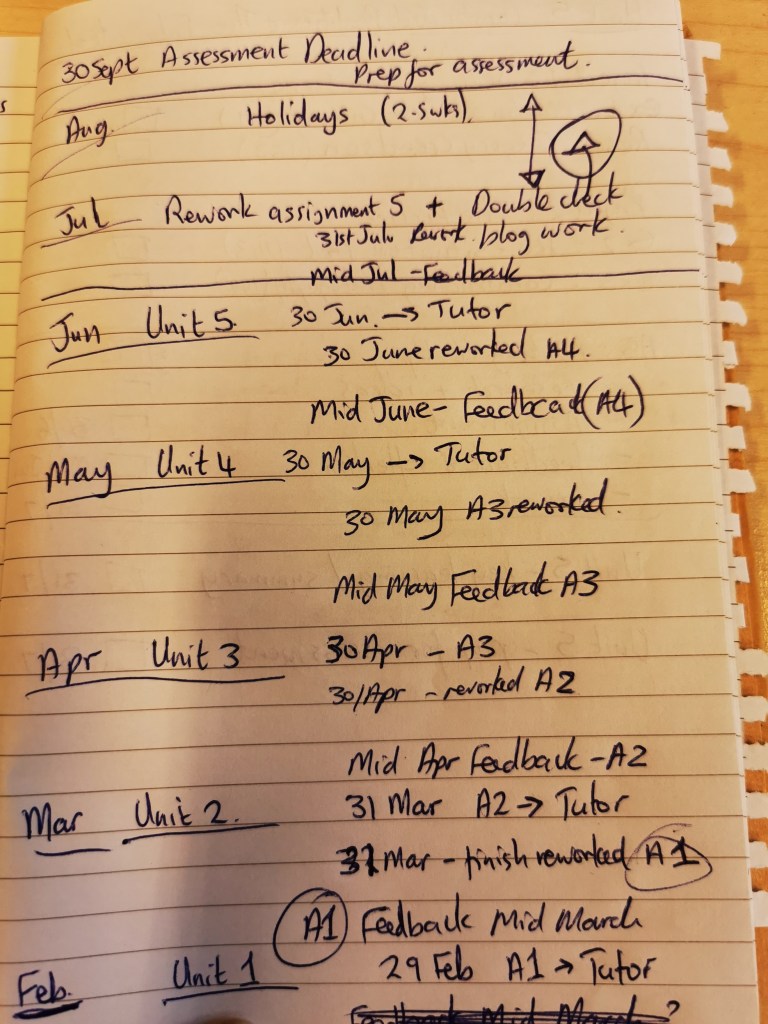
Assessment deadline date for submission is 30th September for November and this is what I am aiming for. I have 5 units to complete so I have given myself a deadline for submitting the assignments and also when I should aim to get feedback, I have planned that each assignment it sent to my tutor at the end of the month, so A1 is with my tutor at end of Feb, A2 is at end of March – so A5 will be end of June. I have assumed that it will take two weeks to get feedback ( middle of the following month ) then I have another 2 weeks to rework based on tutor feedback, so the reworked A5 will be complete at the end of July 2020. I have a summer holiday for 2.5 weeks so I have about 6 weeks to prepare for my assessment submission at the end of September.

During a typical week I plan to work on shooting photos every day for practice of composition skills ( on my way to work in the mornings during the week ) Weekday evenings will be used for coursework (exercises and research and reading) and Sunday mornings and Mondays will be used for assignment work ( I don’t work on Mondays)

The photos below are extracts from the back of my notebook where I have planned my studies, I will tick off work once completed so I know I am on track and where I am in my studies to stay in control of time management.

Context And narrative Timeline to get work done for November Assessment

Prep work and Unit 1 Timeline – as each bit of work is done it will be ticked off the list – I will have a copy of this on my wall above my desk as well as my notebook. My notebook is with me all the time so I can review it any time I have a spare moment – it’ in the back of my notebook so it doesn’t get lost among other notes

Unit 2 list of work to be done with a tick box for when completed – it would be really handy if these were appendices to the coursework that could be used by students to manage their work instead of me having to write this down like this

I have created a process for producing my assignments that works for me, these headings are replicated in my blog so each stage is a separate blog, the “rework” blog is the final version of the assignment that gets sent to be assessed

Lesson learned from my first module, I will now write a summary of each unit before moving on to the next and will make sure all work for assessment is prepared before moving on
I need to aim to complete all work by the end of July to give me time to prepare for assessment to the standard I want to achieve, my first assessment was a rush and was stressful so I want to avoid this with this module

Unit 1 Ex5: The Photograph As Document: Project 5: The Manipulated Image: Critical Analysis

Read the section entitled ‘The Real and the Digital’ in Wells, Liz. (2009) Photography:
A Critical Introduction (4th edition). Abingdon: Routledge, pp.73–75. You’ll find this
on the student website.
Does digital technology change how we see photography as truth? Consider both
sides of the argument and make some notes in your learning log.

The Real And The Digital (Liz Wells – Photography, A Critical Introduction) 

The convergence between computing and audio-visual technologies has, as we all know, produced new kinds of digital media which are transforming the means of image-making together with its social, commercial and aesthetic practices.  Here, we need to note that digital media -with its ability to create, manipulate and edit images –   has given new prominence to arguments about the nature of photography and taken them into the popular domain.  These may briefly be summarised as: questions about the nature of the photographic image; about new ways of defining and understanding ‘the real’ that are brought about by processes of globalisation and postmodern philosophical positions, and, finally, questions about the relationship of photography to other media. It is now clear that images with all the  appearance of ‘real’ photographs may have been created from scratch on computer, montaged from many sources, altered in some respects, or radically transformed. Figures  may be added or removed and the main constituents of the picture rearranged to suggest new relationships or bizarre conjunctions. Does all this not destroy the claim of photography to have a  special ability to show things as they  are and raise serious doubts about those genres with a  particular investment in the ‘real’ -documentary and photojournalism? We can, of course, observe that, as we have already seen, the manipulation of images is nothing new and that photographs have been changed, touched-up or distorted since the earliest  days. But we are not looking here merely at a  technically sophisticated way of altering images, but at much more profound changes that challenge the ontological status of the photo-graph itself. If a photograph is not of something already existing in the world, how can we regard it as an accurate record of how things are? Roland Barthes’ influential conception of the nature of the photograph, is  that it is the result of an event in the world, evidence of the passing of  a moment of time that once was and is no more, which left a  kind of trace of the event on the photograph. It is this trace which has been  considered to give photographs their special relationship to the real. That is that they function, in the typology of signs offered by the American semiotician, C.S. Peirce, as indexical signs. The nature of the sign within semiological  systems is  important, but it is interesting to note that we have always known  that photographs are malleable, contrived and slippery, but have, simultaneously, been prepared to believe them to be evidential and more ‘real’ than  other kinds of images. It is possible to argue that the authenticity of the photograph was validated less by the nature of the image itself than through the structure of discursive, social  and professional practices which constituted photography. Any radical transformation in this structure makes us uneasy about the status of the photograph. Not only do we know that individual photographs could have been manipulated, but our reception and understanding of the world of signs may  have been transformed. Writing in the French newspaper Liberation, in 1991 the  social theorist, Jean Baudrillard famously remarked that ‘the gulf war  did no t  take place’ (Baudrillard 1995). He was commenting on the nature of the real and the authentic in our time and suggesting that .in  t he world of th e  spectacle,  it is pointless to posit an external reality that is then  pictured, described and represented. In his view everything is constructed and our sense of the world is mediated by complex technologies that  are themselves a  major constituent of our reality. What took place, then, was not t he  first Gulf War but  a whole sequence of political, social and military actions that  were acted out in a new 74

kind of social and technical space. While this  may be an extreme  way of formulating the argument, it is clear that a  complex of technical, political, social and cultural changes has transformed not just photography, but the whole of visual culture. For example, David Campany  points out that ‘almost a third of all  news “photographs” are frame grabs from video or digital sources’ and comments that: The definition of a  medium, particularly photography,  is not autonomous or self-governing, but heteronymous, dependent on other media. It  derives less from what  it is technologically than what it is culturally. Photography is what we do with it. And what we do with it depends  on what we do with other image technologies. (Campany 2003: 130; emphasis in original) One significant consequence of this has been a  new merging and lack of definition between photographic genres.  It is increasingly difficult to  distinguish one kind of photograph practice from another. As we shall see later, titles, such as ‘documentary’ are of little use as labels for the new kind of work that is  being  produced. Indeed, all descriptive titles have been freely appropriated and find themselves used in curious couplings, for example, one sub-genre of photography now well established in the USA is that of’wedding photojournalism’.

Notes taken that I found interesting :

The American philosopher and semiotician John Deely said that “objects” are dosed with human experience – when they are photographed they become “signs” – he believes that photographing objects can never be the truth because of this. As soon as we photograph somethng they become objects of our experience. The interpretation of all objects is affected by human experiences

David Campany has stated that a third of all news photographs are screen grabs from videos or a digital source

“Photography is what we do with it” – David Campany

A consequence of digital technology is a new merging of traditional photographic genres – documentary photography is of little use now as a label for the new kind of work that is now being produced – new terms such as wedding photojournalism and citizen photographer have emerged

Social networks are now acting as publishers of photographers, several informal photographs are taken and uploaded around the world rather than the tradtional way of days gone by – mainstream media are accessing them and using them as events unfold

Foreign news and hard news has been squeezed for resources and squeezed for space by cheaper and more advertising friendly features on lifestyle, products and celebrity – coupled with the fact that some governments restrict formal photographers in scenes of conflict, so the rise in demand for the amateur photographer is a result – to add to this, the photo that appears amateurish may come with more authenticity and credibility than a professional photo

There is still room for professional photos of conflict and hard news images of professional quality but even this changing to the storage and transport in a digital format rather than print

Thoughts and Reflection

I believe that photographs, whether in the digital age or when the first documentary work was made, there is always a version of the truth produced because the person making the work will be affected by his or her own life experiences and this will result in what they choose to photograph and what not to, what they decide to include in the frame and what to omit. These elements can alter the narrative drastically but can still be an image that has not been digitally manipulated.

I believe that eyewitness photojournalism can be a good thing because news is communicated almost instantly and in this world of instant gratification it has become an expectation. Fake news is on the rise and also the amount of time we spend reading short, sound bite news items, this can lead to misinformed paranoia and anxiety.

Mobile phone photography and the use of AI in phone photography will, I believe replace the large pro DSLR cameras in the next 10 years. Current phones can take night photos and bring deatil into an image that is not apparent to the human eye, AI will search millions of similar images and in 4 seconds will rectify the image being taken to produce the best version automatically. Mobile phone companies are currently competing is by the quality of their camera, there are hundreds of experts working to improve this phone feature and not anywhere near that much resource is being applied at Canon or Nikon to improve their product in the same way.

Photography is not about taking a technically perfect shot, it is in the words of David Campany “what we do with it” and this will become even more prominent when anyone can take a technically perfect shot because of the advancement in technology.

Bibliography

Contentstore.cla.co.uk. 2020. Openathens / Sign In. [online] Available at: <https://contentstore.cla.co.uk/EReader/Index?p=RDpcU2l0ZXNccHJvZHVjdGlvblxUZW1wXERDUy1kNzlkNjVkZC1lNjkzLTQ4OTUtOWQ0My04ZTg2Mjc1ZjIzNWUucGRm&o=JnB1Ymxpc2hlZENvbnRlbnRfSWQ9OTQ0ODA3JmNvbnRlbnRSZXF1ZXN0X0lkPTEwMjUxMDcmZG9jdW1lbnRMaW5rPWEyYjcyNDkxLTIzZWMtZTkxMS04MGNkLTAwNTA1NmFmNDA5OSZjb250ZW50SXRlbV9JZD0yODAwOTE=&id=a2b72491-23ec-e911-80cd-005056af4099&gt; [Accessed 12 May 2020].
Preparation Work : Ex1: Learning Objectives

The bullet points below explain my learning objectives for this module, I have also attached a link to an summary of key learning points from the first module I have completed, “Expressing Your Vision”

https://jennystorkphotography.wordpress.com/2020/01/28/overall-evaluation-expressing-your-vision/

This is my first experience learning about documentary photography so I am keen to learn as much about the subject as possible so is a wide open learning objective. I am interested in social displacement having grown up in Rhodesia and Zimbabwe then moving from Zimbabwe to the Uk at 21 years old, how different cultures settle in the UK and the preservation of heritage, of life and times gone by that need to be remembered for future generations. Preserving memories is very important to me.

Gaps in my knowledge is around narrative in my work, prominent documentary photographers, the use of photoshop to name a few, being relatively new to photography I have lots of gaps across the board

Areas to expand would be the ability to effectively store, retrieve and edit my work and to work better from contact sheets. I would like to improve how I select work and why, and what to look for to make a series coherent visually and in the narrative

I have never produced black and white work so I am looking forward to exploring this and understanding when is best to use it and in what context.

The preparation for my first assignment was stressful as I left everything to the end, I now have a structure in place for what I want to submit for each unit. I will make sure all work for assessment is prepared at the end of each unit to save time and make sure the quality of submission is the best it can be at the end, plus printing is expensive so it makes sense to do this as I go along after I have reworked assignments based on tutor feedback

Lastly, I started to use a photography sketchbook in my last module “Expressing Your Vision” and this was useful in formulating ideas for assignments. I would like to use this more in this module and from the outset rather than part way into the module. I also didn’t use a notebook as well as I could have in the previous module, this is something I have already started using, I carry this everywhere with me and it will be a very useful resource when I plan to summarise key learning points after each unit, it is also a place to store ideas and inspirational images ( I also have a swipe file on my website )

My first introductory call with my tutor was extremely useful today and these are the notes I took during the conversation which I will follow up on:

  • Photography (theory) is a new concept to me – don’t look on it as ‘theory’ as such more like articulating and summarising how and why images communicate. Functions: Terry Barrett.
  • Grids 
  • Social aspects of photography – the core of what we do. Do you mean documentary style or uses of photography i.e. family photos, giving voice to the subject? Photo-Voice? Socially Engaged Photography – Jim Goldberg, Julian Germain 
  • Pst colonial activities in Zimbabwe and preserving the cultural heritage of people who once lived there – you could follow this path even in level one (may not mean going to Zimbabe) but exploring cultural difference and the way power and representation work. 
  • First assignment at the end of February ? No rush. Make it diagnostic.
  • Plan complete this module by August to submit September for the November assessment if possible.  

Rose, G (2003), Visual Methodologies, Sage. – this book is quite heavy and designed for a second year degree student but is very useful to dip into – begin with this in preparation for the first assessment. If students don’t have a good grounding in analysing photo theory they will struggle in the later levels of degree. My tutor began studying photos as if peeling off the layers of an onion.

The meaning of a photograph is not already there, it is up to the photographer to put that meaning there – there will be some people who wont understand the meaning and so photos are for some viewers and not for others

Perfectly doable so long as you avoid – some students are fond of – ‘hoop jumping’ other than reflecting on your work and learning. I doubt that this will be you from just a cursory read of you blog. 

Put URL in any document at the header

Preparation Work : Ex1: Learning Objectives

This saves hunting through e-mails and my records and is a professional way to work. 

Bullet point main points to summarise (assessors love that) – my tutor was pleased with my writing style that it was to the point and concise which means he thinks I will do well in this module, I hope so!

Narrative the big issue! many types. Broadly the standard (Aristotle ) beginning middle and end or a more ‘associational’ (based on form) poetic links rather than cause and effect ‘picture essay’. 

The two are explored most succinctly in Jörg M. Colberg’s Conscientious Photography Magazine : https://cphmag.com/narrative-1/

My Blog on conventional v poetic/associational narrative: https://www.oca.ac.uk/weareoca/creative-arts/photography-that-gets-people-looking-thinking-and-talking/

He is the author of Understanding Photobooks: The Form and Content of the Photographic Book (Focal Press, 2016). Which is the best book to consider sequencing of photographs – I can send you a précis of his main points. 

Effectively store, retrieve and edit my work and to work better from contact sheets. Colberg software Lightroom or Capture One. Western Digital could be a hard drive to get

  • Workflow systems 
  • Zimbabwe_JS001 – make sure you have a good method of cataloguing from the start to save time and frustration in years to come
  • Photo Rescue 

Photographers Sketchbooks recommended

The viewer first sees a collection of shapes that go together well – visual first and then context and narrative follow