Stephen Monger is a tutor and teaches at UWE – he is the programme leader for the MA – Graphic Arts programme and the BA(Hons) Graphic design https://people.uwe.ac.uk/Person/StephenMongerhttps://people.uwe.ac.uk/Person/StephenMonger
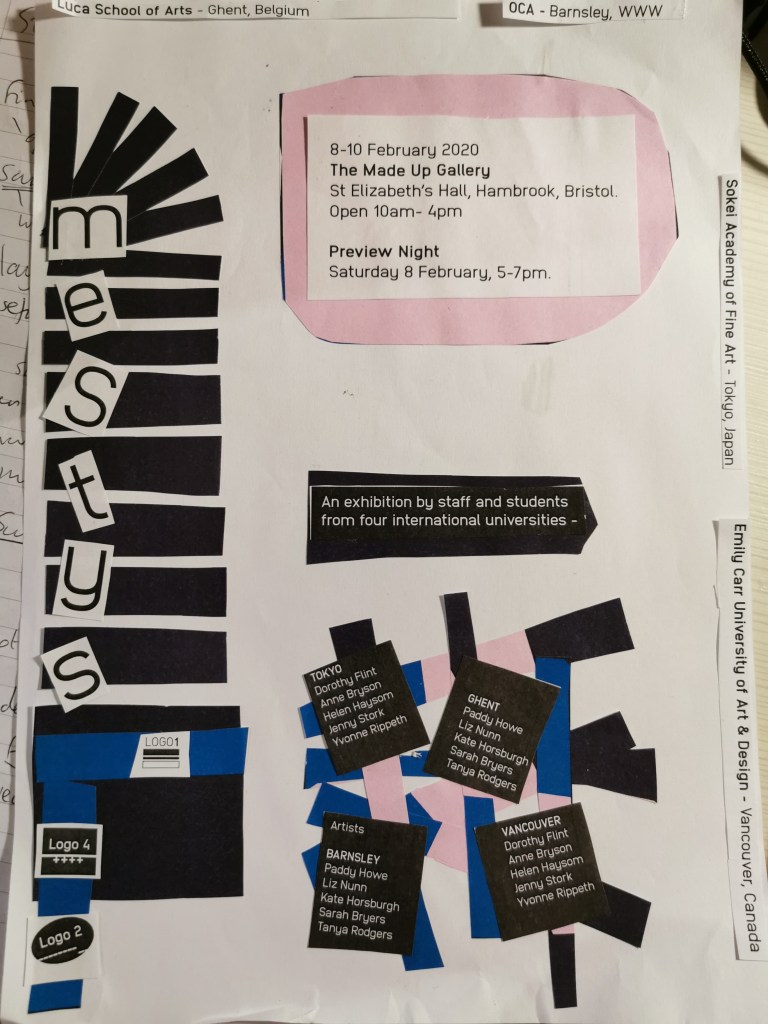
Poster Design Workshop : We had a design workshop in the morning where we were given sheets of paper with different font sizes of various pieces of information that we needed to cut out and create a poster. We needed to choose what we thought was the most appropriate size font that would be suitable. We were split into two groups and our brief was to be “non-conformist” and we had an hour to complete the exercise: This was my creation
Each group was asked to choose one design to represent the group based on the following criteria : 1) On Brief 2) Creativity 3) Legibility
My work was chosen to represent the group because it definitely was non conformist and creative, the mixing up of the wording of the name “Systems” was considered a negative by the group since it was the name of the organisation the poster was for so should have remained the same.
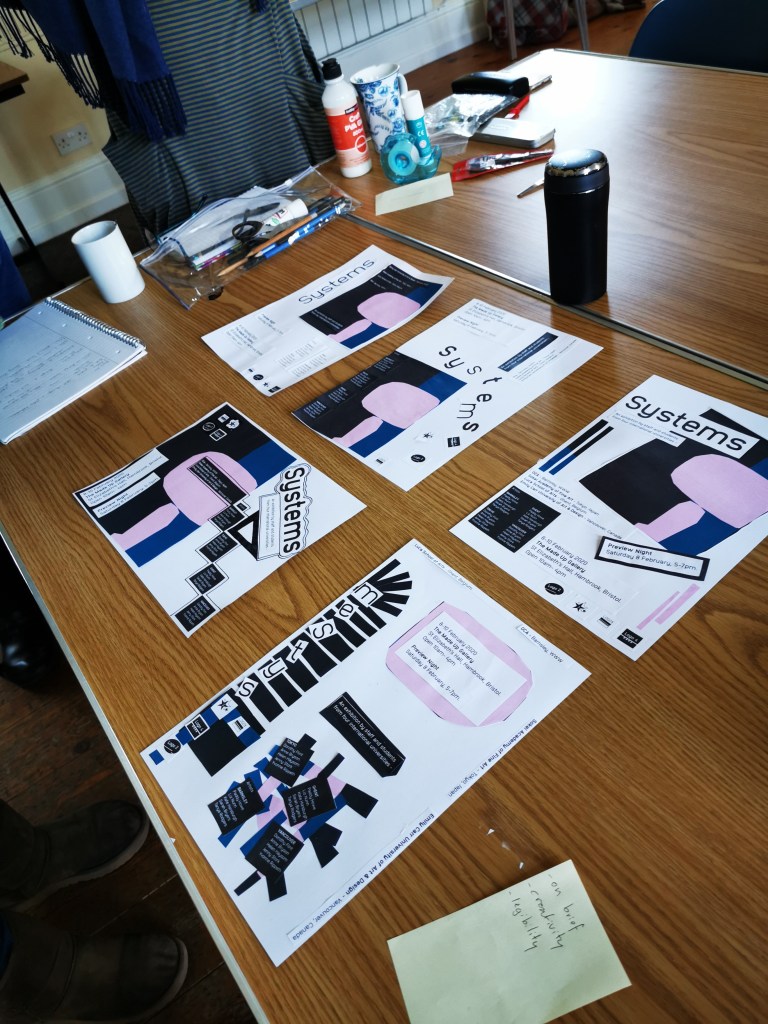
Stephen Monger said that the bottom part where I put the artist information was very playful and exciting and he liked the creativity of my work which I was pleased about.
Some advice Stephen gave us when we create photobooks or anything that needs a design such as a poster or a flyer :
Find a good quality font that has about 5 different weights to it – sans serif means “without the flicks” and is less formal than the ones like Times Roman which has flicks
Design should be functional first then creative
Don’t ever just use 12 size because it shows a lack of effort
Creative Suite – Stephen uses InDesign – Drop the image in and the overlay with Text
Illustrator doesn’t have as much support with grids
Afternoon Feedback Session
The Afternoon was a feedback session where students presented their work and asked the group for ideas and thoughts, Anne Bryson presented her work which was the idea of creating a tunnel book. She showed us an amazing piece of work where she printed 7 identical photos of an old coal mine in the forest of dean. Each photo had a circle cut out of it, starting with a large circle and progressing to a small circle that focused on the main subject in the image. The images would be fixed at their sides by a concertina system and it would have a front cover that when opened the book would create a 3d sculpture.
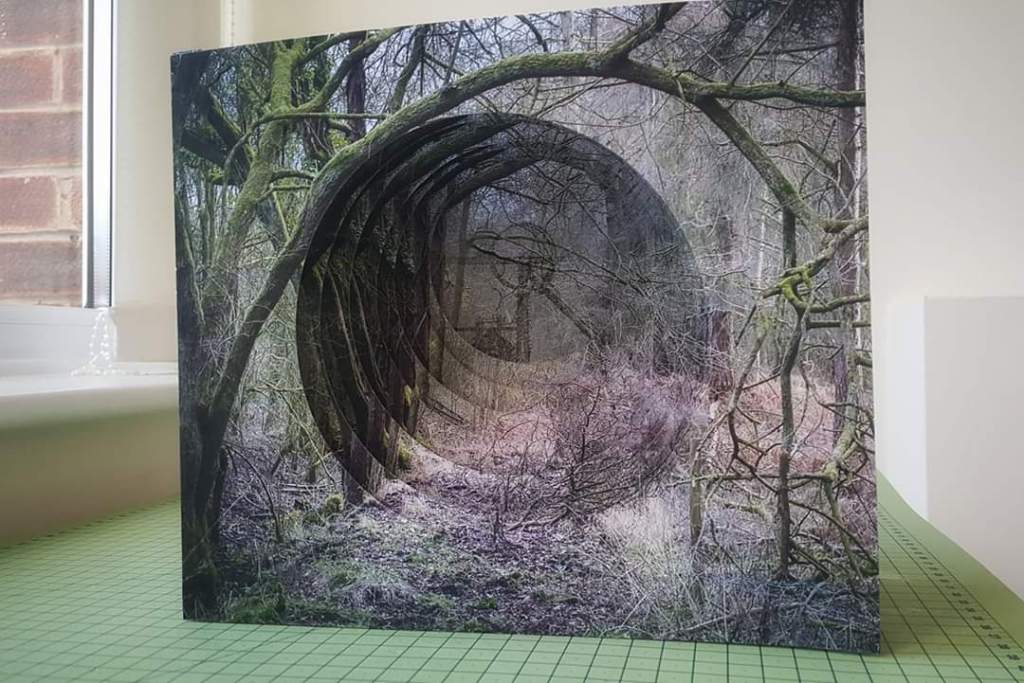
Anne mentioned she got some advice and support from Shona Grant who creates this work on a commercial basis, Shona has a website with good blogs for resource.
The cut out circles are created by using a tool that is a compass with a blade on the end of it and can be bought on Amazon for about £15. Rockingford watercolour inkjet paper was used – Photospeed ultra matt paper can also be used.
The question from Anne was – is this a book or a sculpture – and each one of these has a different way of presenting so the answer dictates how the work is finished
Stephen said that if it is a book then you need to interpret each part of the book into what you are making, so the two front covers can be used for explanatory text rather than text on the image itself.
If it is a sculpture then need to embrace what a sculpture is and make the text sculptural – think of the intentions and outcome while creating the work
Another student presented her finished photobook and some feedback from Stephen on it was:
Allow the viewer to explore – take risks – readers may pick up the book and may just want to read – next time they pick it up they may just want to look at the images and the book needs to be able to do this for the viewer and reader
Make each page a different format to keep interest – think about if you need page numbers at all or are these a distraction, think about where these numbers should be
Nice to put an artists statement at the beginning of the book and a small image of the artist so the reader knows the thoughts and intentions at the outset
Karl Blosfelt is a photographer that Steve said we should look into if interested in this genre – he studied nature and architecture and their relationship with each other
The process of producing work is something I have explored during my first module and will continue to evolve with experience, with this in mind I really liked the advice Stephen gave the group today, something I plan to use in this module when making work for assignments or exercises :
Write down lots of words of mine that I want the book (or body of work) to say – things I want to express – then edit these words to only a few that are the most meaningful – use these words to direct and produce work – then at the end ask yourself – does my work say this?
The benefit of meeting up on a day like this is that you get to share different tools that could be useful in our work, this time Procreate was mentioned, it is an app that you can use to draw or sketch, this was mentioned in a student discussion as well as a company called Snap Mad – a cost effective printing company to consider. These useful names and contacts are noted in my notebook so I can easily access them as and when needed
Conclusion
As always I learned a great deal from the day, it is also good to interact with other students and get support. I would encourage students of any level to get involved because student life gets easier the more support you have. The other point was that there were people studying different things, even music, but there were still things we could learn from each other despite these differences. Stephen Monger gave some excellent advice and feedback in the afternoon session. The morning workshop was very useful because text and imagery and how something is visually designed is really important in the “final outcome” part of my work and is a main criteria for assessment too.
 Jenny Stork: Photography 1: Context & Narrative