
Recreate a childhood memory in a photograph. Think carefully about the
memory you choose and how you’ll recreate it. You’re free to approach this task
in any way you wish.
- Does the memory involve you directly or is it something you witnessed?
- Will you include your adult self in the image (for example, to ‘stand in’ for
your childhood self) or will you ask a model to represent you? Or will you
be absent from the image altogether? (You’ll look at the work of some
artists who have chosen to depict some aspect of their life without
including themselves in the image in the next project.) - Will you try and recreate the memory literally or will you represent it in a
more metaphorical way, as you did in Part Two? - Will you accompany your image with some text?
- In your learning log, reflect on the final outcome. How does the
photograph resemble your memory? Is it different from what you
expected? What does it communicate to the viewer? How?
It might be interesting to show your photograph to friends or family members –
perhaps someone who was there at the time and someone who wasn’t – and see
what the image conveys to them.
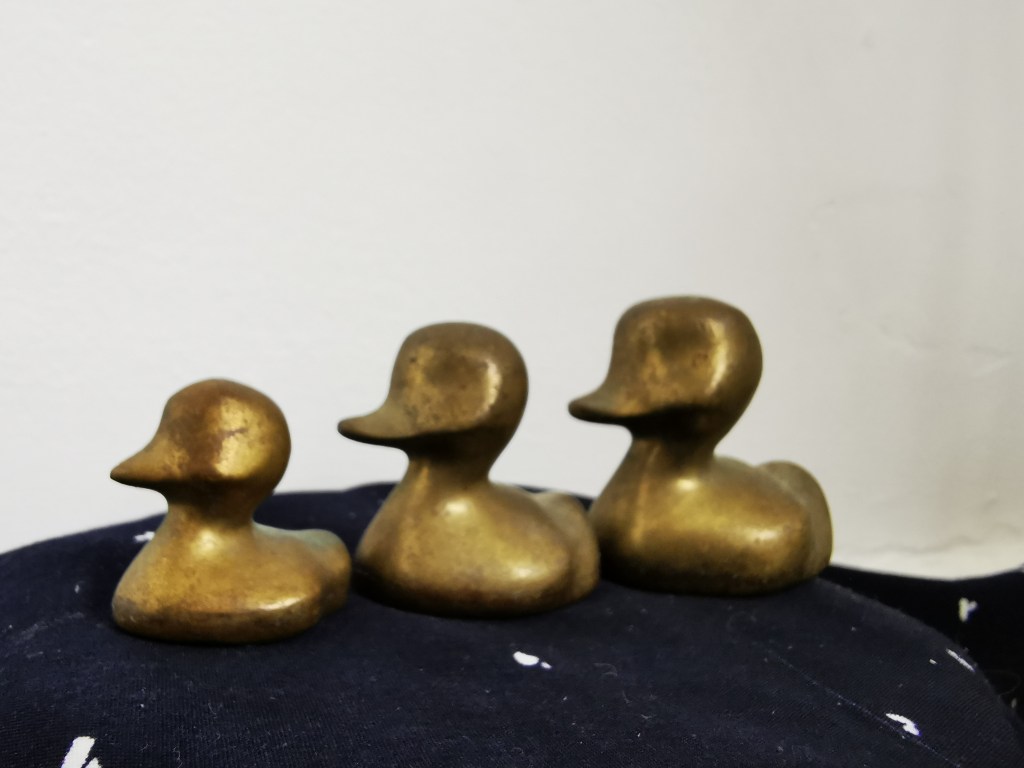
I chose to use two objects from my childhood that bring back memories for me of my mother when I was young. The material background is a dress once owned by my mother who passed away fourteen years ago. She would frequently wear it when I was a child, and when I last saw her I commented on how lovely the dress was so much that she gave it to me. From that day on, now some twenty years ago, I have been striving to lose weight to be able to wear it one day, I fear that day will never come. The dress now hangs in my bedroom as a memory of her. The three brass duck ornaments were once in my childhood home and I was given them when my Mum died. These ornaments my Mum especially treasured and instantly bring back memories of my time with her and how she used to tell me how much she loved to collect brass ornaments and which one she next wanted to buy to add to her collection. This photograph of a childhood memory is recreated in a literal way rather than metaphorically and the image would have to be accompanied by some text for it to be meaningful to anyone else but me.

 Jenny Stork: Photography 1: Context & Narrative