
Go to the artist’s website and look at the other images in Shafran’s series.
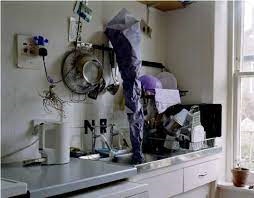
You may have noticed that Washing-up is the only piece of work in Part Three
created by a man. It is also the only one with no human figures in it, although
family members are referred to in the captions.
● In what ways might a photographer’s gender contribute to the creation
and reading of an image?
● What does this series achieve by not including people?
● Do you regard them as interesting ‘still life’ compositions?
Make some notes in your learning log.
Gender plays a part in what a person chooses to photograph and how. Women tend to bring emotion and people into their work, although some very talented male photographers have done the same, Martin Parr, for example, and Daniel Meadows.
The reading of an image could be read differently depending on gender, women tend to look at small details, men are more objective perhaps. Woman like Francesca Woodman and Sophie Calle express their own emotions through the creation of images.
Shafran’s series achieves an opportunity to look into the private spaces in the home of a person which reveals a great deal of information about a person. The everyday objects that are usually not the subject of the photograph but rather a distracting background object are of interest to Sharfran and reveals a great deal about a person. His work reveals a house that is in it’s normal state, something visitors rarely see because it would all be tidied away before they visit.
I do regard Shafran’s work as interesting still life compositions because it is not what would traditionally be considered an attractive photograph and therefore catches my attention. Unusual subject matter is interesting, particularly when there is a lot going on in the photograph which makes you return to it several times and discover something new that you didn’t notice before.
 Jenny Stork: Photography 1: Context & Narrative
Pingback: A3: Self Portraiture: Research & Ideas | Jenny Stork: Photography 1: Context & Narrative