I am a forty six year old mum of three children and I live with my partner in Gloucester. After completing a beginner and an intermediate photography evening course over the last six months I have decided to take my photography from being a hobby to something more in depth and challenging. After careful consideration and making sure I would have enough time to devote to study I have chosen to complete this Potography degree and hopefully enjoy it as much as the short courses I have recently completed. One day I may even make a career out of it, I will just see where it takes me and be guided by what I enjoy most out of the course.
Presenting written work explaining my approach needs to be more structured and a way of doing this is to use CONTENT : FORM and CONTEXT
When images are submitted for assignment they need expression and analysis to accompany each one as to their “meaning”
Name and caption images for submission and also the number in order of sequence – also provide a screenshot of what they need to look like or print out and display how they should look, then take a photo of this layout and submit with the assignment.
Sequencing and editing process of :
– Eliminate technically imperfect from contact sheet
– Print small images and sequence and edit manually
– Naming files in their preferred sequence
– Send annotate contact sheet and sequenced outcome of the series to tutor
Keeping a notebook has really helped with ideas, notes and photographers I have come across. Summarizing it each month is a useful exercise too
Look at a more structured approach for the research part of my preparation for an assignment based on Tutor feedback
In the bibliography of the assignment submission : add a Harvard referenced link to a blog, for example, of how the images were made so the assessor can understand how you have applied certain techniques to this assignment
Attach a bibliography to your main assignment submission that contains all related work to the preparation of the assignment so that the assessor and your tutor can easily see what has been done to prepare for the assignment
Tutor feedback has been really comprehensive with a great deal to digest, rework and read up on which is really positive for me because this learning experience, with some hard work will improve my understanding of this subject greatly.
Restructuring The Explanation Of My Work
This is the first rework that needs to be done as feedback was that my original explanation of the work I made was disjointed : my tutor has suggested the following :
Content : Homelessness
Form: (The shape of content, How it is composed, arranged and constructed visually) Light, colour, texture. Strategy of Point Of View shots presented at Landscape/Portrait dichotomy format images to allude the “two sides of the story”
Context: Documentary “ways of seeing” and giving power back to the subject (photovoice) – challenging previously held assumptions of the genre itself (reformist and paternalist ways of looking down upon destitution)
This is really useful because I now have an example of how I will approach my next explanation of Assignment 2.
Expression And Analysis Of Images
Relate the images to Barret’s different contexts before further study on representation as a process. Reading up and understanding analysis methodologies will help me explain and describe the images to an audience who has no prior information about the work I have produce. (see link in bibliography for notes taken from reading Barret’s text)
Make keyword notes next to the images you submit – each image has an objective and need to remember that viewers are coming into the images cold and not have the background to what they are so they need to be shown.
At this level it is semiotic analysis and then level 2 it goes deeper with how this affects the viewer – Gillian Rose’s Book Visual Methodologies is good to dip into – get used to this now in preparation for the next level
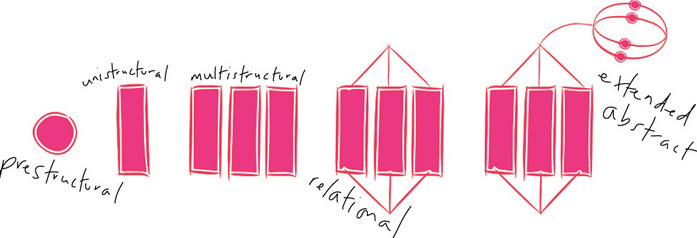
Extract From A Link Sent by my tutor on reading photographs (see bibliography for the link) :
Prestructural: the student learns some unconnected information. Unistructural: simple obvious connections are made but their significance is not fully grasped. Multistructural: several connections are made, but the meta-connections between them are missed, as is their significance for the whole. Relational: the student is able to appreciate the significance of the parts in relation to the whole. Extended Abstract: the student is able to make connections not only within the given subject area, but also beyond it, able to generalise and transfer the principles and ideas underlying the specific instance.
Editing And Sequencing
My tutor has helped me edit and sequence my submission which has been hugely helpful in improving my next assignment. He said that it has taken him 10 years of hard work to get to be able to do this so I need to practice. He has also very helpfully given me a suggested process to use :
Contact sheet – edit out the technically imperfect (print out and annotate)
Small jpegs to edit ( 6×4″ prints) to edit – photograph the desired layout and sequence or create a PDF like the example sent to me by my tutor)
Naming the files in their preferred sequence for submission to tutor
Revision before assessment
My tutor has made a suggestion to the re sequencing and has suggested that the view of the onlooker is landscape and the view from the homeless person’s side should be portrait – this is relating to a person and so it has synergies.
Jorg Colberg 2012 research into editing and sequencing is needed and set up a zoom meeting for help from my tutor for this before submitting my next assignment (see link in bibliography below for research carried out)
Suggested sequencing from my tutor, I didn’t think about landscape/portrait and how this would appear to the viewer, something so obvious now that it has been pointed out to me. I would like to submit my next assignment in this format so my tutor can see how I would want the images presented visually.
Learning Log and Research Structure
When writing blogs on learning log – don’t make it hard for the assessor to find out what you have researched – the student needs to show the work and not tell – make links to other parts of the website to other blogs to explain why certain points are being made and why its relevant. I have done this in this blog so I can start as I mean to go on and have included in the biography below where I have done additional research or reading relating to a particular point.
Outline in the research and analysis in this order:
Content : different ways to depict / contrasting practitioners (analysis in terms of genre and function)
Documentary impulse from history ie. photojournalist “outside looking in”
Codes : use of vantage point : point of view shot ( cinema studies)
Expanded context “Photo Voice” (Germain et al, allowing the poor to represent themselves or at least show how/what they see
My work needs to be less speculating and more showing research as reasons for thinking or doing certain things – rather than telling
Conclusion
My first feedback session has motivated me to work on suggested areas and make the next assignment better as a result. There is a great deal of reading and research needed which needs to be planned in and done so I can improve.
This blog lists all photographers mentioned in Unit 1 and a brief description of their work or why they are important to this unit. Unit 1 is about photography and the truth.
Judith Williamson’s ‘Advertising’ articles in Source photographic review provide an excellent example of a critical approach.
Joachim Schmid is an example of an artist who adopts a thoughtful approach to photography. He is a German artist who had been buying photographs in large quantities from flea markets for years (he has over 100,000). When Flickr was invented he moved from collecting on the street to collecting online.
Jeff Wall have become renowned for their painstaking attention to detail when creating the narrative of the individual image. (A better word in this context is mis-en- scène, a term used in film for the set and construction of the scene.) As on a film set, every prop, dress and character is there for a reason: all contribute to the overall narrative of the image.
Rexford Tugwell and Roy Stryker set up the Farm Security Administration – agency to look out for the farmers who had suffered from the great depression 1935 to 44 – photographers who worked for the FSA were Walker Evans and Dorothea Lange (Migrant Mother (1936)
Lewis Hine used photography as a vehicle for social reform – raise awareness and promote change (1874 to 1940) eg. the law on child labour
Gideon Mendel “Dzhangal” the origin of the term “the Jungle” which is a name used for the migrant camp in Calais. His work is of alternative portraits such as a group of toothbrushes or a child’s school text book
In her 1995 essay “Inside/Out” Abigail Solomon-Godeau (2017) argues against a binary insider/outsider approach to documentary photography – look at the subject from a distance but offer some sort of “truth” – Robert Frank (The Americans) and Ed Ruscha’s work are good examples of this.
Roger Fenton, one of the earliest war photographers photographed battle scenes with dead bodies and took portraits of soldiers in quieter moments
David Campany Essay – “Safety in Numbness” 2003 – sets out concerns of aftermath photography and if it conveys the complexity of political events
Joel Meyerowitz, official photographer for 9/11 – Campany considers his work too safe and beautiful therefore not fitting for depicting the horrific actions of terrorism.
2002 Paul Seawright commissioned by the Imperial War Museum to make a series of images of the war in Afghanistan – he adopted an aftermath approach – deviod of action
Paul Seawright also made “Sectarian Murders” in 1988
Edgar Martins, A Room at 14 Baldwin Farms South (2009) showing an empty house in US after the financial crash – reportage photography
Henri Cartier Bresson’s The Decisive Moment fits in nicely with Reportage photography – its about all the components coming together within one frame to speak of something beyond the frame
Dana Lixenberg – Imperial Courts (1993 to 2005) photographed the residents of Imperial Courts in Los Angeles – an African American estate – she photographed families for 22 years – she was determined to tell the story of these people’s lives from a different angle to the one dimensional reportage happening at the time. The area had been wrecked by racist riots and she was asked to document the reconstruction of the area.
1967 John Szarkowski curated the show New Documents at Moma – aim to show new kind of documentary photography in America and he selected Lee Friedlander, Dianne Arbus and Garry Winogrand to make his point – photography can also be considered as art and not purely as a document
Tate Modern first photography exhibition in 2003 – Cruel and Tender. Examining photography’s relationship with realism. August Sander, Lewis Baltz, Philip Lorca DiCorcia and William Egglestone demonstrate diverse nature of photography and it’s relationship with the truth.
Sarah Pickering “Public Order” (2002 – 5) work about a deserted artificial town for police to use for riot training – this documentary style challenges what is real
Alessandra Sanguinetti is a Magnum photographer – her series “The Adventures of Guille and Belinda and the Enigmatic Meaning Of Their Dreams(2016) ” she documents the lives of two young girls growing up, their relationship as sisters and their lifestyle in South America – she interprets their imaginative play and dreams into visual depictions of fantasy. This documentary style challenges what is real
The Cottingley Fairies taken by Elsie Wright (1917) and Frances Griffiths who claimed they played with and took photos of fairies in their garden. It became a subject of debate for decades and it wasnt until the 1970’s that the hoax was confirmed.
Oscar Gustav Rejlander (1813 -75) became known as the father of art photography and the master of photomontage. His work “Two Ways Of Life” (1857) was made using over 30 separate negatives and depicts the life of a sinner and the life of a saint in one highly elaborate tableau.
Peter Kennard and Cat Phillips (2002 -19) Photo Op series and their photomontage work (digital manipulation)
Wendy McMurdo – “Young Musicians” (1998 -2013) photographed young musicians and later digitally removed the instruments so the viewer is forced to observe the psychological state of the child.
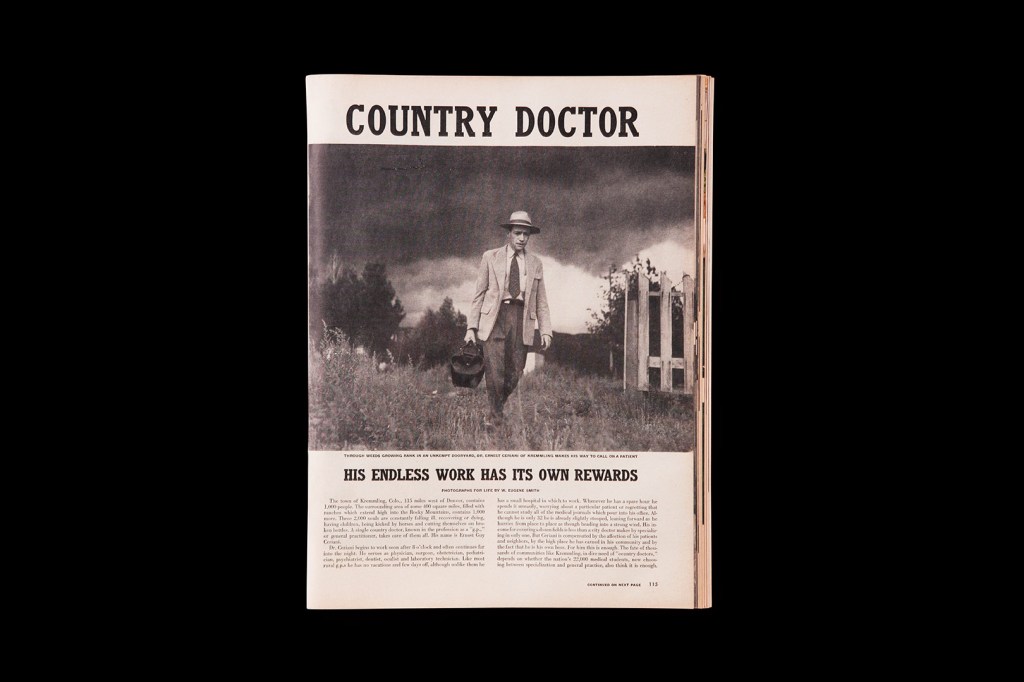
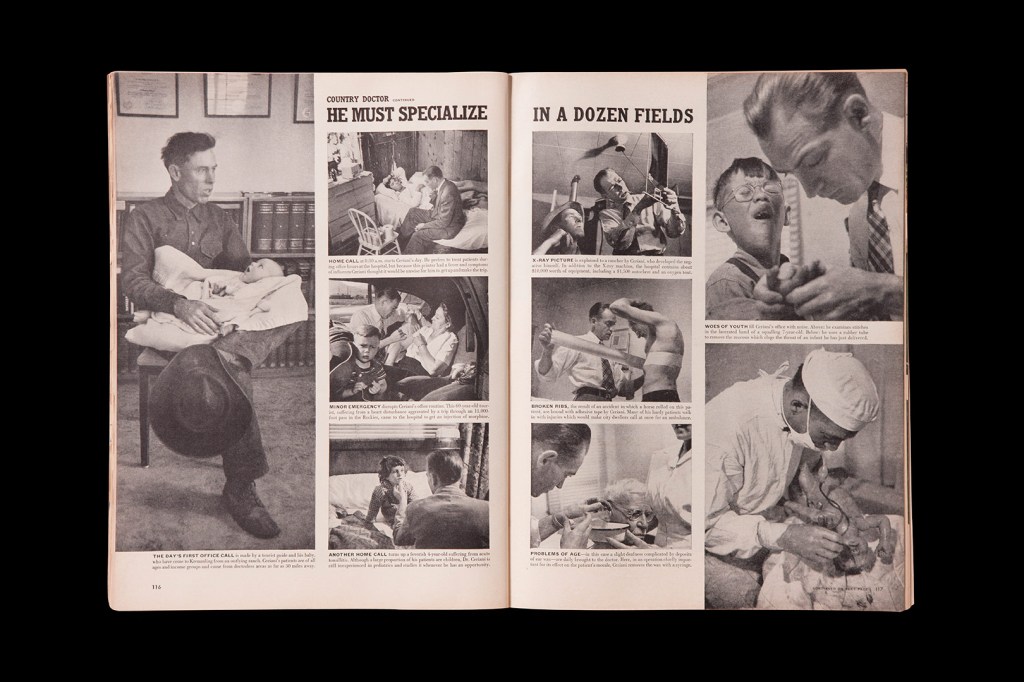
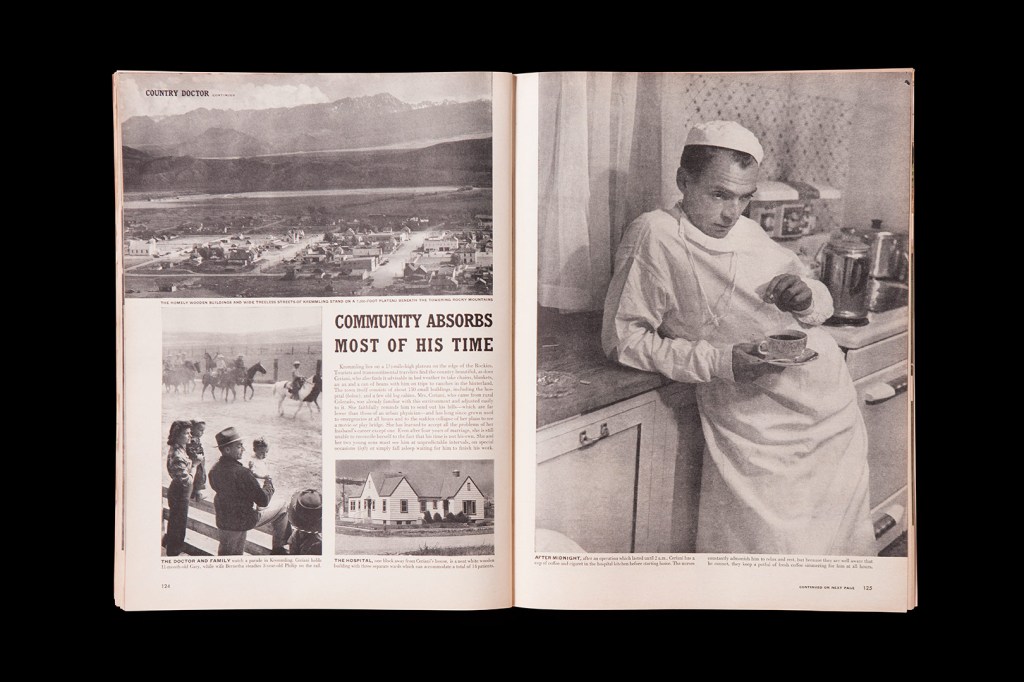
1. How does Bryony Campbell’s The Dad Project compare with Country Doctor?
Both are work relating to health issues over an extended period of time in a diaristic mode. Both show a carer and the part they play in helping ill people. The particular narrative for each image supports the overall story.
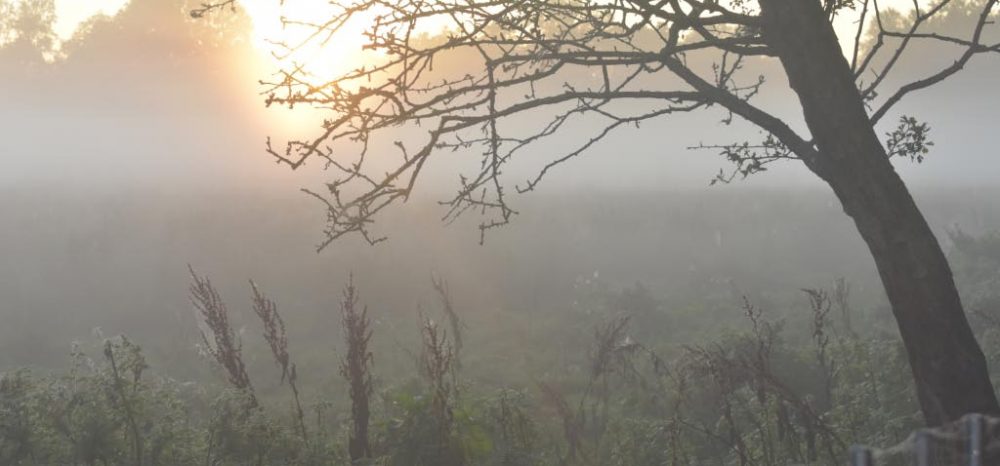
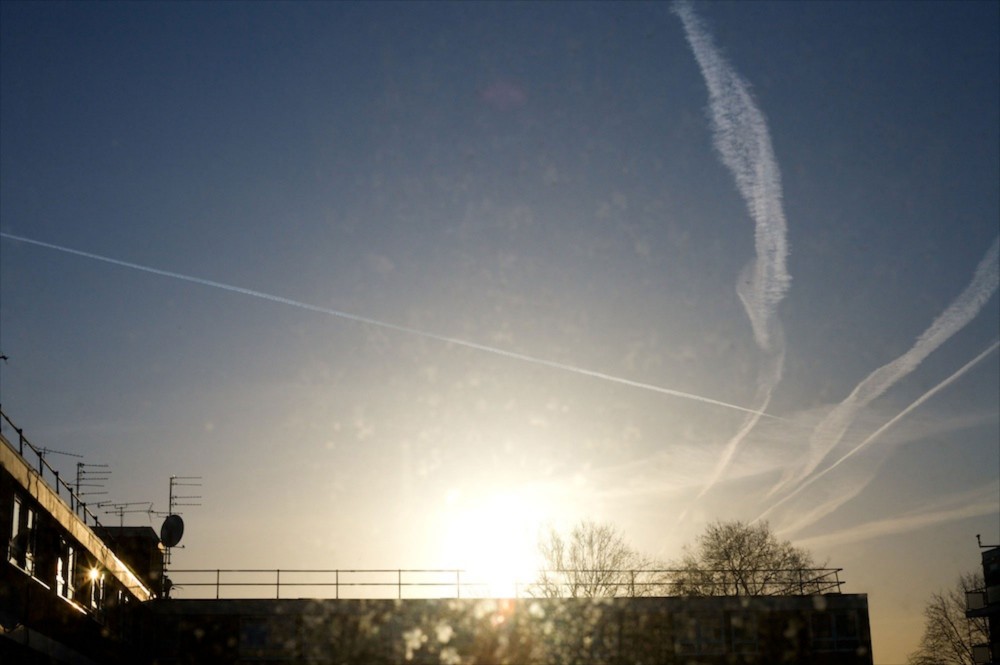
They contrast in a number of ways, Eugene Smith’s is less emotional and more a recording of the facts from a distance where Bryony Campbell’s includes emotional images such at the two below of the blue sky and light which tells adds to the narrativeof how she is feeling.
2. What do you think she means by ‘an ending without an ending’?
She could possible mean two things, she will see him again one day when she dies, or that he will live on in the work produced in the project and other photographs taken of him that keep his memory alive.
Notes :
In 1948 W. Eugene Smith made a photo essay for LIFE magazine. Country Doctor chronicles the ups and downs in the life of general practitioner Dr. Ernest Ceriani from Colorado over 23 days.
Today we knew he would die soon. I went outside and looked at the sky while we waited for the ambulance. It was perfectly beautiful. Bryony Campbell The Dad Project (2009)
The sunlight supported me this year… Bryony Campbell The Dad Project (2009) How Eugene Smith’s photo essay looked like when it was published in Life Magazine
It was recommended a notebook is kept to record various aspects of my course and photography in general. I have kept this with me and I have found it very useful to jot down things that spring to mind that I don’t want to forget. I have also listened to photography podcasts on my journey to work such as one called “A Small Voice, Conversations With Photographers.” I have gained a huge amount from listening to these and have noted interesting things in my notebook.
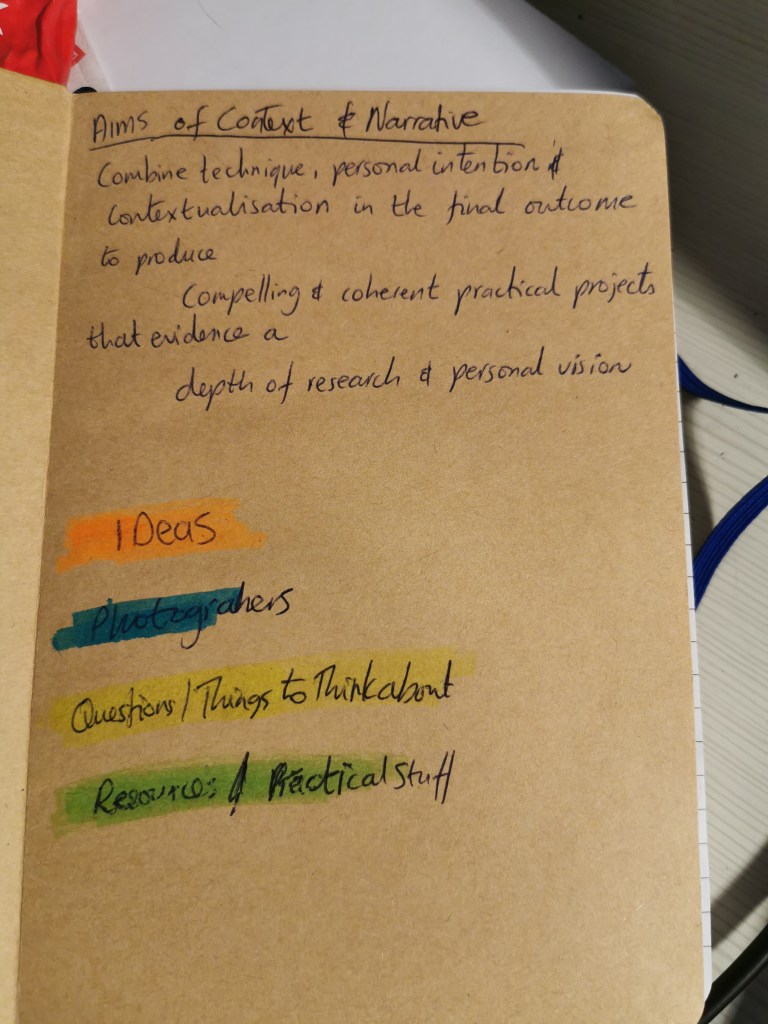
Colour coding – my notebook has been highlighted so I can easily identify different types of information at a later stage :
Colour coding in my notebook which helps me find things later on Extract from my notebook and how I am colour coding my notes for future reference and reflection
Ideas
Unit 1 5th Feb to 15 March
Travel to work each day so there will be down time waiting at some point in the routine : take a photo so you keep practicing and keeping composition skills alive – if at the same place each day you could evaluate the change over time
On my way to work there is wall art which would be good to photograph regularly because the plant at the top of the art changes with the seasons and therefore changes the art
A tree with daffodils underneath is also an image that could be taken regularly during my early morning commute and observe the change over time
iphone has the technology to produce long shutter or slow shutter speed silky water shots in a much shorter time so you don’t need a tripod or technical knowledge
When in a snowy scene (recent trip to Norway) shoot images that look black and white but arent, and have just a bit of colour in them
Pauline Goyard fine art portrait photography – create geometric portraits – create a big black cirdle in the middle of a white backdrop – dress the subject to complement this background
Tunnel photos – this could be created with family portraits for something different to display on the walls
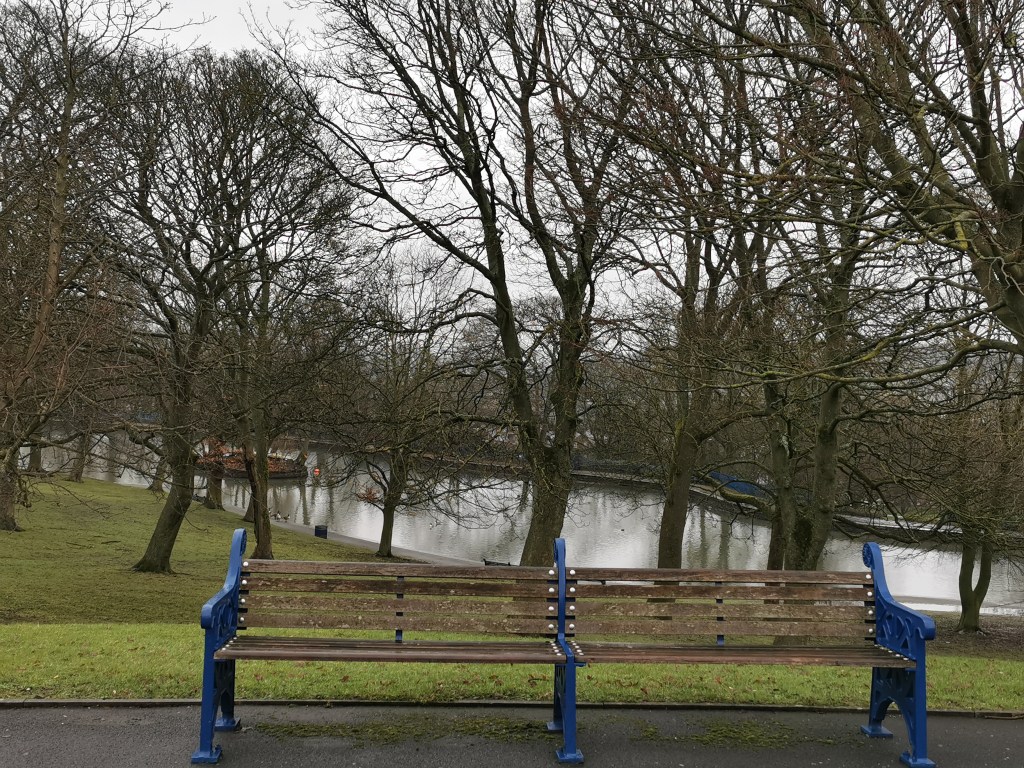
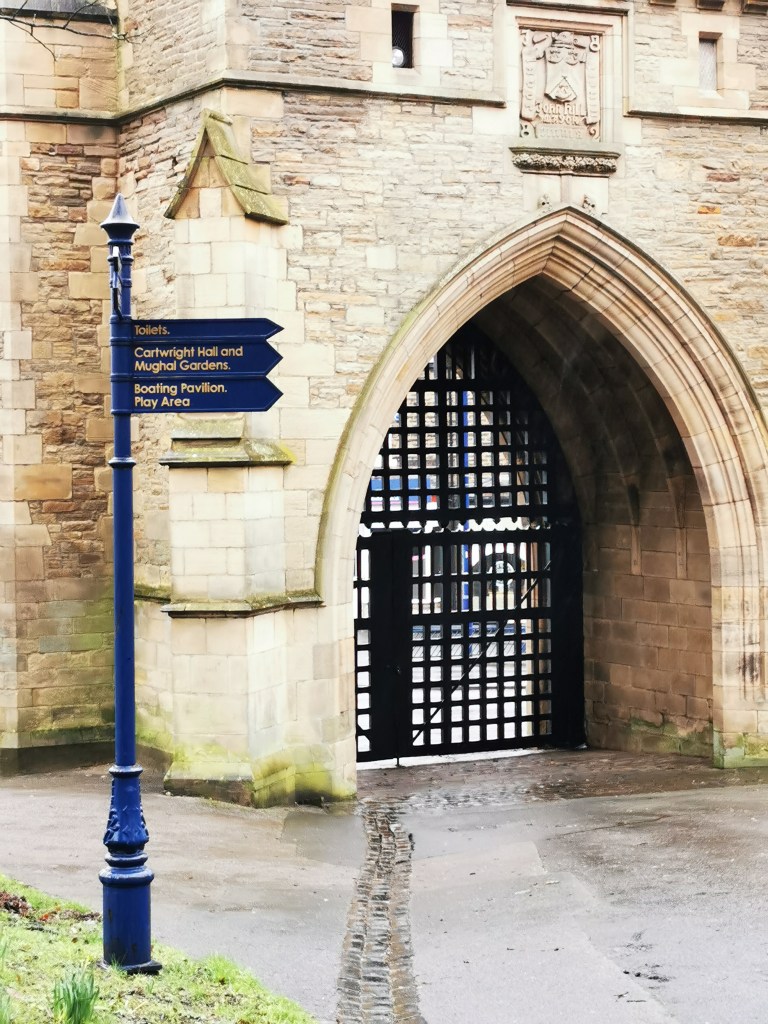
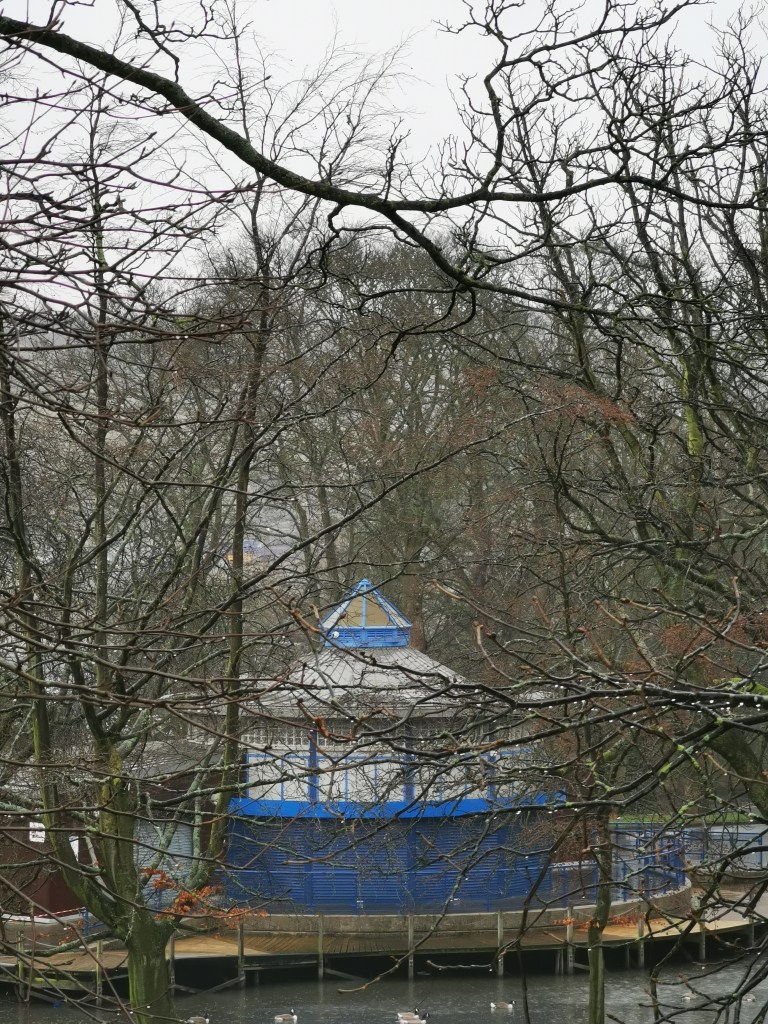
Bradford dull winters day in the park, colours are very dull browns, greys and little foliage, this could form the backdrop and contrast to the amount of bright blue painted objects in the park such as sign posts, fencing and park benches and buildings
The architecture of derelict stark buildings that show their form ( recently saw these in Bradford) are a great theme for a series of black and white photographs
When I travel back to Zimbabwe, gather flame lilies ( my mother’s favourite flower) and recreate an image with the flower petals forming a frame around a printed photograph of my mother and re photograph this – inspired by the Nalini exhibition produced by Arpita Shah
Photographers
Unit 1 5th Feb to 15 March
Emil Pakarlis: runs a phone photography school – a mobile phone can be used to concentrate on, framing, teh subject, light and composition so you can practice on this – it frees up the distractions a DSLR camera brings. “editing is like applying make up, use it to enhance the natural beauty”
Robin Maddock (Our Kids Are Going To Hell, 2009), Engerland 2017 – British Documentary Photographer. The work was of drugs busts etc as he followed the police doing their work in the UK. The photos taken then would not be allowed or would be a lot more difficult to make nowadays with safeguarding policies, compliance and overparenting
“People like to look into a world/life that is not normal”
Pauline Goyard, fine art portrait photographer “you can spend so much time finding your style that you then end up being trapped in it” Has a great Instagram account for ideas. Her inspiration is Sue Bryce, her favourite photographer.
John Blakemore : a British photographer who held a book making workshop which a fellow student attended
Shona Grant is a photographer who has a very useful website full of resources and has been very helpful to a fellow student making a tunnel photo book
Aaron Schuman, John Clowe and Karl Blosfelt (nature and architecture) were mentioned by students at a study day I attended in Bristol
Daniella Zalcman – a documentary photographer based in London. She made work on the government operated Indian residential schools in Canada – interestingly she shot the photos on a phone and a film camera. It is called Signs Of Your Identity and they are double exposure portraits She also mentioned that only 15% of photographers are women which is a shocking statistic
David Alan-Harvey (Magnum Photographer) “Tell It Like It Is” done aged 23 and he lived with a black family in Virginia to document their lives. Growing up in a middle class family with a maid he became empathetic to their plight of apartheid and the injustices.
“Most people haven’t got a creative eye, you have to show them the product and give them a good service and show them”
“Art often stems from a personal struggle – so always be in a state of struggle to be creative”
“complete your work! only a few do this and you may fail and make mistakes several times but dont give up – it’s the small percentage success that defines you”
Mark Power (UK photographer) Magnum. 26 Different Endings (2007) London landscape – the Treasury Project (2002) restore a 19th century historic monument “A gallery collection of images is different to the images you would choose to make a book about the work”
“You can only really sequence about 6 images at a time, then take a break” In a series – can’t all be amazing wow photos – too shouty! You can have blank pages in a photobook. There is always that Mount Everest photo, the one you really struggled to get so you really want to include it – but no one else knows or cares so you need to be objective. You need filler images between the great ones.
Annie Collinge – fine art portraiture – her advice from Martin Parr : “when photographing strangers, do it really quickly for a more natural and less awkward situation for them”
Arpita Shah : Nalini Exhibition : the use of video for the artists statement was great for me as I like to take on information in this way rather than reading. Lots of great ideas about how to exhibit in this. Ie the social media wall, a huge image of the Taj Mahal.
Questions/Things to Think About
Unit 1 5th Feb to 15 March
Image storage : dedicate time each week to organise and structure images in a naming convention and tagging
Should I use my iPhone for serious photography work? Are the photos produced from my phone ok for printing?
How do we get candid shots of children nowadays in a world of overparenting, safeguarding and compliance?
Resources / Practical Stuff
Unit 1 5th Feb to 15 March
Get an underwater case for my Phone for holiday
Snapseed is a good app for editing
Pauline Goyard website is very good and full of resources – so is her instagram
Procreate App, drawing on a tablet with an epen
Snap Mad : large prints cheap 270gsm
Bristol Bound : book binders ( Tobacco Factory)
Womanphotograph.com : directory of female documentary and editorial photographers available for freelance assignments (all have a min of 5 yrs experience) – created by Daniella Zalcman
We hope that Part One has demonstrated to you that each photograph is a ‘point of view’ that depends on the time it was taken, the person who took it (no matter how objective they try to be) and the things outside the frame, unknown to the viewer, which may add or take away from what’s revealed in the frame. In this sense every photograph, regardless of its visual accuracy, is a manipulation of reality. A photograph cannot tell the whole story and is therefore part of a wider narrative. This is an important point that is often overlooked in the dissemination of news and facts in media and popular culture. Although photography has played an important role in providing information, for example in photojournalism and historical archives, we must take its context into consideration in order to fully understand the whole story. Now that you’ve reached the end of Part One, reflect on what you’ve learned in your learning log or blog.
● What was your idea of documentary photography before you worked on Part One? How would you now sum it up?
My idea of documentary photography before the start of this unit was that I could trust what I was shown in a series of photographs and engage in the accompanying narrative so I am better informed having engaged with the work.
After the first unit of this course I am learning that images can be presented in different ways to present instead a “version of the truth”. The image may be genuine but editing out certain images from a series, excluding or including certain components within an image and the context in which the images end up i.e certain tabloid newspapers vs a museum or National Geographic can drastically change the meaning of documentary. There were also examples in the coursework of The Farm Security Administration (1935 to 44) who were set up to look after the welfare of the farmers after the great depression in USA. Dorothea Lange produced some iconic images such as Migrant Mother. It was a known fact that photographers were sent out with specific instructions about what images to take and in what setting and certain facial expressions captured etc. So even nearly 100 years ago a version of the truth was being portrayed.
I also understand the nature of producing documentary photos has changes with the onset of mobile phone photography and social media. The cost of soliciting several people to take more “realistic” snapshot style images in an eyewitness style can come across as more genuine and credible but is also cheaper than paying a professional photographer to travel to a certain part of the world to shoot a particular event. Timing is also a factor in this style of photography.
Today the more traditional human suffering images have been replaced by something that is more eye catching such as Gideon Mendel’s work “Dzhangal” meaning “this is the forest” – a meaning for the Jungle, the refugee camp in Calais. He produced work of the objects left behind in the camp such as a collection of toothbrushes and a text book. Perhaps a method to differentiate himself and/or combat “compassion fatigue”
● What are the differences between documentary, reportage, photojournalism and art photography?
Documentary photography usually refers to a popular form of photography used to chronicle events or environments both significant and relevant to history and historical events as well as everyday life.
Reportage : The reporting of news, especially by an eyewitness. News or information of general interest that has been reported; media coverage of a topic or event.
Photojournalism differs from other forms of photography (e.g. documentary photography, street photography or celebrity photography) by its need to remain honest and impartial.
Art Photography a medium for creative expression. The goal of fine-art photography is to express an idea, a message, or an emotion.
Instead of using double exposures or printing from double negatives we now have the technology available to us to make these changes in post-production, allowing for quite astonishing results. Use digital software such as Photoshop to create a composite image which visually appears to be a documentary photograph but which could never actually be. To make a composite image you need to consider your idea and make the required amount of images to join together. Upload the images and decide which image you’ll use as your main image and background. Use the magic wand to select sections of image from the others you wish to move into your background image. Copy via layer and drag into the background. Do this repeatedly until you have all the pieces of your puzzle in place. In order to make it more convincing, use the erase tool on each layer to keep the edges soft and to create a better illusion. Be aware of perspective and light and shadows for the most effective results. Search YouTube for Photoshop tutorials; there will probably be a suitable upload. If not, ask your tutor or your fellow students for advice or find a digital technique book in your library for more specific instructions. Have a look at Peter Kennard’s Photo Op series for inspiration: https://www.theguardian.com/artanddesign/2013/oct/15/tony-blair-selfie-photo-op-imperial-war-museum
The three people in the bottom left of the image have been added to this photo. A story could be created around hiring a bike and riding along the beach in the Carribean. The bike riding actually took place in Wales Uk.
Find a street that particularly interests you – it may be local or further afield. Shoot 30 colour images and 30 black and white images in a street photography style. In your learning log, comment on the differences between the two formats. What difference does colour make? Which set do you prefer and why?
The benefits of colour
Setting and time inferred – warm colours imply Autumn and cool colours imply Winter
Mood – is communicated. Cool implies sadness and lonliness and warm implies tenderness and joy
Emphasise relationships – same colours join subject matter and emphasise relationships – analogous colours
Black and White
Era – choice of B&W or colour suggests an era – B&W is more timeless
Light and shadows – are accentuated, dramatic shadows brought to attention
Wide range of tonal values – if very black to white and greys in image to start with
Make sure you shoot in RAW so you have the choice of colour or B&W – if you only shoot in JPEG and choose the B&W setting the colour information won’t be captured and stored
Most importantly – make sure you know WHY you chose colour rather than B&W
Convert images to black and white when the light, form, or texture in the scene is more compelling than the hues of the subject matter. Black and white is a good choice when the color in a photo serves only as a distraction from the message you want the image to convey.
Notes On Work Produced
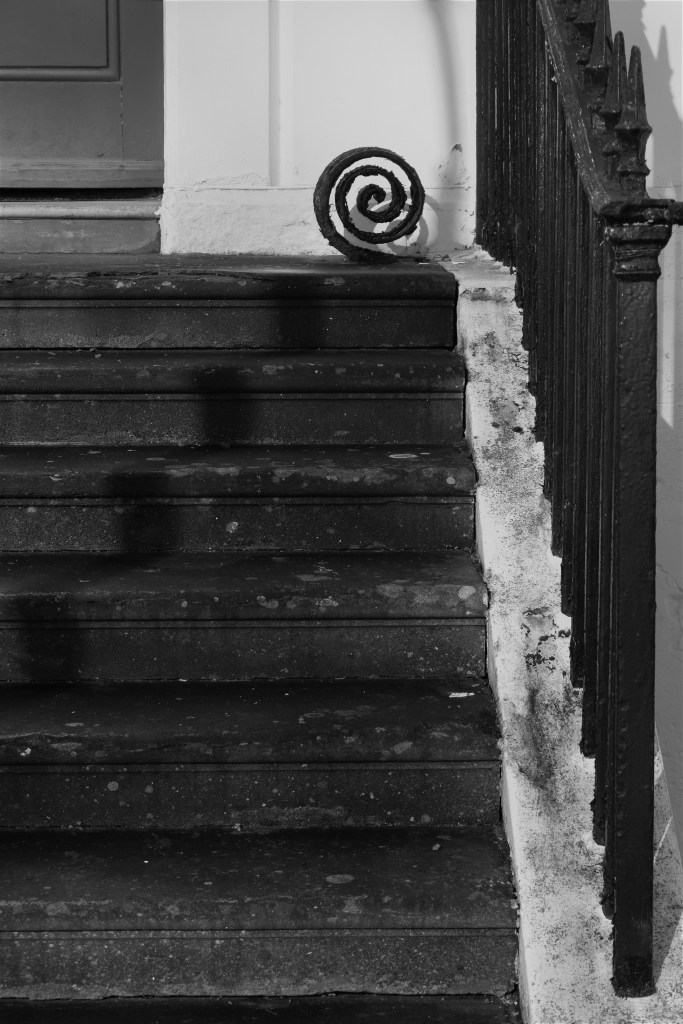
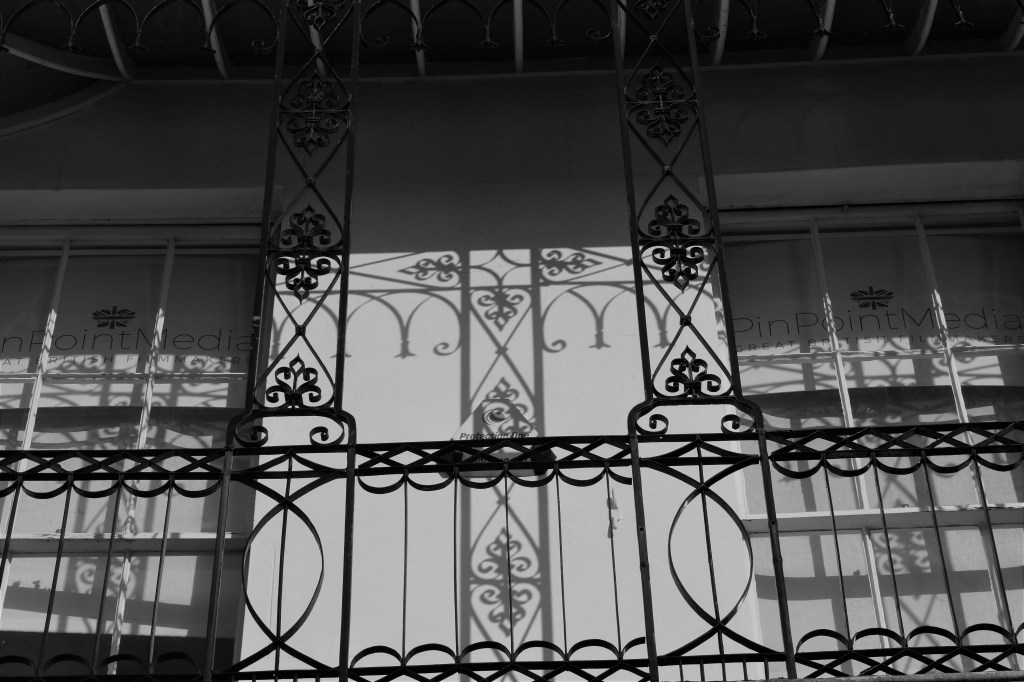
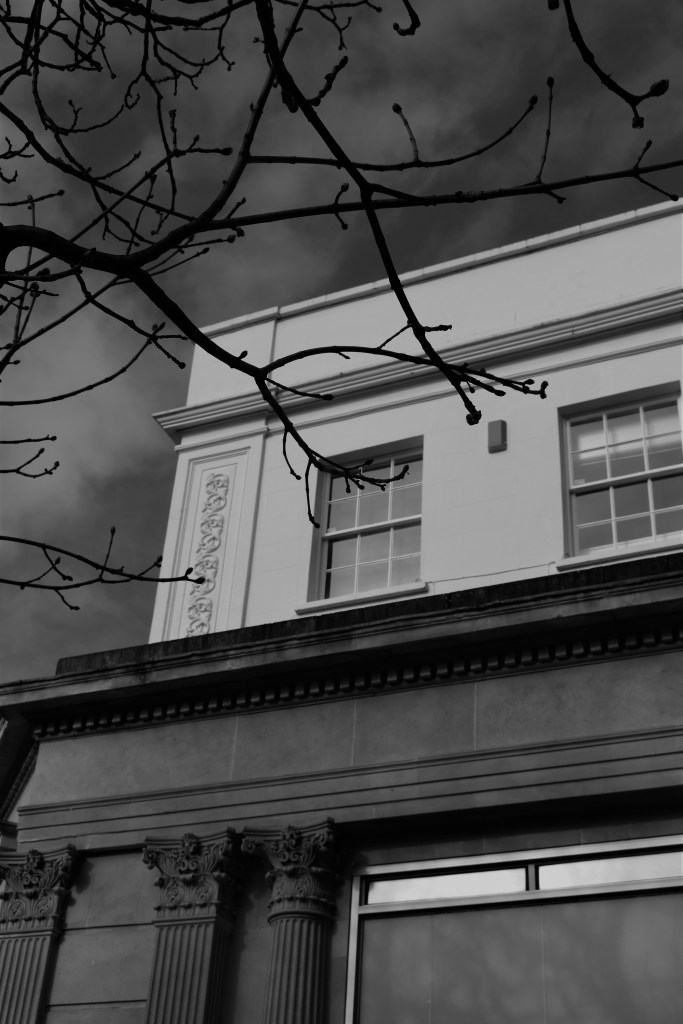
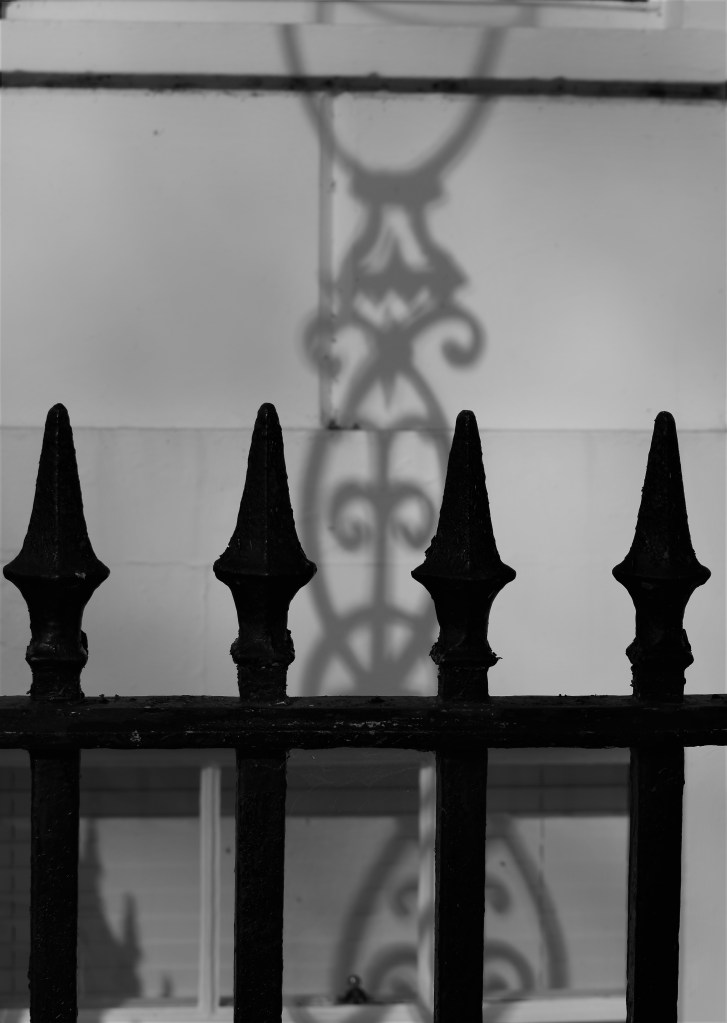
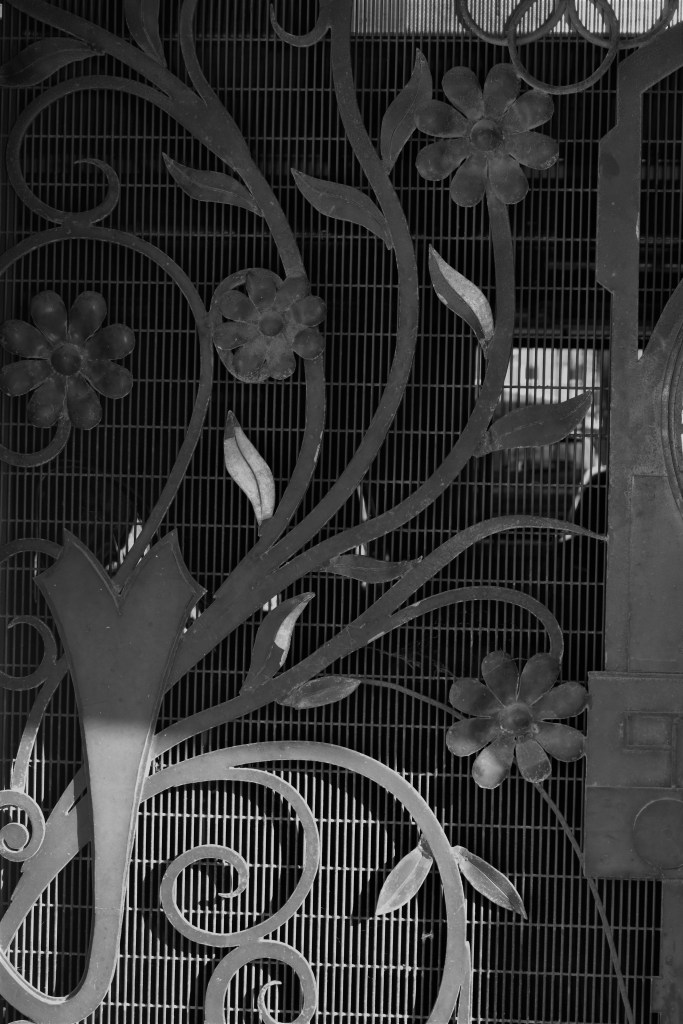
The B&W images taken concentrated on light and form. I really like the ornate ironwork on the Regency buildings in Cheltenham and on a bright day the striking shadows create extra ornate patterns that just improve the look of the building and enhance the existing aesthetics.
The simpler the image, the better B&W works, large striking geometric shapes stand out more if shot this way.
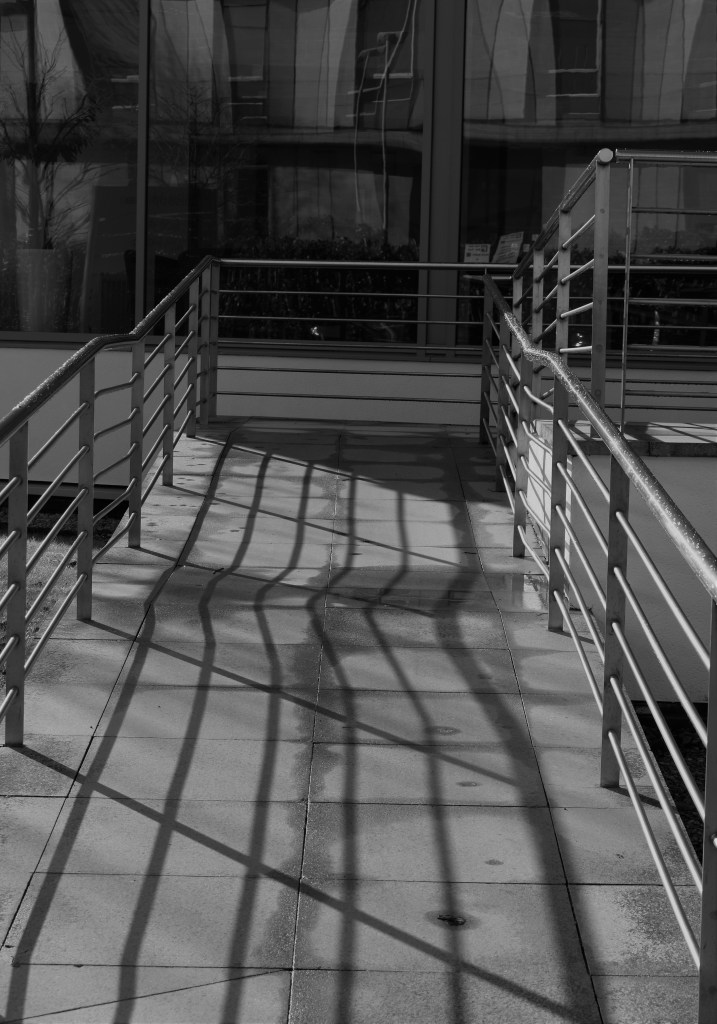
The form of the curly wrought iron structure catches the eye, as well as the shadow cast behind it. The simplicity of the stairs make the structure stand out further. I like how the rough white line on the right hand side draws the eye to the structure at the top.
Light and form at play again in this image – I love how the shadows enhance the ironwork further
Large, simple geometric shapes lend themselves to B&W, I have tried to keep this simple by only including selected elements in the frame so it’s not too busyPlaying with form and light again helps to create interest Close up shapes and patterns that are interesting are emphasised further when in B&W – the light falling on the lower third of the image adds interest and draws the eye to this area as a focal point The shadows have become the main subject of the image – using light and form works with B&W photography Bradford Industrial landscape lends itself well to B&W. The steam cloud on a grey day looks more dramatic. The geometric buildings show their form better in B&W. The colour blue connects these images nicely. On a dreary winters day where the park displays dull colouring, making a contrasting colour the subject adds interestThe blue contrasts with other man made features too. There are no other strong competing colours so this works effectivelyBright blue on a dull day in winter adds interest and beauty
This assignment is designed to give your tutor a feel for your work and won’t count towards your final grade if you decide to have your work assessed. However, the assessors may wish to see it so that they can gauge your progress across the course. Create at least two sets of photographs telling different versions of the same story. The aim of the assignment is to help you explore the convincing nature of documentary, even though what the viewer thinks they see may not in fact be true. Try to make both sets equally convincing so that it’s impossible to tell which version of the images is ‘true’. It might be interesting to consider the project as evidence for a court case. What conflicting stories can you make your images convincingly tell? Would it stand up in court? Choose a theme and aim for 5–7 images for each set, depending on your idea. Discuss this with your tutor. Here are a few ideas: • You could interpret this brief by showing the same scenario from two different angles. Does this alter how we read the situation? • You may wish to create an alter ego by using snapshots of yourself or a friend. This could involve photographing them in two very different and potentially conflicting personas. • You could make a parody of a dating website profile picture. Create different versions of the same person looking completely different in each one. Which one represents them best and how can we know? Or you may prefer to use your own take on the theme. However you choose to interpret the brief, ensure the images are candid and ‘taken from real life’. Be experimental and take some risks. Perhaps you could make a list of ideas and choose the most challenging or absurd option to stretch yourself. Send your sets of images to your tutor by the method you’ve agreed. Include an introduction of 300 words outlining what you set out to do and how you went about it. Also send to your tutor the relevant pages of your learning log or your blog url. It’s good to get in the habit of printing your work so try to send prints to your tutor where possible. This is not obligatory but will help when it comes to assessment. Developing your prints in order to achieve the best results is a long process so it’s best to start now.
Initial Response To The Brief
Having studied the first unit and now understand the differences between witness photography, reportage, documentary photography and Art photography and realising that an image is not necessarily the truth but depends on the context and also how the viewer sees and interprets the image. The idea of introducing different subjects, composition and several other factors to create two different versions of the same story is exciting in a conceptual way but also creatively in the form of art photography. Two sides of the story or different vesions, selective editing can create different versions of the truth. This takes place around us all the time but I have never considered it until now. Social media photography is a perfect example of this concept, where by the power of selection, only the best photos are taken and then chosen to be displayed, giving a very false impression of the reality of the life of an individual.
Planning
Time management is always the challenge. I knew I would have to go out two or three times to take enough shots for this assignment. Street photography like this also has an element of chance and uncertainty since we are dealing with a live dynamic situation. Each time I visit an area to shoot could result in very different results, and possibly nothing at all. Unfortunately the issue of homelessness is never far from us so shooting opportunities will certainly be available.
Research/Inspiration
After an initial discussion with my tutor about my interest in social documentary and I mentioned I was inspired by the work of Anthony Luvera after hearing him speak at the Photography Symposioum at Birmingham City University last year in October. Anthony worked worked with the homeless and has helped highlight their plight and has even changed laws around safeguarding of the vulnerable through photography. Julian Germain was suggested by my tutor as an approach to this assignment, I was also lucky enough to hear him speak about his project in the Brazilian Favelas. The work was called “No Olho da Rua – In the eye of the street – He gave disposable film cameras to mostly the children of the favelas and asked them to take the photographs, this is a great example of “two sides of the story” since the subject becomes the author and the images are by nature totally different.
Idea
I had ideas about taking photographs of a town where the derelict areas are photographed and the second set where photos of the same town but only the nice parts are taken. Also an idea of photographing a road that is being repaired, one set just the road in a bad state of repair but leave the diggers and other related objects out of the photo, then a second set with all the construction activity, by omitting vital elements in one set it would tell a totally different story. Social media is a great one to use as an example too. There was also an idea to photograph less stereotypical things on my recent skiing holiday to Norway, for example, our very messy bedroom, the very wet gloves all competing for space on the dryer in our cabin and others, the car stuck in the snow etc.
Conclusion
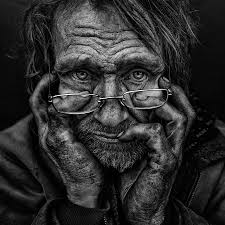
I enjoyed preparing for this assignment and I am interested in social documentary and in particular the people who are vulnerable, on the margins of society who are in need of help and support. Choosing the homeless is in line with the photographers I am drawn to like Julian Germain, Anthony Luvera and also Lee Jeffries.
This assignment is designed to give your tutor a feel for your work and won’t count towards your final grade if you decide to have your work assessed. However, the assessors may wish to see it so that they can gauge your progress across the course. Create at least two sets of photographs telling different versions of the same story. The aim of the assignment is to help you explore the convincing nature of documentary, even though what the viewer thinks they see may not in fact be true. Try to make both sets equally convincing so that it’s impossible to tell which version of the images is ‘true’. It might be interesting to consider the project as evidence for a court case. What conflicting stories can you make your images convincingly tell? Would it stand up in court? Choose a theme and aim for 5–7 images for each set, depending on your idea. Discuss this with your tutor.
Send your sets of images to your tutor by the method you’ve agreed. Include an introduction of 300 words outlining what you set out to do and how you went about it. Also send to your tutor the relevant pages of your learning log or your blog url. It’s good to get in the habit of printing your work so try to send prints to your tutor where possible. This is not obligatory but will help when it comes to assessment. Developing your prints in order to achieve the best results is a long process so it’s best to start now.
Two Sides Of the Story
Documentary photographs can contain different versions of reality, depending on the thought process, the narrative the photographer has in mind and what outcome or objective the work aims to achieve. The two sets of images I have made are inspired from the introductory discussion with my tutor about my interest in social documentary photography. We both have had experiences around the work of Julian Germain, I have attended a talk where he presented his work on the lives of the people in Favelas in Brazil called “No Mundo Maravilhoso do Futebol 1995 – 2002”. Julian Germain gave instant film cameras to the people who lived in the favelas and asked them to take photographs for him, the images produced were the “other side of the story” and therefore less stereotypical images and often less than perfect exposure, however,this added to the narrative.
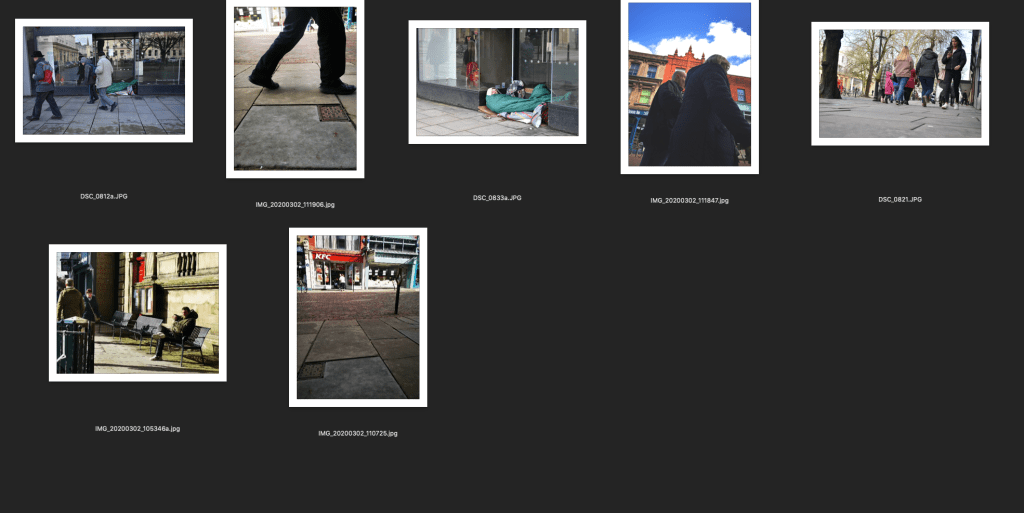
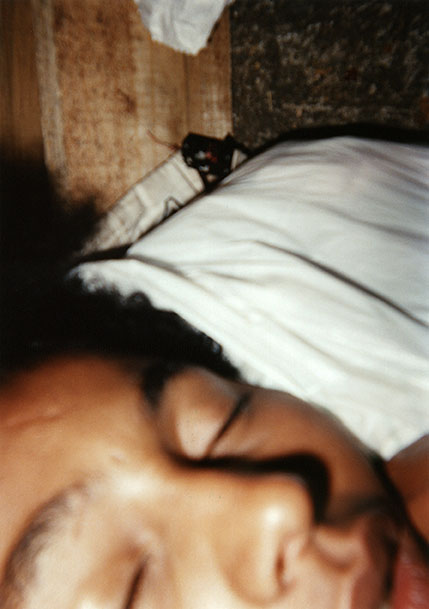
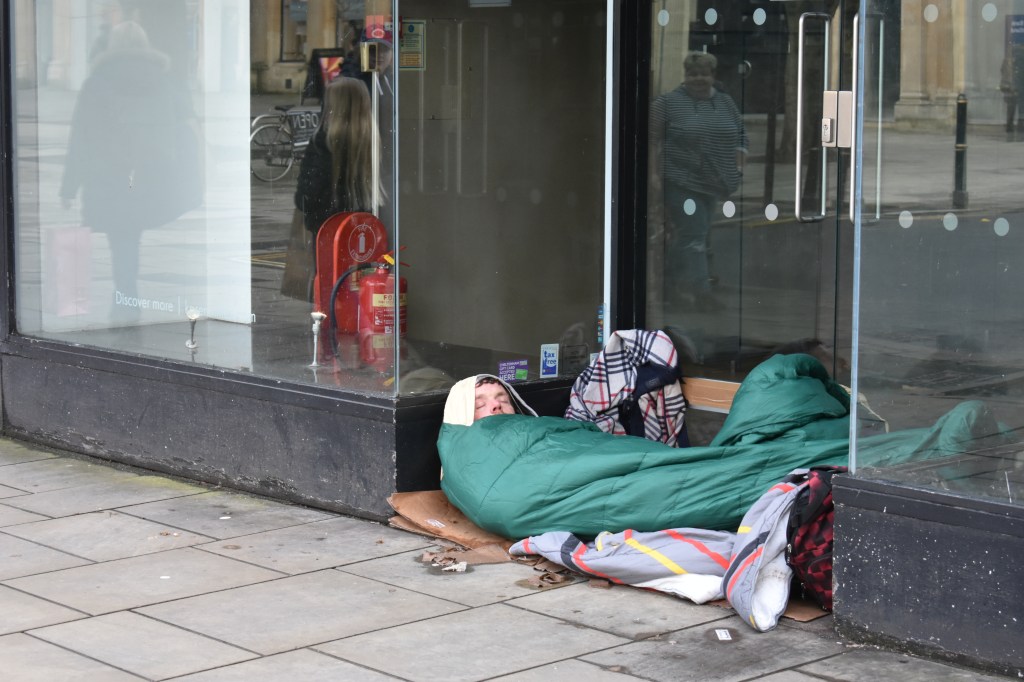
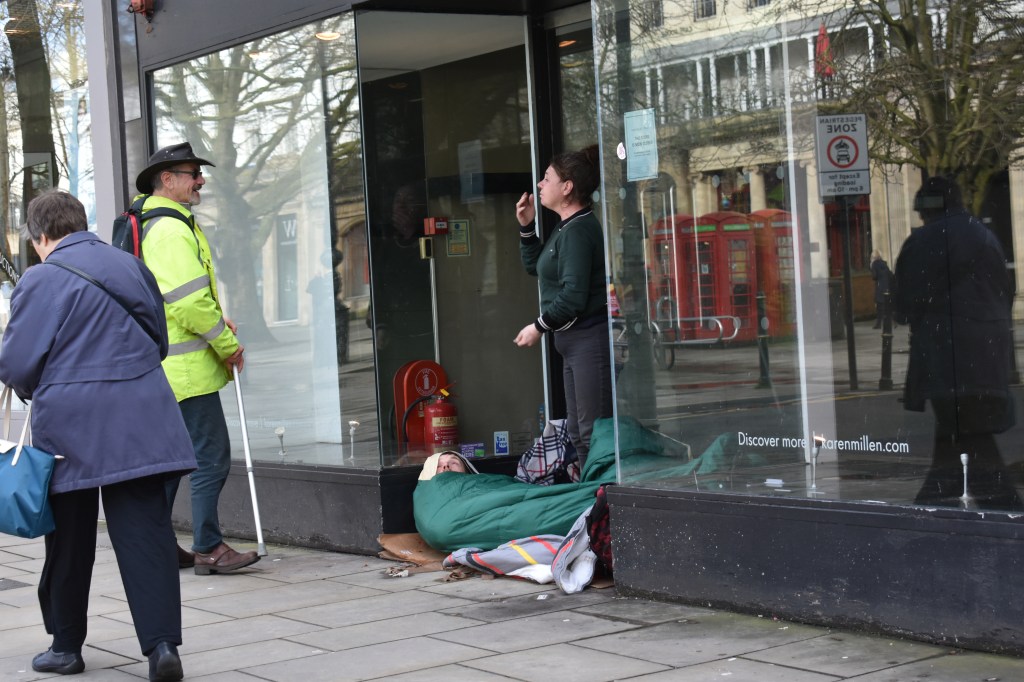
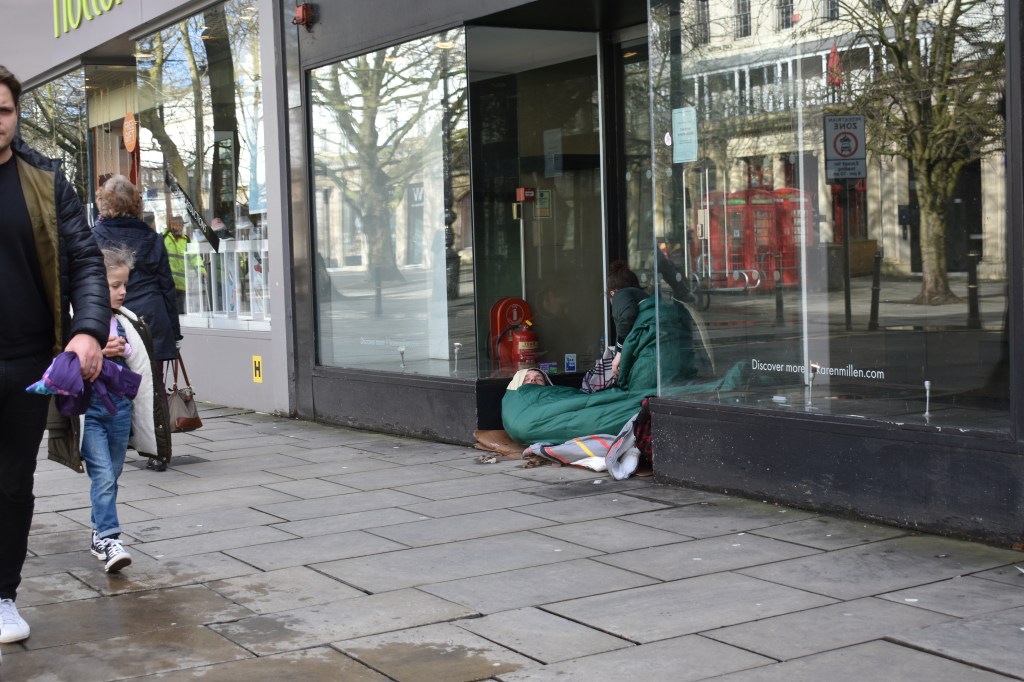
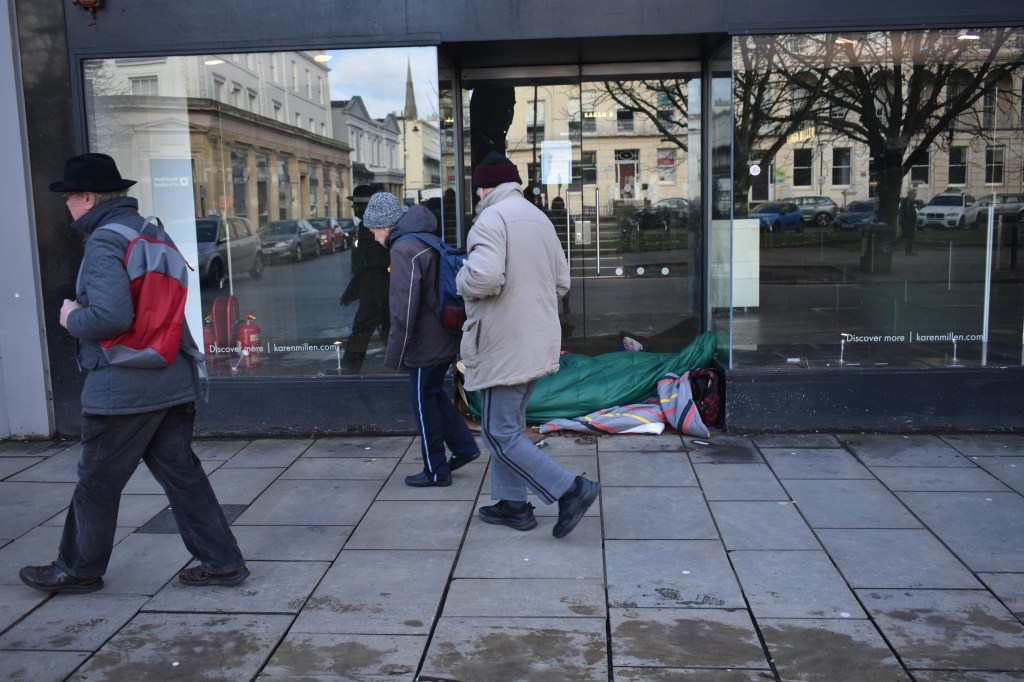
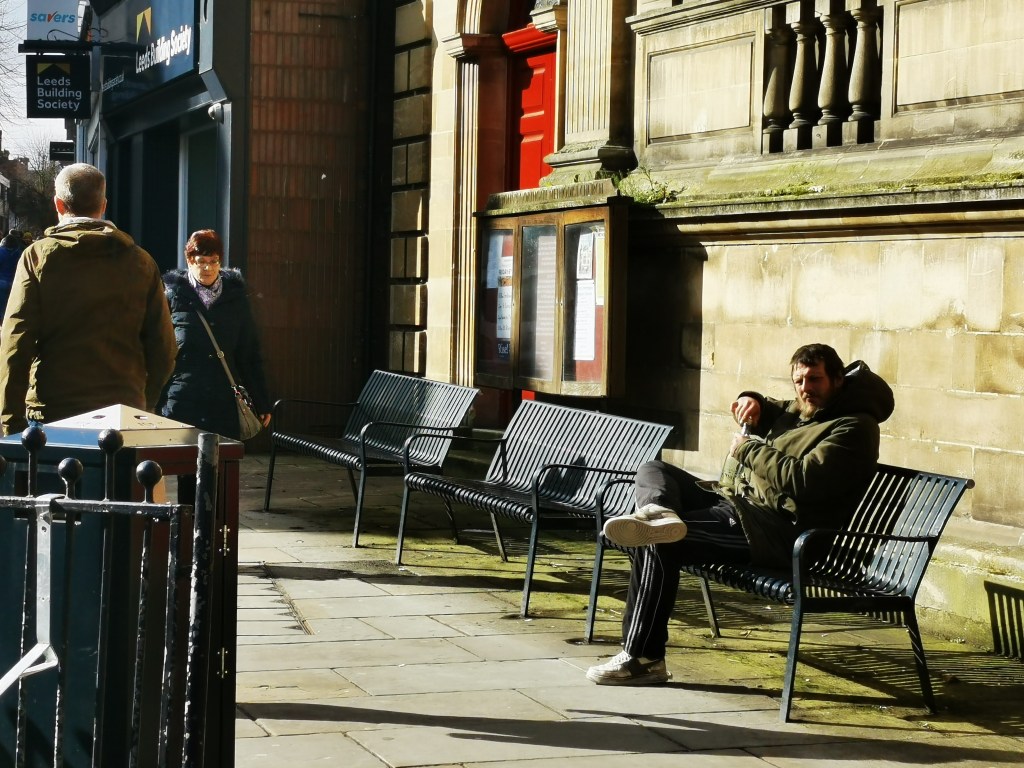
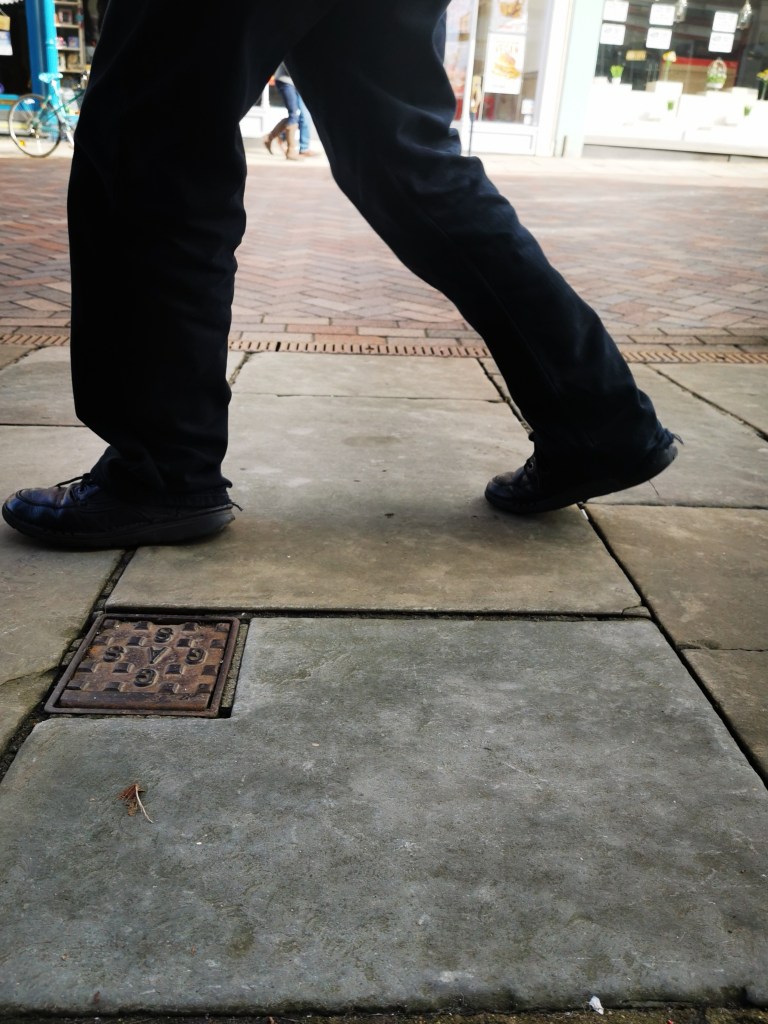
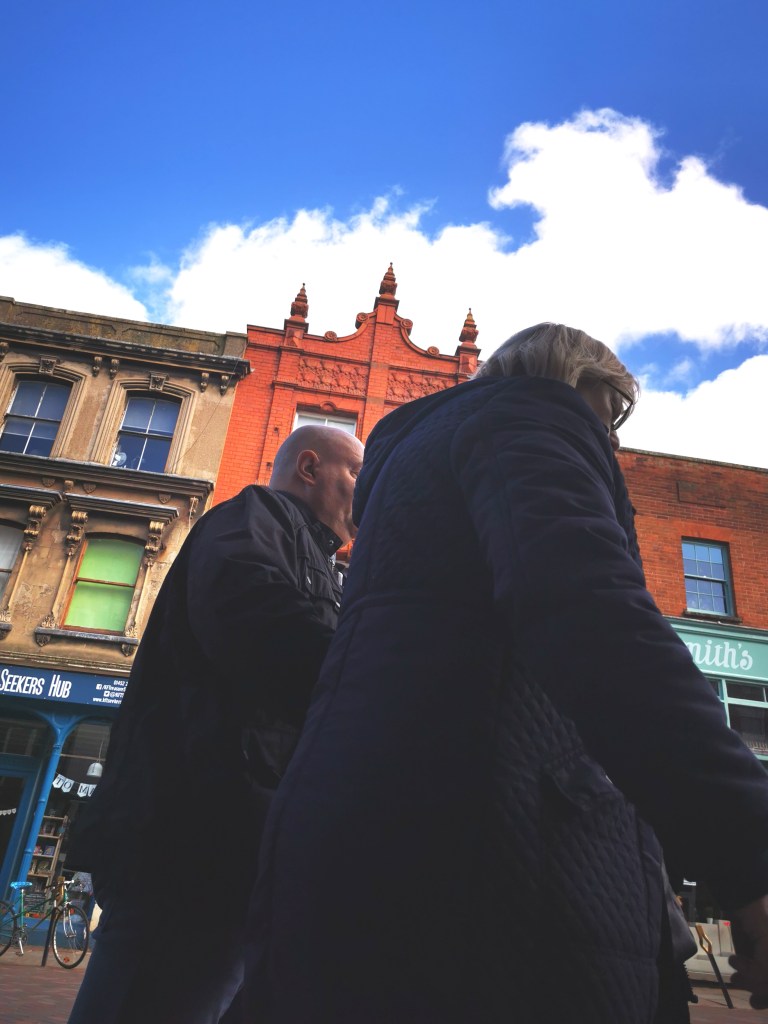
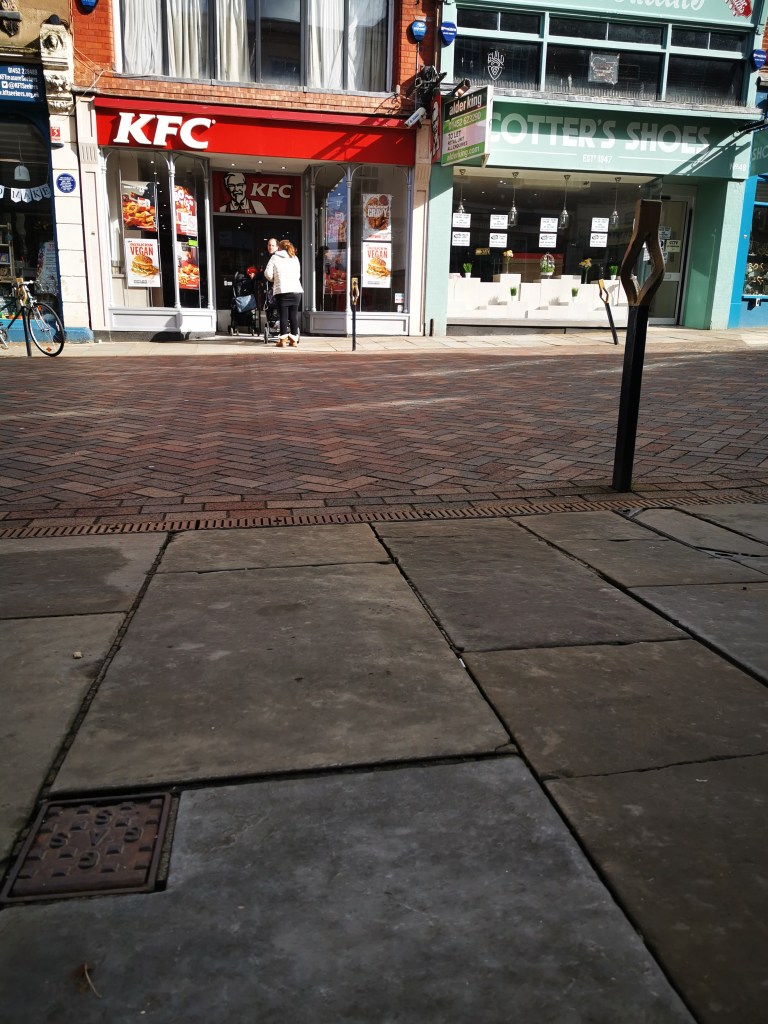
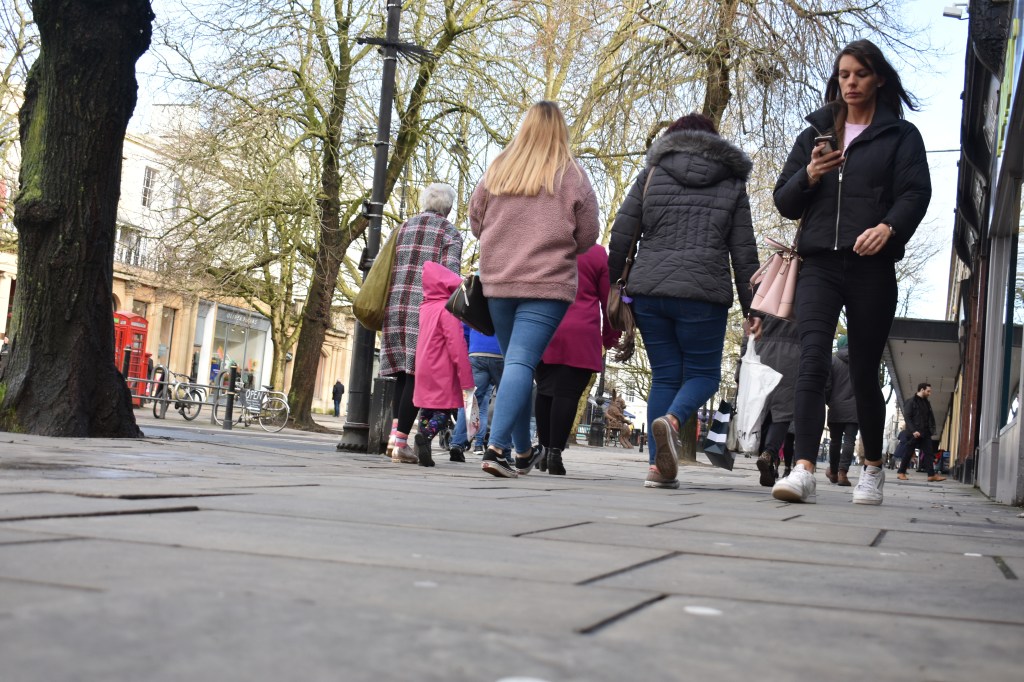
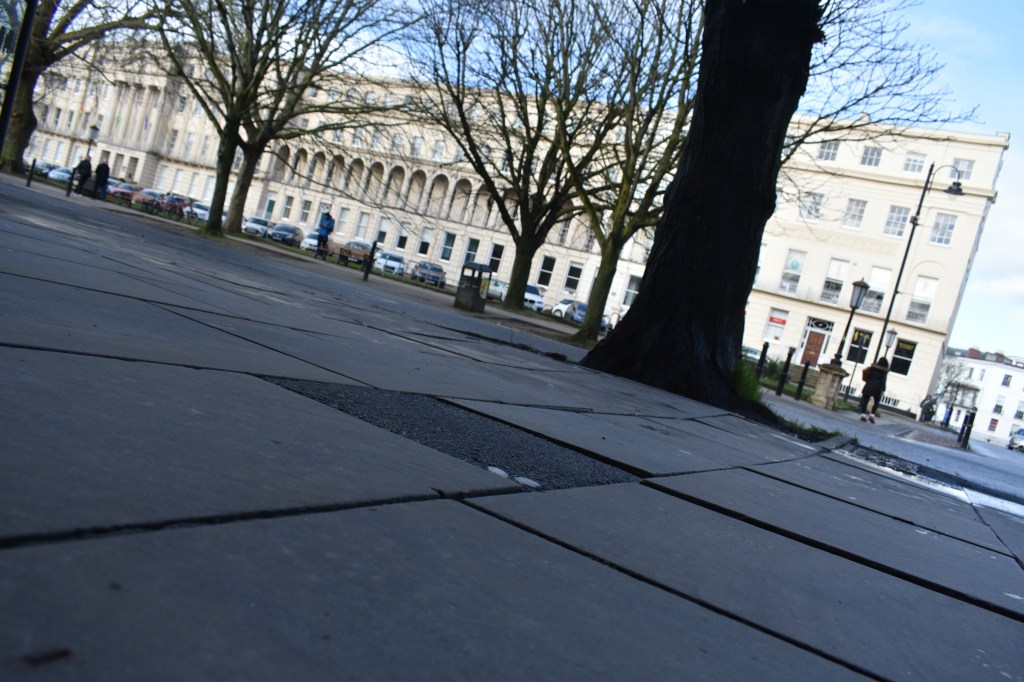
I have made work showing how the public view the homeless on the street, the photographs are taken from the view point of a passer by on the street. The second set of images is from a the perspective of the homeless person, taken lower down with what they would see from a sitting or lying position. The images differ in colours, the public view are more colourful and more subjects are included in the image, a more positive, ordinary feel to these images. The set “The View From The Other Side” shows more concrete pavement and people from a completely different point of view, hardly every seeing people’s faces as they look away or avoid eye contact.
Image 0832a is one that stands out for me because of the interaction between both sides, the look of hope on the man’s face who is in his sleeping bag is one of desperation and hope which I find very sad. This is a common image seen on the streets of Britain, I do prefer the set of images taken from the perspective of the homeless individual,these leave the viewer to find a meaning beyond the initial visual.
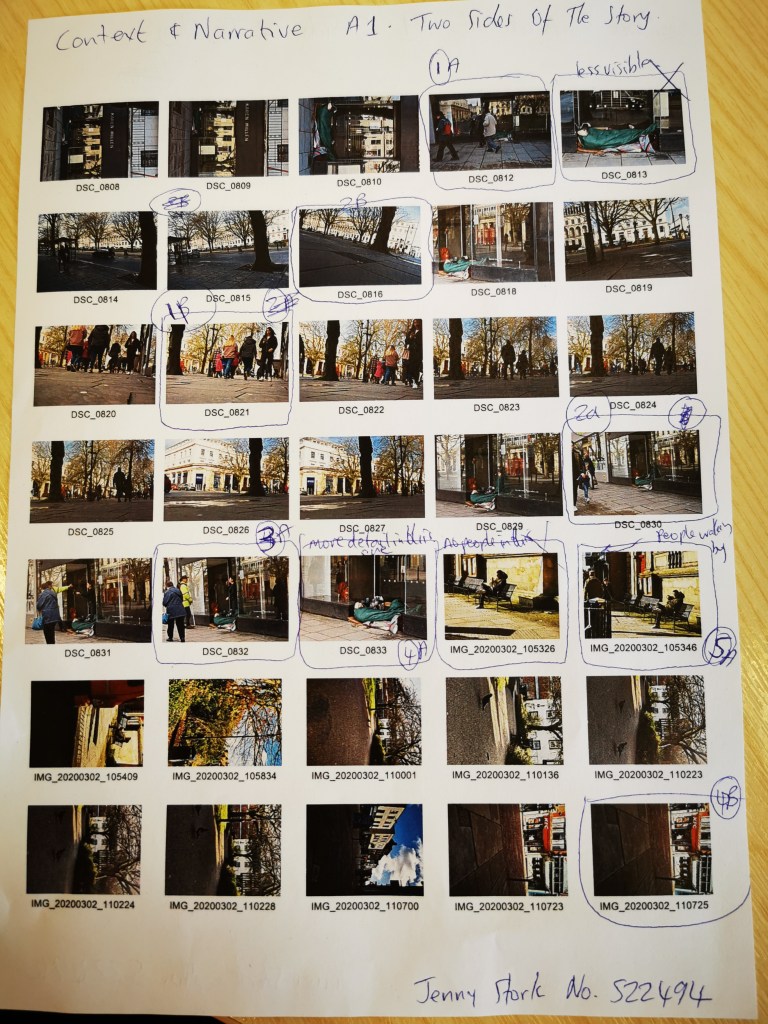
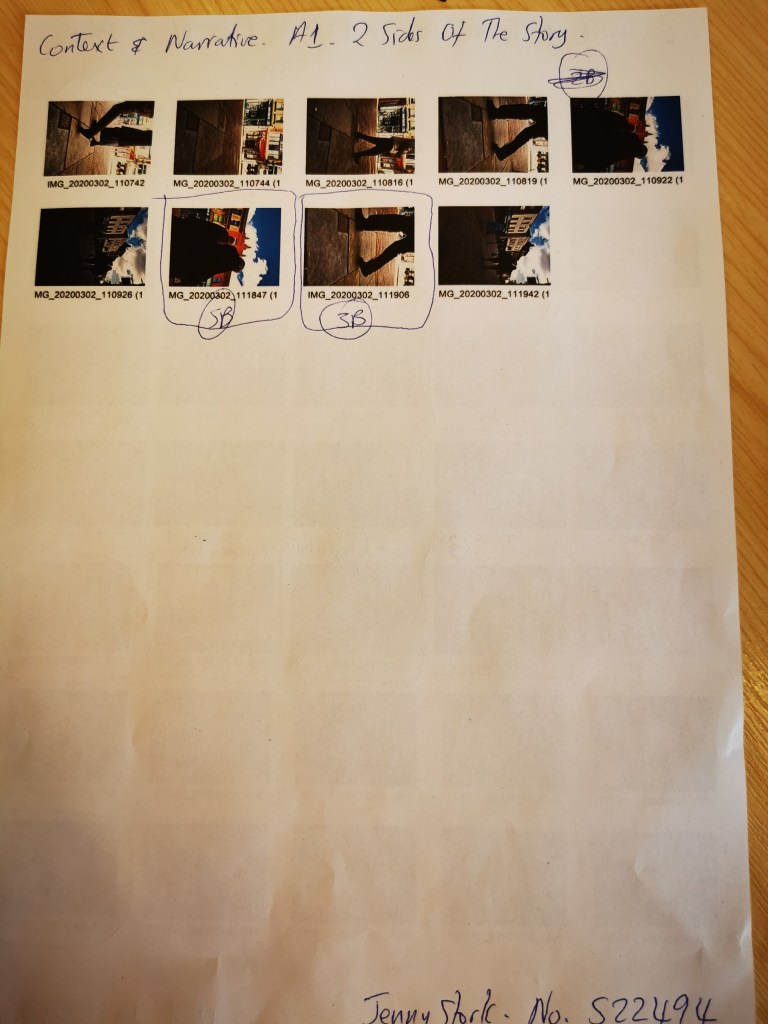
Annotated Contact Sheets show my thought process for selection of the images
The images with the letter A next to them are from the public point of view – the ones with the letter B are from the viewpoint of the homeless person – the other side of the story The images with the letter A next to them are from the public point of view – the ones with the letter B are from the viewpoint of the homeless person – the other side of the story








 Jenny Stork: Photography 1: Context & Narrative