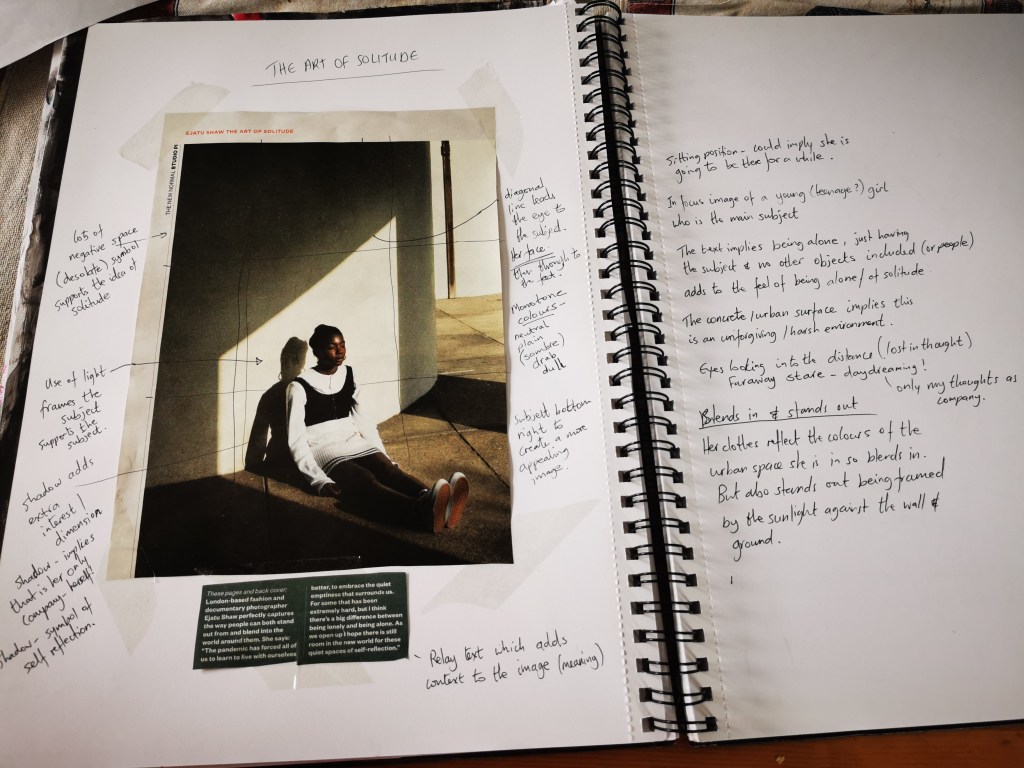
Rip out an advertising image from a newspaper supplement and circle and write on as many parts of the image as you can. Comment on what it is, what it says about the product and why you think it’s there. You could use this as the basis for your assignment if you feel it’s taking you somewhere interesting. Or you could adopt this method for your assignment preparation. Come back to this exercise when you’ve reached the end of Part Four and see if you can add anything to your analysis.
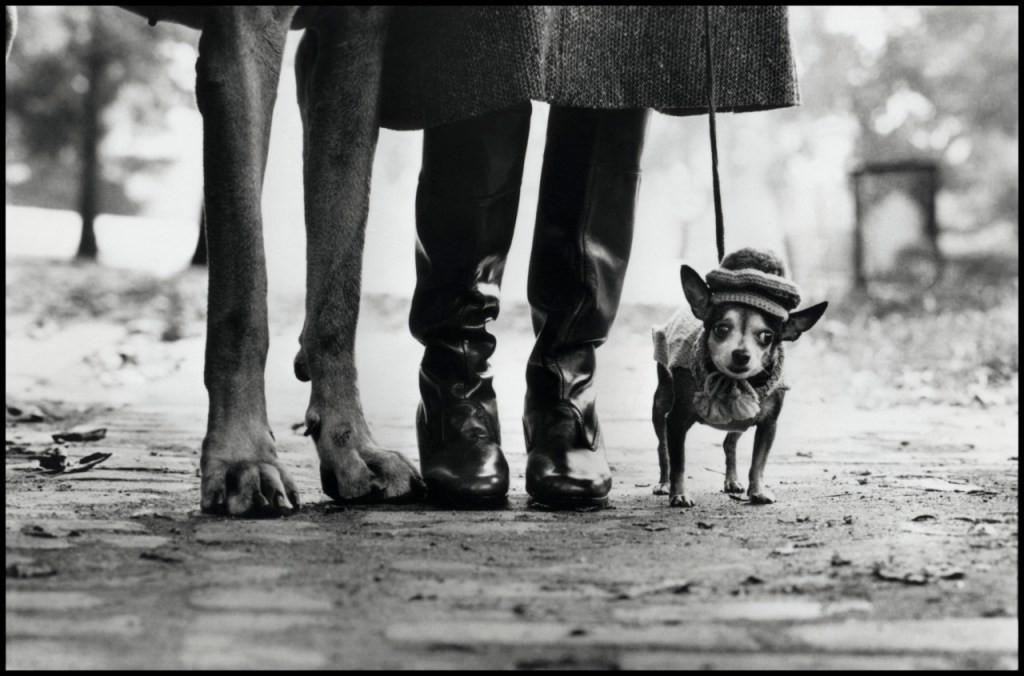
USA,New York city. New York, 1974. Felix, Gladys and Rover.
Before you read any further, look carefully at Erwitt’s image and write some notes about how the subject matter is placed within the frame.
● How has Erwitt structured this image?
Erwitt has ensured the smallest subject is what is being focused on by cutting the others out the frame, yet still including parts to ensure a balance and perspective. By the photographer coming down to the level of the smallest subject it makes it more prominent.
● What do you think the image is ‘saying’?
Even the smallest dog is important and has a place in the world in a dignified way.
● How does the structure contribute to this meaning?
By cutting out the larger dog and the human from the image it places more importance on the smallest dog where it is seen in it’s entirety. It forces the viewer to focus on this dog alone whereas in another structure the smallest dog would have been lost
● Did you spot that the picture is framed in stages of three?
The bottom third is the foreground, the middle is the subject matter and the top shows the subject and the background. This element of three is repeated in the number of subjects and the horizontal thirds are balanced by the vertical thirds of the small dog and other subjects’ legs. This use of three and the horizontal and vertical lines make the image appear visually complete. You get the impression that what’s within the frame is the whole picture, but of course there were bodies and heads and the rest of the larger dog just outside the viewfinder. This leads us to the photographer’s decision to crop at a particular point. This was a witty decision but, more importantly, we’re reminded that it was a decision. What we see of the situation very much depends on the photographer’s point of view. By placing the small dog as the main focus, Erwitt emphasises its small stature. The size of this dog probably means that it’s often overlooked, especially in relation to its larger friend, so Erwitt’s decision to make it the main focus may tell us something about him as a person.
● Does he like to help the ‘underdog’? ● Does he prefer dogs over humans? ● Is he making a statement about giving everyone a voice? ● Or is he just making a joke?
We can’t answer all these questions from one picture, but if you read it as part of the whole series Dogs, it’s clear that he has a special fondness for canines and sees their role in society as an important one. There’s another important difference between different types of language. In spoken or written language, the information is given in a certain order, allowing the author to build anticipation or shock the reader. A photograph, on the other hand, gives all this information at the same time and how this information is processed by the viewer is outside the photographer’s control. For example, one viewer of the Erwitt picture might be very interested in locating the park as Central Park while another might focus on the breed of the dogs. All Erwitt can do is present the information; the way it’s read is taken on by the viewer.

 Jenny Stork: Photography 1: Context & Narrative