Presenting written work explaining my approach needs to be more structured and a way of doing this is to use CONTENT : FORM and CONTEXT
When images are submitted for assignment they need expression and analysis to accompany each one as to their “meaning”
Name and caption images for submission and also the number in order of sequence – also provide a screenshot of what they need to look like or print out and display how they should look, then take a photo of this layout and submit with the assignment.
Sequencing and editing process of :
– Eliminate technically imperfect from contact sheet
– Print small images and sequence and edit manually
– Naming files in their preferred sequence
– Send annotate contact sheet and sequenced outcome of the series to tutor
Keeping a notebook has really helped with ideas, notes and photographers I have come across. Summarizing it each month is a useful exercise too
Look at a more structured approach for the research part of my preparation for an assignment based on Tutor feedback
In the bibliography of the assignment submission : add a Harvard referenced link to a blog, for example, of how the images were made so the assessor can understand how you have applied certain techniques to this assignment
Attach a bibliography to your main assignment submission that contains all related work to the preparation of the assignment so that the assessor and your tutor can easily see what has been done to prepare for the assignment
This blog lists all photographers mentioned in Unit 1 and a brief description of their work or why they are important to this unit. Unit 1 is about photography and the truth.
Judith Williamson’s ‘Advertising’ articles in Source photographic review provide an excellent example of a critical approach.
Joachim Schmid is an example of an artist who adopts a thoughtful approach to photography. He is a German artist who had been buying photographs in large quantities from flea markets for years (he has over 100,000). When Flickr was invented he moved from collecting on the street to collecting online.
Jeff Wall have become renowned for their painstaking attention to detail when creating the narrative of the individual image. (A better word in this context is mis-en- scène, a term used in film for the set and construction of the scene.) As on a film set, every prop, dress and character is there for a reason: all contribute to the overall narrative of the image.
Rexford Tugwell and Roy Stryker set up the Farm Security Administration – agency to look out for the farmers who had suffered from the great depression 1935 to 44 – photographers who worked for the FSA were Walker Evans and Dorothea Lange (Migrant Mother (1936)
Lewis Hine used photography as a vehicle for social reform – raise awareness and promote change (1874 to 1940) eg. the law on child labour
Gideon Mendel “Dzhangal” the origin of the term “the Jungle” which is a name used for the migrant camp in Calais. His work is of alternative portraits such as a group of toothbrushes or a child’s school text book
In her 1995 essay “Inside/Out” Abigail Solomon-Godeau (2017) argues against a binary insider/outsider approach to documentary photography – look at the subject from a distance but offer some sort of “truth” – Robert Frank (The Americans) and Ed Ruscha’s work are good examples of this.
Roger Fenton, one of the earliest war photographers photographed battle scenes with dead bodies and took portraits of soldiers in quieter moments
David Campany Essay – “Safety in Numbness” 2003 – sets out concerns of aftermath photography and if it conveys the complexity of political events
Joel Meyerowitz, official photographer for 9/11 – Campany considers his work too safe and beautiful therefore not fitting for depicting the horrific actions of terrorism.
2002 Paul Seawright commissioned by the Imperial War Museum to make a series of images of the war in Afghanistan – he adopted an aftermath approach – deviod of action
Paul Seawright also made “Sectarian Murders” in 1988
Edgar Martins, A Room at 14 Baldwin Farms South (2009) showing an empty house in US after the financial crash – reportage photography
Henri Cartier Bresson’s The Decisive Moment fits in nicely with Reportage photography – its about all the components coming together within one frame to speak of something beyond the frame
Dana Lixenberg – Imperial Courts (1993 to 2005) photographed the residents of Imperial Courts in Los Angeles – an African American estate – she photographed families for 22 years – she was determined to tell the story of these people’s lives from a different angle to the one dimensional reportage happening at the time. The area had been wrecked by racist riots and she was asked to document the reconstruction of the area.
1967 John Szarkowski curated the show New Documents at Moma – aim to show new kind of documentary photography in America and he selected Lee Friedlander, Dianne Arbus and Garry Winogrand to make his point – photography can also be considered as art and not purely as a document
Tate Modern first photography exhibition in 2003 – Cruel and Tender. Examining photography’s relationship with realism. August Sander, Lewis Baltz, Philip Lorca DiCorcia and William Egglestone demonstrate diverse nature of photography and it’s relationship with the truth.
Sarah Pickering “Public Order” (2002 – 5) work about a deserted artificial town for police to use for riot training – this documentary style challenges what is real
Alessandra Sanguinetti is a Magnum photographer – her series “The Adventures of Guille and Belinda and the Enigmatic Meaning Of Their Dreams(2016) ” she documents the lives of two young girls growing up, their relationship as sisters and their lifestyle in South America – she interprets their imaginative play and dreams into visual depictions of fantasy. This documentary style challenges what is real
The Cottingley Fairies taken by Elsie Wright (1917) and Frances Griffiths who claimed they played with and took photos of fairies in their garden. It became a subject of debate for decades and it wasnt until the 1970’s that the hoax was confirmed.
Oscar Gustav Rejlander (1813 -75) became known as the father of art photography and the master of photomontage. His work “Two Ways Of Life” (1857) was made using over 30 separate negatives and depicts the life of a sinner and the life of a saint in one highly elaborate tableau.
Peter Kennard and Cat Phillips (2002 -19) Photo Op series and their photomontage work (digital manipulation)
Wendy McMurdo – “Young Musicians” (1998 -2013) photographed young musicians and later digitally removed the instruments so the viewer is forced to observe the psychological state of the child.
It was recommended a notebook is kept to record various aspects of my course and photography in general. I have kept this with me and I have found it very useful to jot down things that spring to mind that I don’t want to forget. I have also listened to photography podcasts on my journey to work such as one called “A Small Voice, Conversations With Photographers.” I have gained a huge amount from listening to these and have noted interesting things in my notebook.
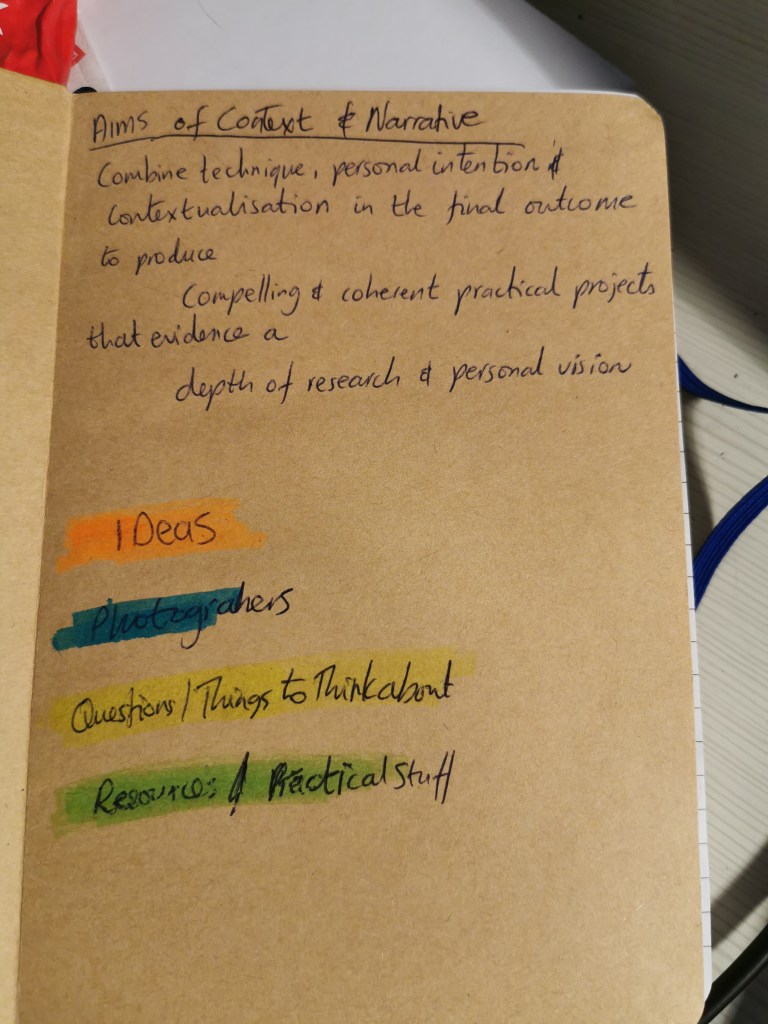
Colour coding – my notebook has been highlighted so I can easily identify different types of information at a later stage :
Colour coding in my notebook which helps me find things later on Extract from my notebook and how I am colour coding my notes for future reference and reflection
Ideas
Unit 1 5th Feb to 15 March
Travel to work each day so there will be down time waiting at some point in the routine : take a photo so you keep practicing and keeping composition skills alive – if at the same place each day you could evaluate the change over time
On my way to work there is wall art which would be good to photograph regularly because the plant at the top of the art changes with the seasons and therefore changes the art
A tree with daffodils underneath is also an image that could be taken regularly during my early morning commute and observe the change over time
iphone has the technology to produce long shutter or slow shutter speed silky water shots in a much shorter time so you don’t need a tripod or technical knowledge
When in a snowy scene (recent trip to Norway) shoot images that look black and white but arent, and have just a bit of colour in them
Pauline Goyard fine art portrait photography – create geometric portraits – create a big black cirdle in the middle of a white backdrop – dress the subject to complement this background
Tunnel photos – this could be created with family portraits for something different to display on the walls
Bradford dull winters day in the park, colours are very dull browns, greys and little foliage, this could form the backdrop and contrast to the amount of bright blue painted objects in the park such as sign posts, fencing and park benches and buildings
The architecture of derelict stark buildings that show their form ( recently saw these in Bradford) are a great theme for a series of black and white photographs
When I travel back to Zimbabwe, gather flame lilies ( my mother’s favourite flower) and recreate an image with the flower petals forming a frame around a printed photograph of my mother and re photograph this – inspired by the Nalini exhibition produced by Arpita Shah
Photographers
Unit 1 5th Feb to 15 March
Emil Pakarlis: runs a phone photography school – a mobile phone can be used to concentrate on, framing, teh subject, light and composition so you can practice on this – it frees up the distractions a DSLR camera brings. “editing is like applying make up, use it to enhance the natural beauty”
Robin Maddock (Our Kids Are Going To Hell, 2009), Engerland 2017 – British Documentary Photographer. The work was of drugs busts etc as he followed the police doing their work in the UK. The photos taken then would not be allowed or would be a lot more difficult to make nowadays with safeguarding policies, compliance and overparenting
“People like to look into a world/life that is not normal”
Pauline Goyard, fine art portrait photographer “you can spend so much time finding your style that you then end up being trapped in it” Has a great Instagram account for ideas. Her inspiration is Sue Bryce, her favourite photographer.
John Blakemore : a British photographer who held a book making workshop which a fellow student attended
Shona Grant is a photographer who has a very useful website full of resources and has been very helpful to a fellow student making a tunnel photo book
Aaron Schuman, John Clowe and Karl Blosfelt (nature and architecture) were mentioned by students at a study day I attended in Bristol
Daniella Zalcman – a documentary photographer based in London. She made work on the government operated Indian residential schools in Canada – interestingly she shot the photos on a phone and a film camera. It is called Signs Of Your Identity and they are double exposure portraits She also mentioned that only 15% of photographers are women which is a shocking statistic
David Alan-Harvey (Magnum Photographer) “Tell It Like It Is” done aged 23 and he lived with a black family in Virginia to document their lives. Growing up in a middle class family with a maid he became empathetic to their plight of apartheid and the injustices.
“Most people haven’t got a creative eye, you have to show them the product and give them a good service and show them”
“Art often stems from a personal struggle – so always be in a state of struggle to be creative”
“complete your work! only a few do this and you may fail and make mistakes several times but dont give up – it’s the small percentage success that defines you”
Mark Power (UK photographer) Magnum. 26 Different Endings (2007) London landscape – the Treasury Project (2002) restore a 19th century historic monument “A gallery collection of images is different to the images you would choose to make a book about the work”
“You can only really sequence about 6 images at a time, then take a break” In a series – can’t all be amazing wow photos – too shouty! You can have blank pages in a photobook. There is always that Mount Everest photo, the one you really struggled to get so you really want to include it – but no one else knows or cares so you need to be objective. You need filler images between the great ones.
Annie Collinge – fine art portraiture – her advice from Martin Parr : “when photographing strangers, do it really quickly for a more natural and less awkward situation for them”
Arpita Shah : Nalini Exhibition : the use of video for the artists statement was great for me as I like to take on information in this way rather than reading. Lots of great ideas about how to exhibit in this. Ie the social media wall, a huge image of the Taj Mahal.
Questions/Things to Think About
Unit 1 5th Feb to 15 March
Image storage : dedicate time each week to organise and structure images in a naming convention and tagging
Should I use my iPhone for serious photography work? Are the photos produced from my phone ok for printing?
How do we get candid shots of children nowadays in a world of overparenting, safeguarding and compliance?
Resources / Practical Stuff
Unit 1 5th Feb to 15 March
Get an underwater case for my Phone for holiday
Snapseed is a good app for editing
Pauline Goyard website is very good and full of resources – so is her instagram
Procreate App, drawing on a tablet with an epen
Snap Mad : large prints cheap 270gsm
Bristol Bound : book binders ( Tobacco Factory)
Womanphotograph.com : directory of female documentary and editorial photographers available for freelance assignments (all have a min of 5 yrs experience) – created by Daniella Zalcman
We hope that Part One has demonstrated to you that each photograph is a ‘point of view’ that depends on the time it was taken, the person who took it (no matter how objective they try to be) and the things outside the frame, unknown to the viewer, which may add or take away from what’s revealed in the frame. In this sense every photograph, regardless of its visual accuracy, is a manipulation of reality. A photograph cannot tell the whole story and is therefore part of a wider narrative. This is an important point that is often overlooked in the dissemination of news and facts in media and popular culture. Although photography has played an important role in providing information, for example in photojournalism and historical archives, we must take its context into consideration in order to fully understand the whole story. Now that you’ve reached the end of Part One, reflect on what you’ve learned in your learning log or blog.
● What was your idea of documentary photography before you worked on Part One? How would you now sum it up?
My idea of documentary photography before the start of this unit was that I could trust what I was shown in a series of photographs and engage in the accompanying narrative so I am better informed having engaged with the work.
After the first unit of this course I am learning that images can be presented in different ways to present instead a “version of the truth”. The image may be genuine but editing out certain images from a series, excluding or including certain components within an image and the context in which the images end up i.e certain tabloid newspapers vs a museum or National Geographic can drastically change the meaning of documentary. There were also examples in the coursework of The Farm Security Administration (1935 to 44) who were set up to look after the welfare of the farmers after the great depression in USA. Dorothea Lange produced some iconic images such as Migrant Mother. It was a known fact that photographers were sent out with specific instructions about what images to take and in what setting and certain facial expressions captured etc. So even nearly 100 years ago a version of the truth was being portrayed.
I also understand the nature of producing documentary photos has changes with the onset of mobile phone photography and social media. The cost of soliciting several people to take more “realistic” snapshot style images in an eyewitness style can come across as more genuine and credible but is also cheaper than paying a professional photographer to travel to a certain part of the world to shoot a particular event. Timing is also a factor in this style of photography.
Today the more traditional human suffering images have been replaced by something that is more eye catching such as Gideon Mendel’s work “Dzhangal” meaning “this is the forest” – a meaning for the Jungle, the refugee camp in Calais. He produced work of the objects left behind in the camp such as a collection of toothbrushes and a text book. Perhaps a method to differentiate himself and/or combat “compassion fatigue”
● What are the differences between documentary, reportage, photojournalism and art photography?
Documentary photography usually refers to a popular form of photography used to chronicle events or environments both significant and relevant to history and historical events as well as everyday life.
Reportage : The reporting of news, especially by an eyewitness. News or information of general interest that has been reported; media coverage of a topic or event.
Photojournalism differs from other forms of photography (e.g. documentary photography, street photography or celebrity photography) by its need to remain honest and impartial.
Art Photography a medium for creative expression. The goal of fine-art photography is to express an idea, a message, or an emotion.
This quick exercise is designed to introduce the idea of analysing and reflecting on the work of others, and to give you some material for your first learning log entry or blogpost. Here’s a selection of creative practitioners that you will encounter during this course unit: ● Elina Brotherus ● Gideon Mendel ● Hannah Starkey ● Nigel Shafran.
Choose one of these names and find a piece of work they’ve produced. Remember to reference the works you have chosen using Harvard Referencing, so it’s clear what you are looking at, who made it, and when.
Pick one of the pieces and briefly describe it. Consider its qualities by trying to describe it. What are the different elements within the work and how do these elements work together? What do you think the work is trying to communicate? Imagine you’re describing the work to somebody over the telephone. Try to do this in no more than 50 words. For image based work, what you’re doing here is analysing the formal visual language of an image. This is known as visual research or, sometimes visual analysis. Writing can be a useful tool in visual analysis, but you can also annotate images with notes.
Using the same piece, briefly write about how you relate to this work. Do you like it or hate it, find it intriguing, influential or outdated, and if so, why? Does the work connect to wider ideas or other creative practitioners? In other words, what’s your opinion on this work. Don’t worry about ‘getting it wrong’ or ‘missing the point’. Perhaps your reflection raises more questions than answers. Again, try to do this in no more than 50 words.
Use the text you’ve generated to create your first blog post or learning log entry. You may also want to be self-reflective by considering your experience of doing the exercise. Did you find it an easy or difficult task? Did it raise any interesting issues or areas you want to develop further? Write a sentence or two picking up on any of these points in your learning log.
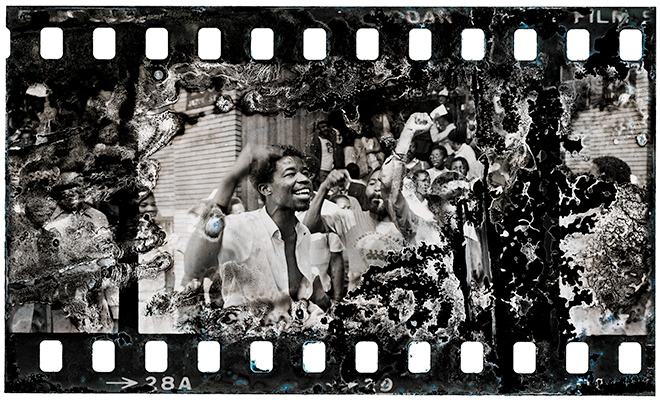
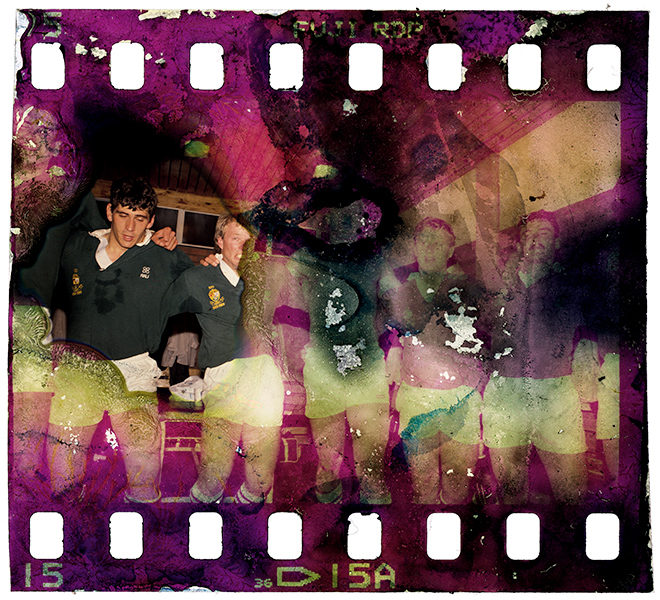
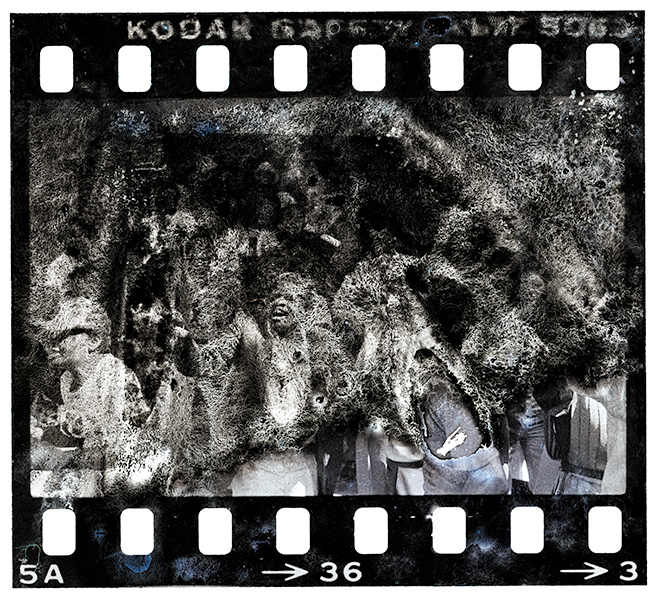
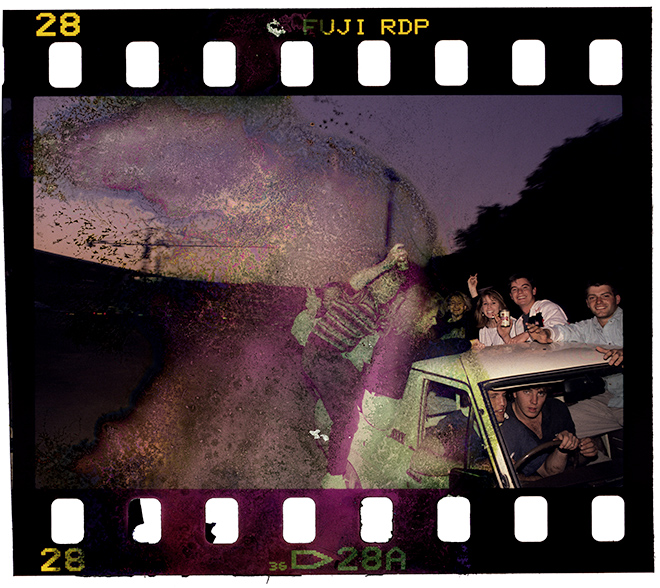
I have chosen Gideon Mendel and his work Freedom or Death
The images were taken during an intense period of war in South Africa from 1985 and 1989 at the start of Gideon Mendel’s photography career. The images depict a struggle for freedom by the indigenous people and the life of the white minority, this can still be visible by the subjects in these distorted images. The images appear abstract because the water damage has created distortions on the image, this adds to the aesthetic quality of the work. Mendel chose to include the negative borders in the images which connects it’s origins and ties in with the narrative about the damaged physical negatives over time.
I like this work because I am drawn the the material affectation of physical prints, this is just a variation on that theme. I like the abstract patterns created by chance to when the negatives were damaged, colourful quality where the damage occurred is attractive to me. I am drawn to this work on a deeper level, growing up in Rhodesia during a similar civil war and also witnessing this struggle first hand in the 1980’s whilst on holiday in South Africa, this work resonates with me on an emotional level. I was first drawn to the physical affectation of the printed image at my first student visit to the Blast festival in West Bromwich in 2019. Nilupa Yasmin takes images and cuts them into strips and weaves them together to create an abstract version as the final outcome. Nilupa Yasmin’s work “Where Can I Find This” was work taken at the Sandwell markets and then cut and woven together.
Nilupa Yasmin’s final outcome of work is physically affected through the process of weavingWoven images are grouped together to form larger more abstract images which I really like
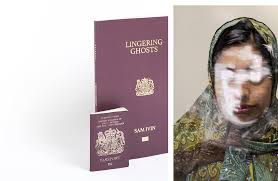
I was also drawn to the work of Sam Ivin, called “Lingering Ghosts” where he scratched out the faces of asylum seekers on printed images, as if to erase their identity, similar to what asylum seekers feel when in limbo, awaiting approval for residency. This work also represents a social struggle by a group of people and I am also drawn to social issues, which connects Gideon Mendel’s work to this I have previously enjoyed.
These scratched out prints produced by Sam Ivin for his work “Lingering Ghosts” are very moving and thought provoking
Sam Ivin’s Lingering Ghosts Work is also socially engaged and symbolises a struggle
Below are some images from Gideon Mendel’s Work “Freedom or Death” that I particularly liked. The captions are what accompanies the images on his website
Protestors outside the Congressof South African Trade Unions (COSATU) House, after a May Day rally in which COSATU demanded the day become a paid holiday and called for a nationwide ‘stay away’ protest by workers. One and a half million workers across the country, along with thousands of school pupils and students observed the call. —Johannesburg, May 1986Members of the RAU rugby team have a moment of prayer and bonding after winning a gameat the RAU Stadium. —Johannesburg, July 1989Protestors outside COSATU House. The first of May 1986, marked the 100th anniversary of International Labour Day, also known as May Day. —Johannesburg, May 1986Students from the Rand Afrikaans University (RAU) celebrate at the end of their annual RAG parade during their first week of university. —Johannesburg, March 1989Activists during a mass political funeral for youths slain in the so-called ‘grenade incident’ which took place in Duduza Township. Eight activists were killed when an undercover agent gave them booby-trapped hand grenades. —East Rand, Gauteng, July 1985
Their distortion speaking a deeper truth beyond the original documentary format.
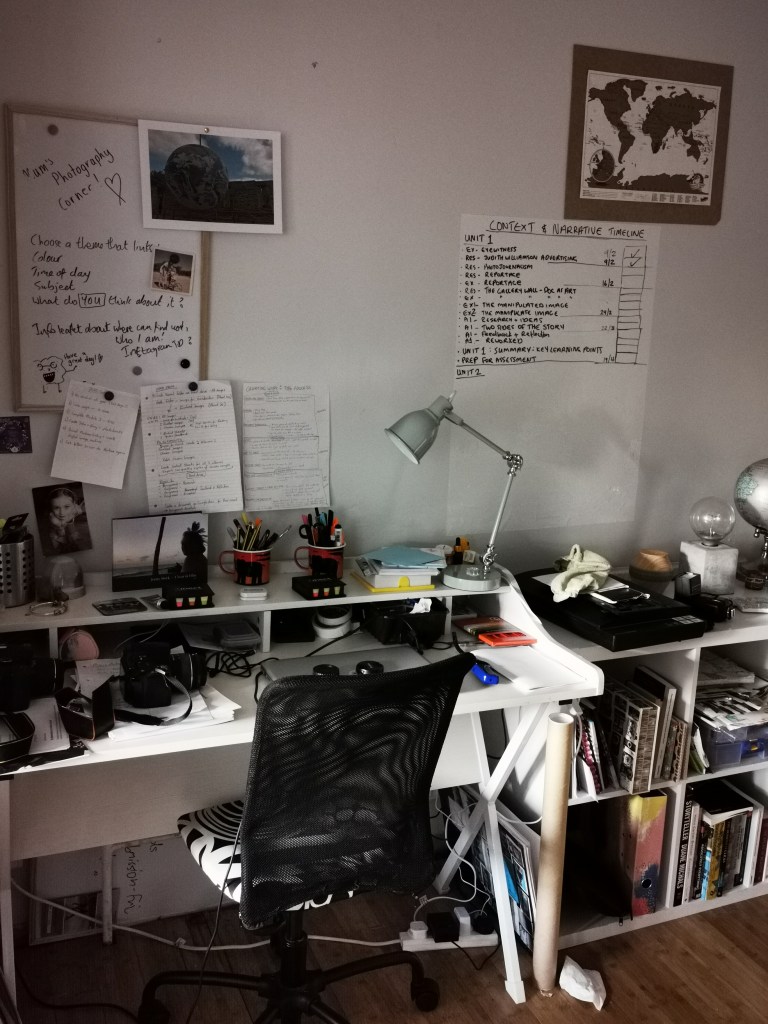
I have checked through the list of resources for this course and I have recently created an area for my studies at home, it has a wall I can use for images I want to live with and consider when making work, I have some temporary flip chart paper that sticks to the wall which I have found extremely useful.
Photoshop is something I need to get to grips with and so I am considering an evening class for this which starts in April.
I don’t currently have lots of space for a portraiture, ideally it would be great to have this space so I have a permanent backdrop set up for this purpose, I will have to think about how I can do this.
I need to sort out my printer as I find this really valuable when sequencing and deciding which photos go together as a seriex. The printer needs to be in this room ideally, it is currently in another room.
My work area for my studies, I have organised my books and equipment so I can find everything easily. I like the whiteboard plastic sheets I can write my work schedule on so I stay focused on completing work to the timescales I have set myself.
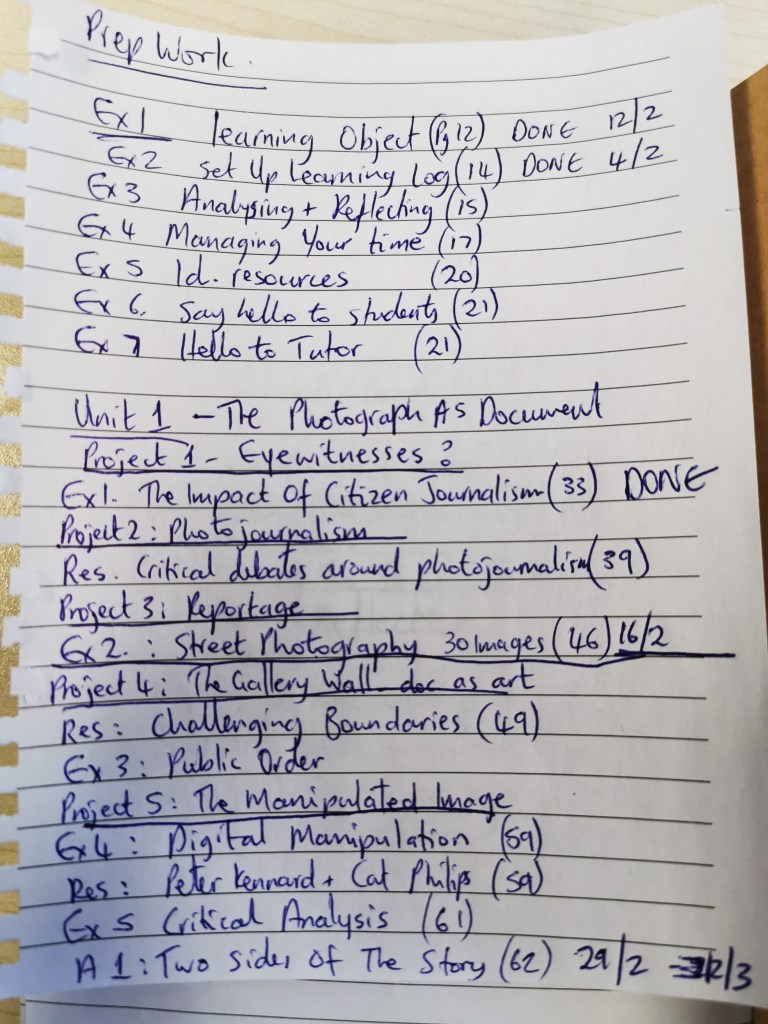
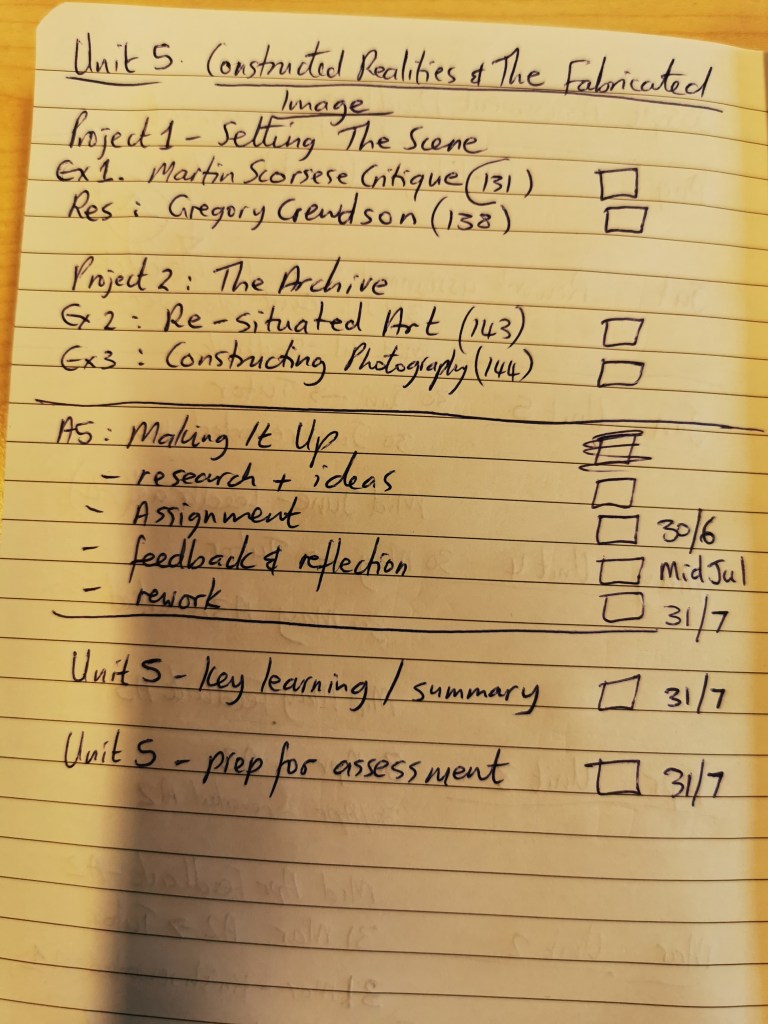
Balancing a job, a family and study needs careful planning to make sure the work gets done. With this in mind I created a list of all exercises, research, assignment work and reflective work for each unit so I can keep track of what needs to be done and tick it off as it is completed. I have put my list of work for my first unit above my desk at home to keep me focused on what needs to be done
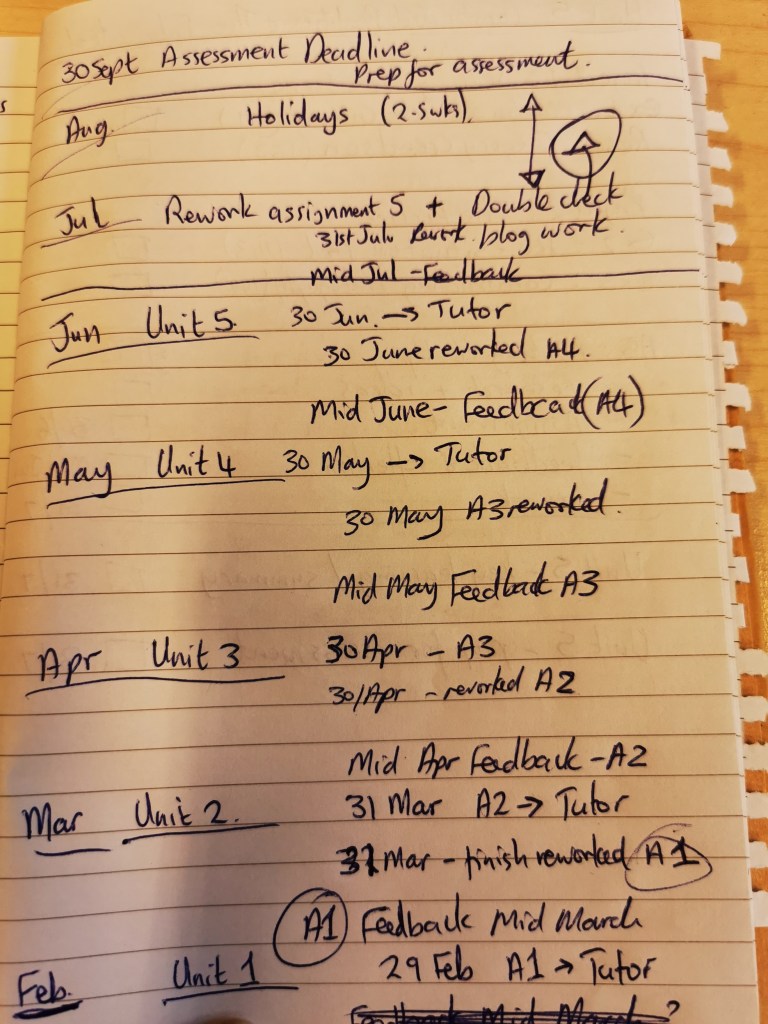
Assessment deadline date for submission is 30th September for November and this is what I am aiming for. I have 5 units to complete so I have given myself a deadline for submitting the assignments and also when I should aim to get feedback, I have planned that each assignment it sent to my tutor at the end of the month, so A1 is with my tutor at end of Feb, A2 is at end of March – so A5 will be end of June. I have assumed that it will take two weeks to get feedback ( middle of the following month ) then I have another 2 weeks to rework based on tutor feedback, so the reworked A5 will be complete at the end of July 2020. I have a summer holiday for 2.5 weeks so I have about 6 weeks to prepare for my assessment submission at the end of September.
During a typical week I plan to work on shooting photos every day for practice of composition skills ( on my way to work in the mornings during the week ) Weekday evenings will be used for coursework (exercises and research and reading) and Sunday mornings and Mondays will be used for assignment work ( I don’t work on Mondays)
The photos below are extracts from the back of my notebook where I have planned my studies, I will tick off work once completed so I know I am on track and where I am in my studies to stay in control of time management.
Context And narrative Timeline to get work done for November Assessment Prep work and Unit 1 Timeline – as each bit of work is done it will be ticked off the list – I will have a copy of this on my wall above my desk as well as my notebook. My notebook is with me all the time so I can review it any time I have a spare moment – it’ in the back of my notebook so it doesn’t get lost among other notes Unit 2 list of work to be done with a tick box for when completed – it would be really handy if these were appendices to the coursework that could be used by students to manage their work instead of me having to write this down like this I have created a process for producing my assignments that works for me, these headings are replicated in my blog so each stage is a separate blog, the “rework” blog is the final version of the assignment that gets sent to be assessed Lesson learned from my first module, I will now write a summary of each unit before moving on to the next and will make sure all work for assessment is prepared before moving on I need to aim to complete all work by the end of July to give me time to prepare for assessment to the standard I want to achieve, my first assessment was a rush and was stressful so I want to avoid this with this module
Read the section entitled ‘The Real and the Digital’ in Wells, Liz. (2009) Photography: A Critical Introduction (4th edition). Abingdon: Routledge, pp.73–75. You’ll find this on the student website. Does digital technology change how we see photography as truth? Consider both sides of the argument and make some notes in your learning log.
The Real And The Digital (Liz Wells – Photography, A Critical Introduction)
The convergence between computing and audio-visual technologies has, as we all know, produced new kinds of digital media which are transforming the means of image-making together with its social, commercial and aesthetic practices. Here, we need to note that digital media -with its ability to create, manipulate and edit images – has given new prominence to arguments about the nature of photography and taken them into the popular domain. These may briefly be summarised as: questions about the nature of the photographic image; about new ways of defining and understanding ‘the real’ that are brought about by processes of globalisation and postmodern philosophical positions, and, finally, questions about the relationship of photography to other media. It is now clear that images with all the appearance of ‘real’ photographs may have been created from scratch on computer, montaged from many sources, altered in some respects, or radically transformed. Figures may be added or removed and the main constituents of the picture rearranged to suggest new relationships or bizarre conjunctions. Does all this not destroy the claim of photography to have a special ability to show things as they are and raise serious doubts about those genres with a particular investment in the ‘real’ -documentary and photojournalism? We can, of course, observe that, as we have already seen, the manipulation of images is nothing new and that photographs have been changed, touched-up or distorted since the earliest days. But we are not looking here merely at a technically sophisticated way of altering images, but at much more profound changes that challenge the ontological status of the photo-graph itself. If a photograph is not of something already existing in the world, how can we regard it as an accurate record of how things are? Roland Barthes’ influential conception of the nature of the photograph, is that it is the result of an event in the world, evidence of the passing of a moment of time that once was and is no more, which left a kind of trace of the event on the photograph. It is this trace which has been considered to give photographs their special relationship to the real. That is that they function, in the typology of signs offered by the American semiotician, C.S. Peirce, as indexical signs. The nature of the sign within semiological systems is important, but it is interesting to note that we have always known that photographs are malleable, contrived and slippery, but have, simultaneously, been prepared to believe them to be evidential and more ‘real’ than other kinds of images. It is possible to argue that the authenticity of the photograph was validated less by the nature of the image itself than through the structure of discursive, social and professional practices which constituted photography. Any radical transformation in this structure makes us uneasy about the status of the photograph. Not only do we know that individual photographs could have been manipulated, but our reception and understanding of the world of signs may have been transformed. Writing in the French newspaper Liberation, in 1991 the social theorist, Jean Baudrillard famously remarked that ‘the gulf war did no t take place’ (Baudrillard 1995). He was commenting on the nature of the real and the authentic in our time and suggesting that .in t he world of th e spectacle, it is pointless to posit an external reality that is then pictured, described and represented. In his view everything is constructed and our sense of the world is mediated by complex technologies that are themselves a major constituent of our reality. What took place, then, was not t he first Gulf War but a whole sequence of political, social and military actions that were acted out in a new 74
kind of social and technical space. While this may be an extreme way of formulating the argument, it is clear that a complex of technical, political, social and cultural changes has transformed not just photography, but the whole of visual culture. For example, David Campany points out that ‘almost a third of all news “photographs” are frame grabs from video or digital sources’ and comments that: The definition of a medium, particularly photography, is not autonomous or self-governing, but heteronymous, dependent on other media. It derives less from what it is technologically than what it is culturally. Photography is what we do with it. And what we do with it depends on what we do with other image technologies. (Campany 2003: 130; emphasis in original) One significant consequence of this has been a new merging and lack of definition between photographic genres. It is increasingly difficult to distinguish one kind of photograph practice from another. As we shall see later, titles, such as ‘documentary’ are of little use as labels for the new kind of work that is being produced. Indeed, all descriptive titles have been freely appropriated and find themselves used in curious couplings, for example, one sub-genre of photography now well established in the USA is that of’wedding photojournalism’.
Notes taken that I found interesting :
The American philosopher and semiotician John Deely said that “objects” are dosed with human experience – when they are photographed they become “signs” – he believes that photographing objects can never be the truth because of this. As soon as we photograph somethng they become objects of our experience. The interpretation of all objects is affected by human experiences
David Campany has stated that a third of all news photographs are screen grabs from videos or a digital source
“Photography is what we do with it” – David Campany
A consequence of digital technology is a new merging of traditional photographic genres – documentary photography is of little use now as a label for the new kind of work that is now being produced – new terms such as wedding photojournalism and citizen photographer have emerged
Social networks are now acting as publishers of photographers, several informal photographs are taken and uploaded around the world rather than the tradtional way of days gone by – mainstream media are accessing them and using them as events unfold
Foreign news and hard news has been squeezed for resources and squeezed for space by cheaper and more advertising friendly features on lifestyle, products and celebrity – coupled with the fact that some governments restrict formal photographers in scenes of conflict, so the rise in demand for the amateur photographer is a result – to add to this, the photo that appears amateurish may come with more authenticity and credibility than a professional photo
There is still room for professional photos of conflict and hard news images of professional quality but even this changing to the storage and transport in a digital format rather than print
Thoughts and Reflection
I believe that photographs, whether in the digital age or when the first documentary work was made, there is always a version of the truth produced because the person making the work will be affected by his or her own life experiences and this will result in what they choose to photograph and what not to, what they decide to include in the frame and what to omit. These elements can alter the narrative drastically but can still be an image that has not been digitally manipulated.
I believe that eyewitness photojournalism can be a good thing because news is communicated almost instantly and in this world of instant gratification it has become an expectation. Fake news is on the rise and also the amount of time we spend reading short, sound bite news items, this can lead to misinformed paranoia and anxiety.
Mobile phone photography and the use of AI in phone photography will, I believe replace the large pro DSLR cameras in the next 10 years. Current phones can take night photos and bring deatil into an image that is not apparent to the human eye, AI will search millions of similar images and in 4 seconds will rectify the image being taken to produce the best version automatically. Mobile phone companies are currently competing is by the quality of their camera, there are hundreds of experts working to improve this phone feature and not anywhere near that much resource is being applied at Canon or Nikon to improve their product in the same way.
Photography is not about taking a technically perfect shot, it is in the words of David Campany “what we do with it” and this will become even more prominent when anyone can take a technically perfect shot because of the advancement in technology.
The bullet points below explain my learning objectives for this module, I have also attached a link to an summary of key learning points from the first module I have completed, “Expressing Your Vision”
This is my first experience learning about documentary photography so I am keen to learn as much about the subject as possible so is a wide open learning objective. I am interested in social displacement having grown up in Rhodesia and Zimbabwe then moving from Zimbabwe to the Uk at 21 years old, how different cultures settle in the UK and the preservation of heritage, of life and times gone by that need to be remembered for future generations. Preserving memories is very important to me.
Gaps in my knowledge is around narrative in my work, prominent documentary photographers, the use of photoshop to name a few, being relatively new to photography I have lots of gaps across the board
Areas to expand would be the ability to effectively store, retrieve and edit my work and to work better from contact sheets. I would like to improve how I select work and why, and what to look for to make a series coherent visually and in the narrative
I have never produced black and white work so I am looking forward to exploring this and understanding when is best to use it and in what context.
The preparation for my first assignment was stressful as I left everything to the end, I now have a structure in place for what I want to submit for each unit. I will make sure all work for assessment is prepared at the end of each unit to save time and make sure the quality of submission is the best it can be at the end, plus printing is expensive so it makes sense to do this as I go along after I have reworked assignments based on tutor feedback
Lastly, I started to use a photography sketchbook in my last module “Expressing Your Vision” and this was useful in formulating ideas for assignments. I would like to use this more in this module and from the outset rather than part way into the module. I also didn’t use a notebook as well as I could have in the previous module, this is something I have already started using, I carry this everywhere with me and it will be a very useful resource when I plan to summarise key learning points after each unit, it is also a place to store ideas and inspirational images ( I also have a swipe file on my website )
My first introductory call with my tutor was extremely useful today and these are the notes I took during the conversation which I will follow up on:
Photography (theory) is a new concept to me – don’t look on it as ‘theory’ as such more like articulating and summarising how and why images communicate. Functions: Terry Barrett.
Grids
Social aspects of photography – the core of what we do. Do you mean documentary style or uses of photography i.e. family photos, giving voice to the subject? Photo-Voice? Socially Engaged Photography – Jim Goldberg, Julian Germain
Pst colonial activities in Zimbabwe and preserving the cultural heritage of people who once lived there – you could follow this path even in level one (may not mean going to Zimbabe) but exploring cultural difference and the way power and representation work.
First assignment at the end of February ? No rush. Make it diagnostic.
Plan complete this module by August to submit September for the November assessment if possible.
Rose, G (2003), Visual Methodologies, Sage. – this book is quite heavy and designed for a second year degree student but is very useful to dip into – begin with this in preparation for the first assessment. If students don’t have a good grounding in analysing photo theory they will struggle in the later levels of degree. My tutor began studying photos as if peeling off the layers of an onion.
The meaning of a photograph is not already there, it is up to the photographer to put that meaning there – there will be some people who wont understand the meaning and so photos are for some viewers and not for others
Perfectly doable so long as you avoid – some students are fond of – ‘hoop jumping’ other than reflecting on your work and learning. I doubt that this will be you from just a cursory read of you blog.
This saves hunting through e-mails and my records and is a professional way to work.
Bullet point main points to summarise (assessors love that) – my tutor was pleased with my writing style that it was to the point and concise which means he thinks I will do well in this module, I hope so!
Narrative the big issue! many types. Broadly the standard (Aristotle ) beginning middle and end or a more ‘associational’ (based on form) poetic links rather than cause and effect ‘picture essay’.
The two are explored most succinctly in Jörg M. Colberg’s Conscientious Photography Magazine : https://cphmag.com/narrative-1/
Effectively store, retrieve and edit my work and to work better from contact sheets. Colberg software Lightroom or Capture One. Western Digital could be a hard drive to get
Workflow systems
Zimbabwe_JS001 – make sure you have a good method of cataloguing from the start to save time and frustration in years to come
Photo Rescue
Photographers Sketchbooks recommended
The viewer first sees a collection of shapes that go together well – visual first and then context and narrative follow






 Jenny Stork: Photography 1: Context & Narrative