My tutor suggested further reading around editing and sequencing of images, this is an area I need practice and to develop an effective techniqe
Some notes I took from the book so far :
The book’s concept is very important
Elements of the story can be introduced at first without being related – the viewer trusts the author that the story will be revealed later on in the book and they can make sense of the photos – eventually things will start to relate to what has been seen before
Use double sided tape so can attach and remove images either from a wall or a dummy book
Dont put too many different layouts and image sizes for different spreads
Start edit and sequence and simple layout with a basic dummy – and then when happy refine other bits.
Simple decisions and ideas lead to a complex and truly immersive book – Mariela Sancan (Moises) – the book is unfolded to discover portraits of an old man in his 70’s – her dad died from suicide and this searching experience in the book reflects her pain.
Design :
How a page works
How to pace information
How text can support an image and vice versa
Design is not what the photographer wants but what the work in question demands
Most photographers are not trained designers- approaching a professional designer early on in the process is a good idea – find graphic and physical manifestation of your photographic ideas
Tien Van Der Heijden – Dutch Designer
2 books on either side of the design spectrum : Walker Evans – American Photographs and Interrogations, Donald Weber
A designer that knows how to read the language of photography can have input on the editing too
Design helps telling the story in a physical form that adds to the intention of the story
Limited budget will force you to enhance the essentials and the basic elements – often making the work stronger as a result
The Dutch Photobook – Aperture 2012
The photobook, A History – Martin Parr
Kuipers 10 golden rules pdf
Physical aspects : the colour cast across a book especially if its a budget print
Choice of paper, type of printing and type of binding will all affect the outcome
Perfect Binding – a common cost effective binding, restricts opening – avoid detail close to the middle – there is no perfect binding option and with age a physical object will deteriorate no matter what the quality of binding used
Richard Benson describes the difference between a photobook and an exhibition :
“How naive are we to think that we can see it all at first glance when hung on a wall or on a computer monitor. The book solves this problem, we can look long and hard without distraction and return to it again and again. Photographs can become like old friends, and like the best of them they can reveal themselves endlessly as we come to know them better”
In my own work
I need to start to print out my work and get the editing and sequencing part of my work better – put images on the walls and live with them
Need to find a partner that can critically evaluate my work and I can work with going forward
Become familiar with a number of photo books to inform your own work – try to understand whether they work, how they work – how their different elements come together and how design helps to support the work
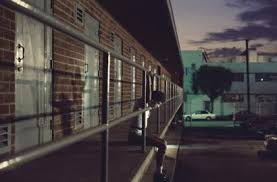
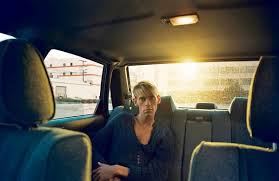
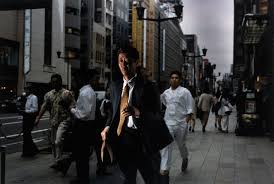
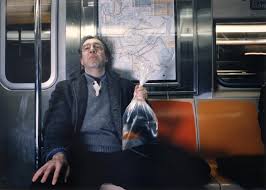
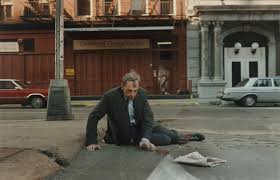
Feedback from my tutor about assignment 1 suggested further reading into the work of diCorcia- his method was to set up a camera a distance from where he is located and use a remote control to operate it, so people are photographed without their knowledge in a completely natural state
The main points I noted from watching the youtube video were :
The method of making work was to :
Set up the lighting rig and the scene ( the dramatic elements)
Use a polariod with actors and construct the scene in advance and test the result
Let the subject walk into the frame – these can be either known or unknown people
I classify people into different archetypes, most of the time they are not like that but I manipulate them to be like that.
To photograph people in the street effectively you have to sensitise yourself to the subtle clues
A photo captures a moment of truth and diCorcia operates to disrupt this completely
Often he didn’t know his subjects because of his methodology
The interior of a person is very different to the exterior, “life is a performance”
Because of the physical distance from which the images are taken, this gives the viewer alot of authority to interpret and experience the images in the way they want to.
The eye level cinematic approach to making his work is what draws the viewer in and makes them more real and engaging
The idea you can manipulate people and the world in this way is an interesting and compelling motivation for me.
For my own work: this was a very quick diagnostic assignment, diCorcia took over 3000 images to make a series of 17 – so lots more work and photos needed to be able to create something I am happy with
Setting up with a tripod, perhaps at a cinema style level which is square and a level aspect would give more impact – use a remote for taking the shots
Think about lighting, this has a huge impact on the feel of the image
Street photography has become more difficult over the years in the UK with an increasing amount of suspicion around the intent when a photographer is seen on the streets with a large, obtrusive camera. The duty of care over children and the use of their images on the internet has also become an issue, however, a public space is a space where it is legal to take photographs in the UK, for now anyway.
My approach to making this work was to simply stand at a distance from my subject and photograph the buildings next to them so the camera was not facing them directly. After a while my subject became used to me and thought I was not photographing them. I would move my camera occasionally towards them and take the shots quickly as people entered the frame, then move it back towards some buildings again. This took about twenty minutes and some patience. I wanted to capture the same scene but different reactions from people walking by, hence what appears to be a similar photo, but is in fact not because of the interactions that are going on within the frame between those on the margins of society and those who are not.
Ideally I would have liked to introduce myself to the subjects and asked their permission, but in this instance I felt the purpose of my shots were totally in my interest and not theirs. Reflecting on the situation, the activity could have been mutually beneficial where I could pay them cash perhaps? There is still no guarantee that this approach would have been received well.
I am interested in social change for the better for all people and have a particular empathy for the homeless, I admire artists such as Anthony Luvera and Lee Jeffries who spent time with the people and treated them with dignity and respect and built up mutual trust before they embarked on a collaborative photography project. The projects also generated income for better support for them and also changed the way councils are obligated to support the homeless in the UK. This, ideally is how I would want to approach an activity such as this, but since it was just for an assignment at this time I chose the anonymous route this time.
Feedback from my tutor on this assignment was to link this blog to my assignment in its bibliography so there is a better understanding by the reader about how I made the work.
For my own work: this was a very quick diagnostic assignment, diCorcia took over 3000 images to make a series of 17 – so lots more work and photos needed to be able to create something I am happy with
Setting up with a tripod, perhaps at a cinema style level which is square and a level aspect would give more impact – use a remote for taking the shots
Think about lighting, this has a huge impact on the feel of the image
Understand fully the different street photography techniques and with practice and experience develop a style and approach that reflects my values and interests, currently I prefer the collaborative way in that the process has a positive impact on everyone involved, however, the practicalities of this approach at present inhibit me.
Additional feedback is to research the work of :
Street Photography Alternatives: Placing the camera (on a tripod) and allowing people to walk into the frame (might help less conspicuous when making the ’objective’ images/ Passer by • David Campany. 2020. ‘Anonymous And Incognito: Walker Evans’ – David Campany.[online] Available at: https://davidcampany.com/anonymous-and-incognito-walker- evans [Accessed 23 March 2020].
• Lorca diCorcia, P. (2014). The Hepworth Wakefield: Photographs 1975 – 2012 . [online] Available at: https://www.youtube.com/watch?v=So_FK4qnz5Q [Accessed 21 March. 2020].
Below are key notes from recommended reading from my tutor after my A1 submission.
Photographs are segments excised from large real-world situations
Photographs are instants frozen from a real-world temporal flow
We ought to replace a pictured segment back into the unpictured world – we need to do this to understand what a photographer has done and what the picture is about
Understanding the difference between a picture and the reality of where the picture was made is essential to understand and appreciate the photograph
Understanding the difference between a picture and the reality from which it was made is essential to understand and appreciate the photograph
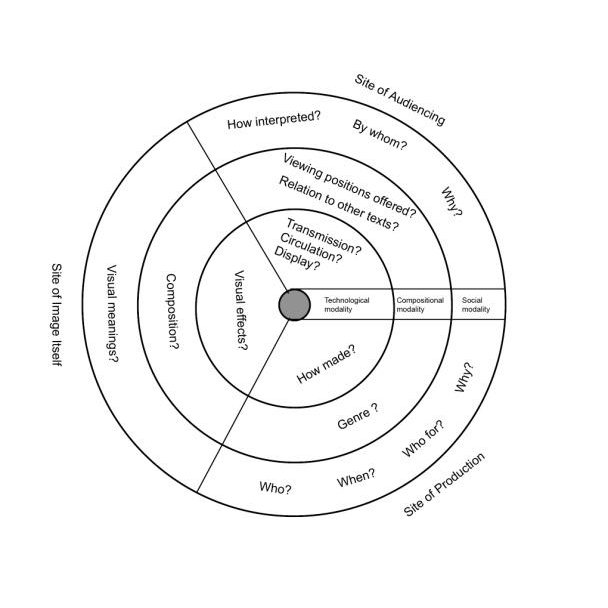
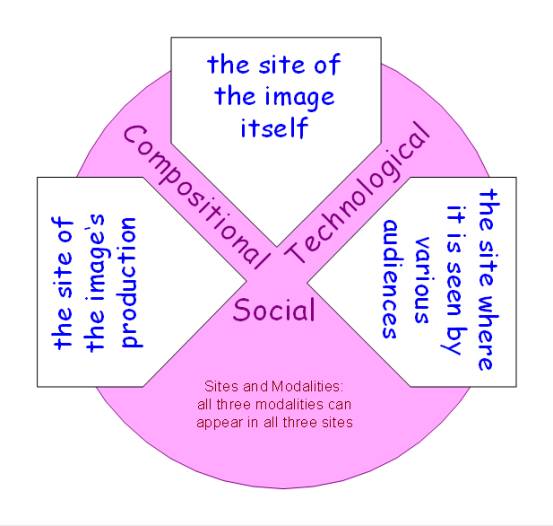
Internal context : that which is given in the photograph – how form and subject combine to express – this is an obvious starting point for any photo – methodologies for investigating the apparent in a photo need to be considered – some photographs only need internal context to understand their meaning, a general knowledge of culture and careful attention to what is being shown is enough. Depth of field, ISO, exposure and other technical aspects are also used to express meaning and need to be considered too.
Original context : refers to what is broadly physically and psychologically present at the time the photographer made the image – the photographer’s intent, the intellectual, sytlistic and imagistic thoughts of the photographer. Knowledge about circumstances surrounding the photograph makes it more than what is obviously displayed and therefore more meaningful.
External Context: refers to the photographers presentational environments – how and where it is being presented, how other interpreters have understood it and where it is placed in the history of art. The meaning of any photo is highly dependent on the context in which it is placed.
Learning how critics and historians think and work and sometimes adopting this approach may benefit students
Students should examine how presentational environments influence the meaning and understanding of a photo
Photographer, editor or curator who has put text next to a photograph? Students should seek to know this to understand the meaning of the image
An editor or curator are forms of interpretation only and are therefore not part of the photo
Take advantage of alternative viewpoints when studying a photo
Simple name, date, title, medium, size and source of the reproduction are clues to the meaning
An untitled photograph could be considered a work of art because there is no title
What was going on in the art world and social and historically when the photo was made?
The photographer can alter the meaning and emotional effect of a photograph by surrounding it with other photographs
Curators arrange photographs for new theoretical insights and greater emotional impact.
Presenting written work explaining my approach needs to be more structured and a way of doing this is to use CONTENT : FORM and CONTEXT
When images are submitted for assignment they need expression and analysis to accompany each one as to their “meaning”
Name and caption images for submission and also the number in order of sequence – also provide a screenshot of what they need to look like or print out and display how they should look, then take a photo of this layout and submit with the assignment.
Sequencing and editing process of :
– Eliminate technically imperfect from contact sheet
– Print small images and sequence and edit manually
– Naming files in their preferred sequence
– Send annotate contact sheet and sequenced outcome of the series to tutor
Keeping a notebook has really helped with ideas, notes and photographers I have come across. Summarizing it each month is a useful exercise too
Look at a more structured approach for the research part of my preparation for an assignment based on Tutor feedback
In the bibliography of the assignment submission : add a Harvard referenced link to a blog, for example, of how the images were made so the assessor can understand how you have applied certain techniques to this assignment
Attach a bibliography to your main assignment submission that contains all related work to the preparation of the assignment so that the assessor and your tutor can easily see what has been done to prepare for the assignment
This blog lists all photographers mentioned in Unit 1 and a brief description of their work or why they are important to this unit. Unit 1 is about photography and the truth.
Judith Williamson’s ‘Advertising’ articles in Source photographic review provide an excellent example of a critical approach.
Joachim Schmid is an example of an artist who adopts a thoughtful approach to photography. He is a German artist who had been buying photographs in large quantities from flea markets for years (he has over 100,000). When Flickr was invented he moved from collecting on the street to collecting online.
Jeff Wall have become renowned for their painstaking attention to detail when creating the narrative of the individual image. (A better word in this context is mis-en- scène, a term used in film for the set and construction of the scene.) As on a film set, every prop, dress and character is there for a reason: all contribute to the overall narrative of the image.
Rexford Tugwell and Roy Stryker set up the Farm Security Administration – agency to look out for the farmers who had suffered from the great depression 1935 to 44 – photographers who worked for the FSA were Walker Evans and Dorothea Lange (Migrant Mother (1936)
Lewis Hine used photography as a vehicle for social reform – raise awareness and promote change (1874 to 1940) eg. the law on child labour
Gideon Mendel “Dzhangal” the origin of the term “the Jungle” which is a name used for the migrant camp in Calais. His work is of alternative portraits such as a group of toothbrushes or a child’s school text book
In her 1995 essay “Inside/Out” Abigail Solomon-Godeau (2017) argues against a binary insider/outsider approach to documentary photography – look at the subject from a distance but offer some sort of “truth” – Robert Frank (The Americans) and Ed Ruscha’s work are good examples of this.
Roger Fenton, one of the earliest war photographers photographed battle scenes with dead bodies and took portraits of soldiers in quieter moments
David Campany Essay – “Safety in Numbness” 2003 – sets out concerns of aftermath photography and if it conveys the complexity of political events
Joel Meyerowitz, official photographer for 9/11 – Campany considers his work too safe and beautiful therefore not fitting for depicting the horrific actions of terrorism.
2002 Paul Seawright commissioned by the Imperial War Museum to make a series of images of the war in Afghanistan – he adopted an aftermath approach – deviod of action
Paul Seawright also made “Sectarian Murders” in 1988
Edgar Martins, A Room at 14 Baldwin Farms South (2009) showing an empty house in US after the financial crash – reportage photography
Henri Cartier Bresson’s The Decisive Moment fits in nicely with Reportage photography – its about all the components coming together within one frame to speak of something beyond the frame
Dana Lixenberg – Imperial Courts (1993 to 2005) photographed the residents of Imperial Courts in Los Angeles – an African American estate – she photographed families for 22 years – she was determined to tell the story of these people’s lives from a different angle to the one dimensional reportage happening at the time. The area had been wrecked by racist riots and she was asked to document the reconstruction of the area.
1967 John Szarkowski curated the show New Documents at Moma – aim to show new kind of documentary photography in America and he selected Lee Friedlander, Dianne Arbus and Garry Winogrand to make his point – photography can also be considered as art and not purely as a document
Tate Modern first photography exhibition in 2003 – Cruel and Tender. Examining photography’s relationship with realism. August Sander, Lewis Baltz, Philip Lorca DiCorcia and William Egglestone demonstrate diverse nature of photography and it’s relationship with the truth.
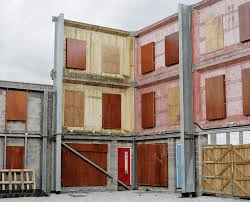
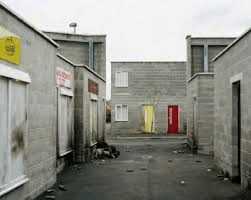
Sarah Pickering “Public Order” (2002 – 5) work about a deserted artificial town for police to use for riot training – this documentary style challenges what is real
Alessandra Sanguinetti is a Magnum photographer – her series “The Adventures of Guille and Belinda and the Enigmatic Meaning Of Their Dreams(2016) ” she documents the lives of two young girls growing up, their relationship as sisters and their lifestyle in South America – she interprets their imaginative play and dreams into visual depictions of fantasy. This documentary style challenges what is real
The Cottingley Fairies taken by Elsie Wright (1917) and Frances Griffiths who claimed they played with and took photos of fairies in their garden. It became a subject of debate for decades and it wasnt until the 1970’s that the hoax was confirmed.
Oscar Gustav Rejlander (1813 -75) became known as the father of art photography and the master of photomontage. His work “Two Ways Of Life” (1857) was made using over 30 separate negatives and depicts the life of a sinner and the life of a saint in one highly elaborate tableau.
Peter Kennard and Cat Phillips (2002 -19) Photo Op series and their photomontage work (digital manipulation)
Wendy McMurdo – “Young Musicians” (1998 -2013) photographed young musicians and later digitally removed the instruments so the viewer is forced to observe the psychological state of the child.
It was recommended a notebook is kept to record various aspects of my course and photography in general. I have kept this with me and I have found it very useful to jot down things that spring to mind that I don’t want to forget. I have also listened to photography podcasts on my journey to work such as one called “A Small Voice, Conversations With Photographers.” I have gained a huge amount from listening to these and have noted interesting things in my notebook.
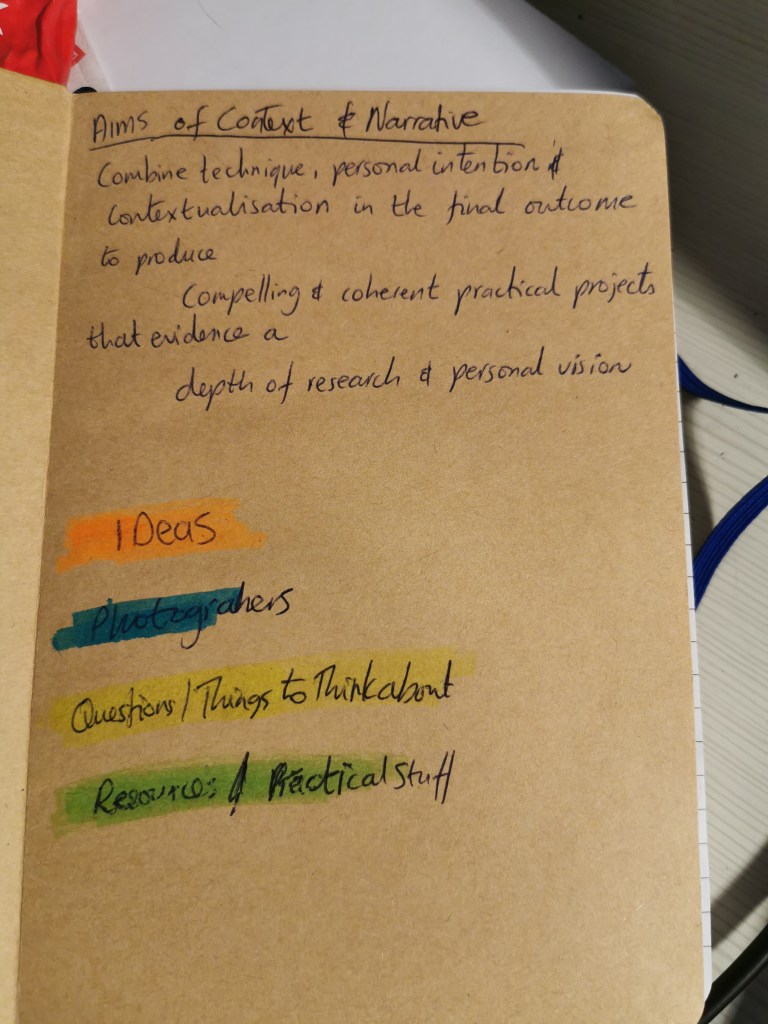
Colour coding – my notebook has been highlighted so I can easily identify different types of information at a later stage :
Colour coding in my notebook which helps me find things later on Extract from my notebook and how I am colour coding my notes for future reference and reflection
Ideas
Unit 1 5th Feb to 15 March
Travel to work each day so there will be down time waiting at some point in the routine : take a photo so you keep practicing and keeping composition skills alive – if at the same place each day you could evaluate the change over time
On my way to work there is wall art which would be good to photograph regularly because the plant at the top of the art changes with the seasons and therefore changes the art
A tree with daffodils underneath is also an image that could be taken regularly during my early morning commute and observe the change over time
iphone has the technology to produce long shutter or slow shutter speed silky water shots in a much shorter time so you don’t need a tripod or technical knowledge
When in a snowy scene (recent trip to Norway) shoot images that look black and white but arent, and have just a bit of colour in them
Pauline Goyard fine art portrait photography – create geometric portraits – create a big black cirdle in the middle of a white backdrop – dress the subject to complement this background
Tunnel photos – this could be created with family portraits for something different to display on the walls
Bradford dull winters day in the park, colours are very dull browns, greys and little foliage, this could form the backdrop and contrast to the amount of bright blue painted objects in the park such as sign posts, fencing and park benches and buildings
The architecture of derelict stark buildings that show their form ( recently saw these in Bradford) are a great theme for a series of black and white photographs
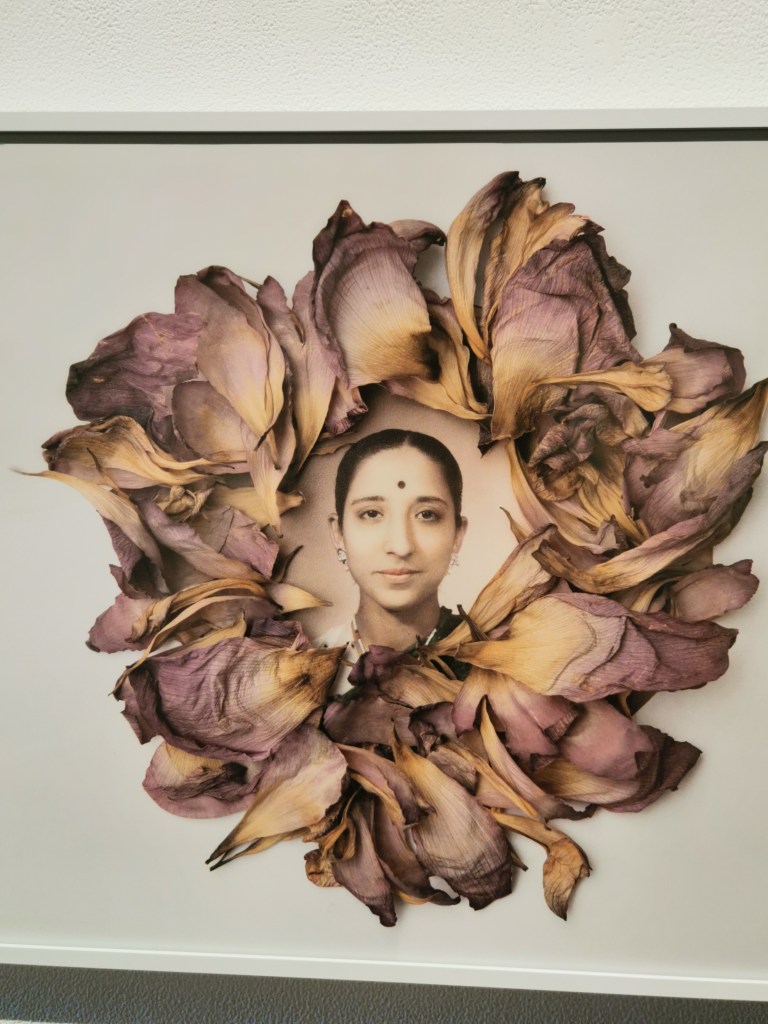
When I travel back to Zimbabwe, gather flame lilies ( my mother’s favourite flower) and recreate an image with the flower petals forming a frame around a printed photograph of my mother and re photograph this – inspired by the Nalini exhibition produced by Arpita Shah
Photographers
Unit 1 5th Feb to 15 March
Emil Pakarlis: runs a phone photography school – a mobile phone can be used to concentrate on, framing, teh subject, light and composition so you can practice on this – it frees up the distractions a DSLR camera brings. “editing is like applying make up, use it to enhance the natural beauty”
Robin Maddock (Our Kids Are Going To Hell, 2009), Engerland 2017 – British Documentary Photographer. The work was of drugs busts etc as he followed the police doing their work in the UK. The photos taken then would not be allowed or would be a lot more difficult to make nowadays with safeguarding policies, compliance and overparenting
“People like to look into a world/life that is not normal”
Pauline Goyard, fine art portrait photographer “you can spend so much time finding your style that you then end up being trapped in it” Has a great Instagram account for ideas. Her inspiration is Sue Bryce, her favourite photographer.
John Blakemore : a British photographer who held a book making workshop which a fellow student attended
Shona Grant is a photographer who has a very useful website full of resources and has been very helpful to a fellow student making a tunnel photo book
Aaron Schuman, John Clowe and Karl Blosfelt (nature and architecture) were mentioned by students at a study day I attended in Bristol
Daniella Zalcman – a documentary photographer based in London. She made work on the government operated Indian residential schools in Canada – interestingly she shot the photos on a phone and a film camera. It is called Signs Of Your Identity and they are double exposure portraits She also mentioned that only 15% of photographers are women which is a shocking statistic
David Alan-Harvey (Magnum Photographer) “Tell It Like It Is” done aged 23 and he lived with a black family in Virginia to document their lives. Growing up in a middle class family with a maid he became empathetic to their plight of apartheid and the injustices.
“Most people haven’t got a creative eye, you have to show them the product and give them a good service and show them”
“Art often stems from a personal struggle – so always be in a state of struggle to be creative”
“complete your work! only a few do this and you may fail and make mistakes several times but dont give up – it’s the small percentage success that defines you”
Mark Power (UK photographer) Magnum. 26 Different Endings (2007) London landscape – the Treasury Project (2002) restore a 19th century historic monument “A gallery collection of images is different to the images you would choose to make a book about the work”
“You can only really sequence about 6 images at a time, then take a break” In a series – can’t all be amazing wow photos – too shouty! You can have blank pages in a photobook. There is always that Mount Everest photo, the one you really struggled to get so you really want to include it – but no one else knows or cares so you need to be objective. You need filler images between the great ones.
Annie Collinge – fine art portraiture – her advice from Martin Parr : “when photographing strangers, do it really quickly for a more natural and less awkward situation for them”
Arpita Shah : Nalini Exhibition : the use of video for the artists statement was great for me as I like to take on information in this way rather than reading. Lots of great ideas about how to exhibit in this. Ie the social media wall, a huge image of the Taj Mahal.
Questions/Things to Think About
Unit 1 5th Feb to 15 March
Image storage : dedicate time each week to organise and structure images in a naming convention and tagging
Should I use my iPhone for serious photography work? Are the photos produced from my phone ok for printing?
How do we get candid shots of children nowadays in a world of overparenting, safeguarding and compliance?
Resources / Practical Stuff
Unit 1 5th Feb to 15 March
Get an underwater case for my Phone for holiday
Snapseed is a good app for editing
Pauline Goyard website is very good and full of resources – so is her instagram
Procreate App, drawing on a tablet with an epen
Snap Mad : large prints cheap 270gsm
Bristol Bound : book binders ( Tobacco Factory)
Womanphotograph.com : directory of female documentary and editorial photographers available for freelance assignments (all have a min of 5 yrs experience) – created by Daniella Zalcman
We hope that Part One has demonstrated to you that each photograph is a ‘point of view’ that depends on the time it was taken, the person who took it (no matter how objective they try to be) and the things outside the frame, unknown to the viewer, which may add or take away from what’s revealed in the frame. In this sense every photograph, regardless of its visual accuracy, is a manipulation of reality. A photograph cannot tell the whole story and is therefore part of a wider narrative. This is an important point that is often overlooked in the dissemination of news and facts in media and popular culture. Although photography has played an important role in providing information, for example in photojournalism and historical archives, we must take its context into consideration in order to fully understand the whole story. Now that you’ve reached the end of Part One, reflect on what you’ve learned in your learning log or blog.
● What was your idea of documentary photography before you worked on Part One? How would you now sum it up?
My idea of documentary photography before the start of this unit was that I could trust what I was shown in a series of photographs and engage in the accompanying narrative so I am better informed having engaged with the work.
After the first unit of this course I am learning that images can be presented in different ways to present instead a “version of the truth”. The image may be genuine but editing out certain images from a series, excluding or including certain components within an image and the context in which the images end up i.e certain tabloid newspapers vs a museum or National Geographic can drastically change the meaning of documentary. There were also examples in the coursework of The Farm Security Administration (1935 to 44) who were set up to look after the welfare of the farmers after the great depression in USA. Dorothea Lange produced some iconic images such as Migrant Mother. It was a known fact that photographers were sent out with specific instructions about what images to take and in what setting and certain facial expressions captured etc. So even nearly 100 years ago a version of the truth was being portrayed.
I also understand the nature of producing documentary photos has changes with the onset of mobile phone photography and social media. The cost of soliciting several people to take more “realistic” snapshot style images in an eyewitness style can come across as more genuine and credible but is also cheaper than paying a professional photographer to travel to a certain part of the world to shoot a particular event. Timing is also a factor in this style of photography.
Today the more traditional human suffering images have been replaced by something that is more eye catching such as Gideon Mendel’s work “Dzhangal” meaning “this is the forest” – a meaning for the Jungle, the refugee camp in Calais. He produced work of the objects left behind in the camp such as a collection of toothbrushes and a text book. Perhaps a method to differentiate himself and/or combat “compassion fatigue”
● What are the differences between documentary, reportage, photojournalism and art photography?
Documentary photography usually refers to a popular form of photography used to chronicle events or environments both significant and relevant to history and historical events as well as everyday life.
Reportage : The reporting of news, especially by an eyewitness. News or information of general interest that has been reported; media coverage of a topic or event.
Photojournalism differs from other forms of photography (e.g. documentary photography, street photography or celebrity photography) by its need to remain honest and impartial.
Art Photography a medium for creative expression. The goal of fine-art photography is to express an idea, a message, or an emotion.
Look at some more images from this series on the artist’s website. • How do Pickering’s images make you feel? • Is Public Order an effective use of documentary or is it misleading? Make some notes in your learning log.
Pickerings images are of desolate fake urban areas where the police practice how they would deal with a violent riot situation. The images are after their training and there are no people in her work which I find quite disconcerting, the areas, although they look deprived are rather clean and clinical which also creates a sense of unease.
I don’t think Public Order is an effective piece of documentary since this training area assumes that riots only happen in urban areas when we know that they also take place in the countryside and different environments to what is described in these images.
I would imagine that since it is a training area that a documentary series of images would be more meaningful if they included people and what they use this area for, it would be less ambiguous and would not leave the viewer to construct the meaning as much as they would in this series.
“Behind Flicks Nightclub 2004” These images don’t make me feel comfortable, they are disconcerting The lack of people in all these images creates ambiguity which is not documentary
Yesterday I visited Impressions Gallery in Bradford to see an exhibition I had heard a great deal about and had a particular interest in for 2 reasons:
1) Arpitah Shah was my tutor for “Expressing Your Vision” and
2) I have a personal connection to this work that focuses on migration, distance and loss. I moved from Africa where I lived till the age of 21 and moved to the UK, dealing with cultural differences and still visiting and talking to family who have remained in Africa.
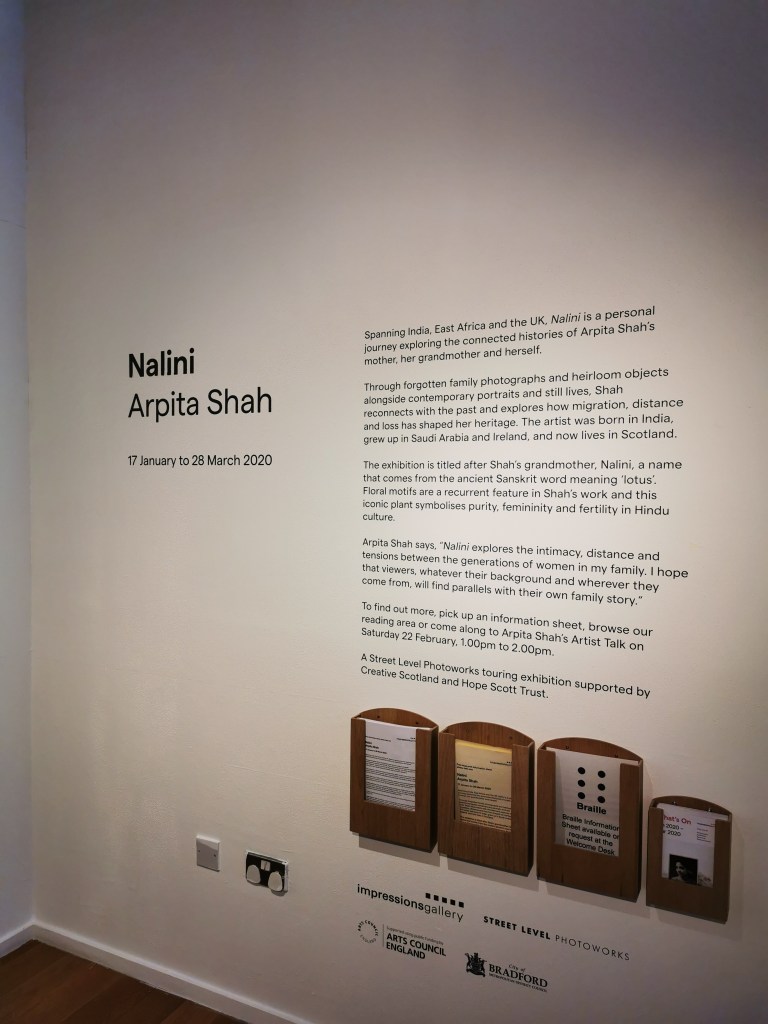
The exhibition is named after Shah’s grandmother, Nalini, a name that comes from the ancient Sanskrit word meaning “lotus” which symbolises purity, femininity and fertility in Hindu culture.
This exhibition has been four years in the making and I love how Arpita has combined so many elements to make exhibition a rich experience for the viewer, some of the ways she has done this :
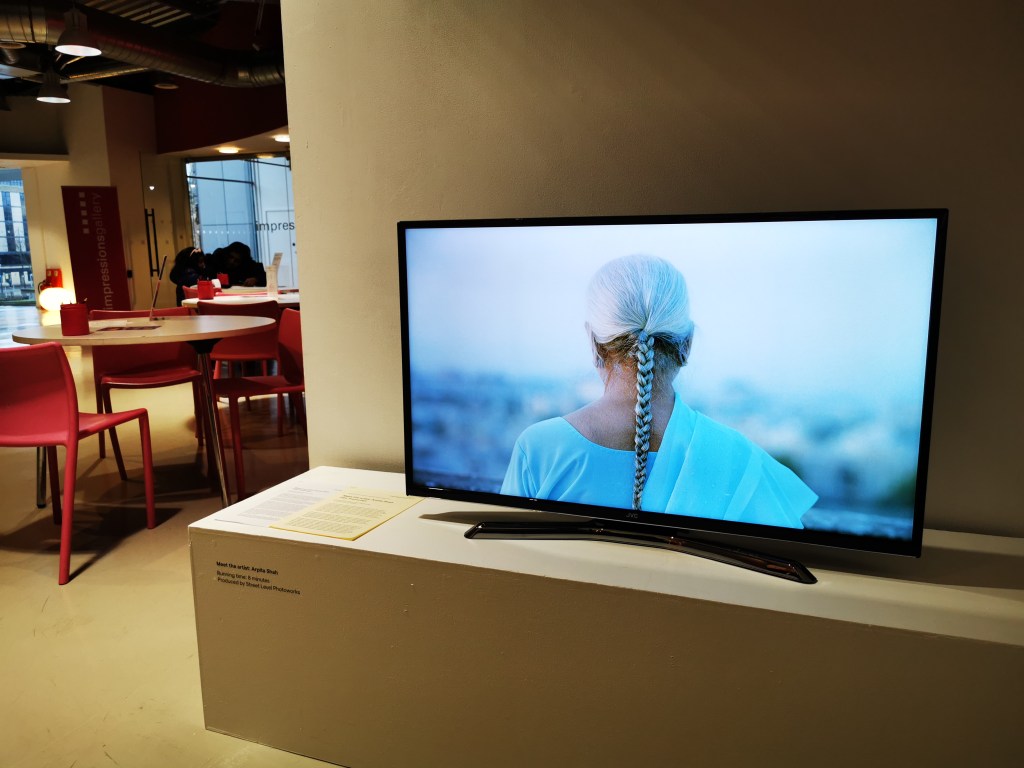
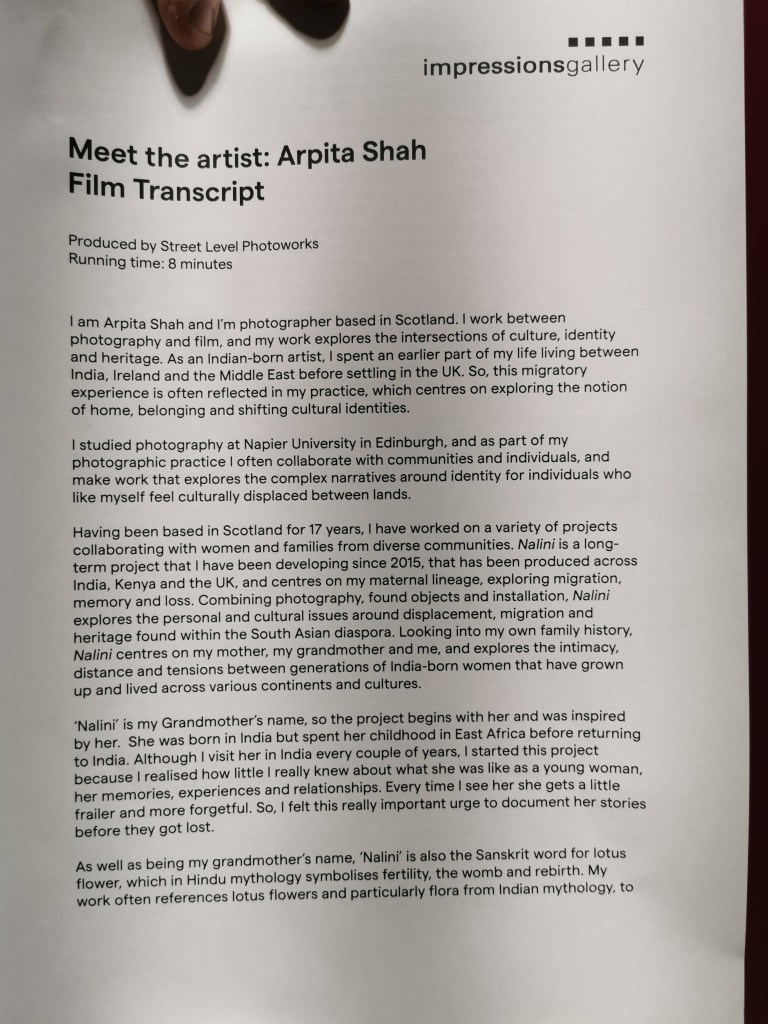
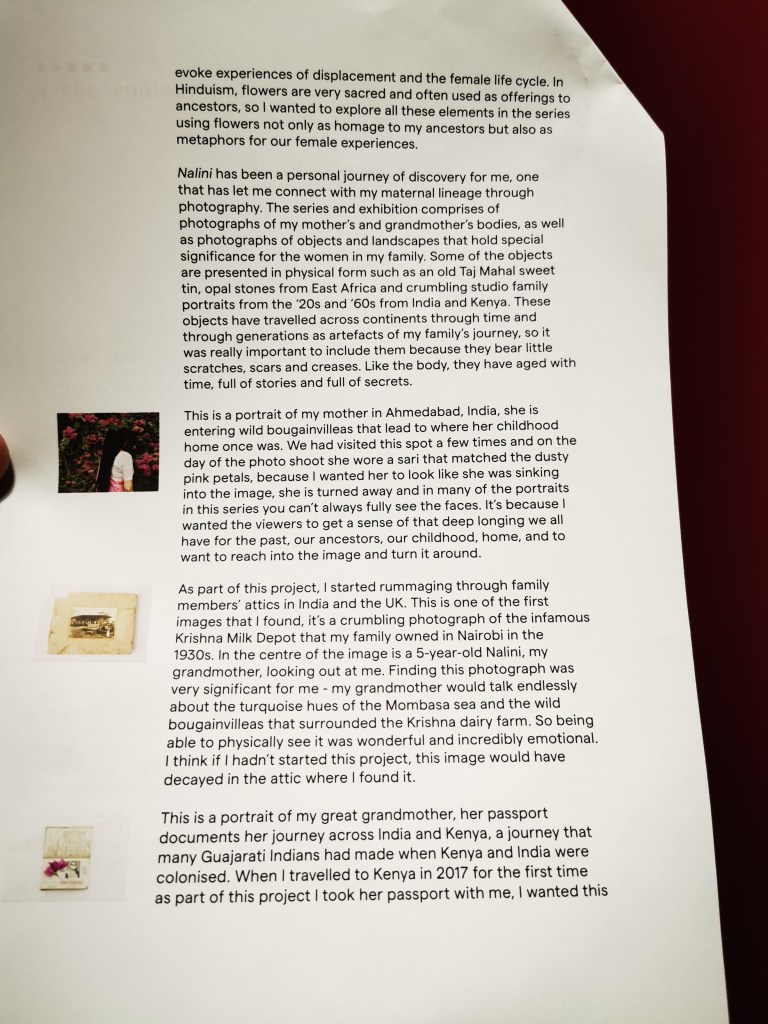
The video at the entrance gives a very good overview of the meaning behind the images she is exhibiting without reading about it, there is also a script of the video which is useful.
The explanatory video at the entrance to the exhibition is really useful to give the visitor a good idea of the thought behind each image and an explanation of the work
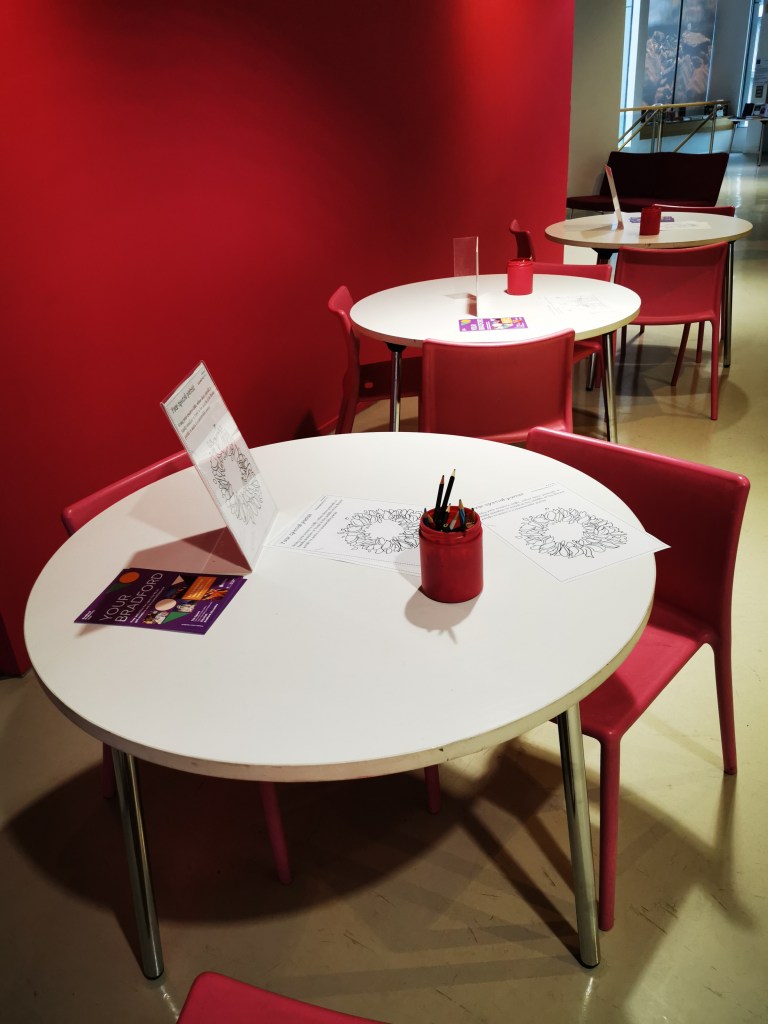
There is a children’s area where some of the images have been recreated into images that can be coloured in
The children’s area is a great idea, they can learn about art and heritage while the parents can view the exhibition, a double benefit, win win situation!One of a number of colouring choices for the children
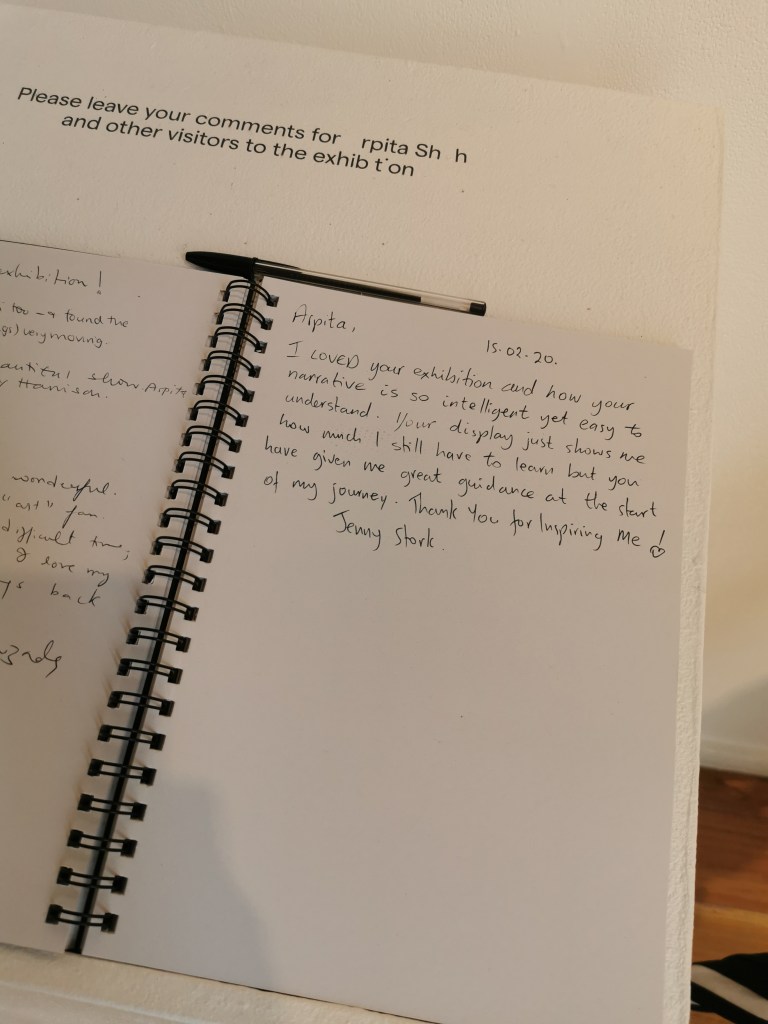
There is a comments book for visitors
The comments book is something I enjoyed at the exhibition and haven’t seen it before at any others I have been to, being new to photography I am not sure if this sort of thing is common ?
There are options for large print and braille
I really like the thought behind the large print and braille versions of informaiton
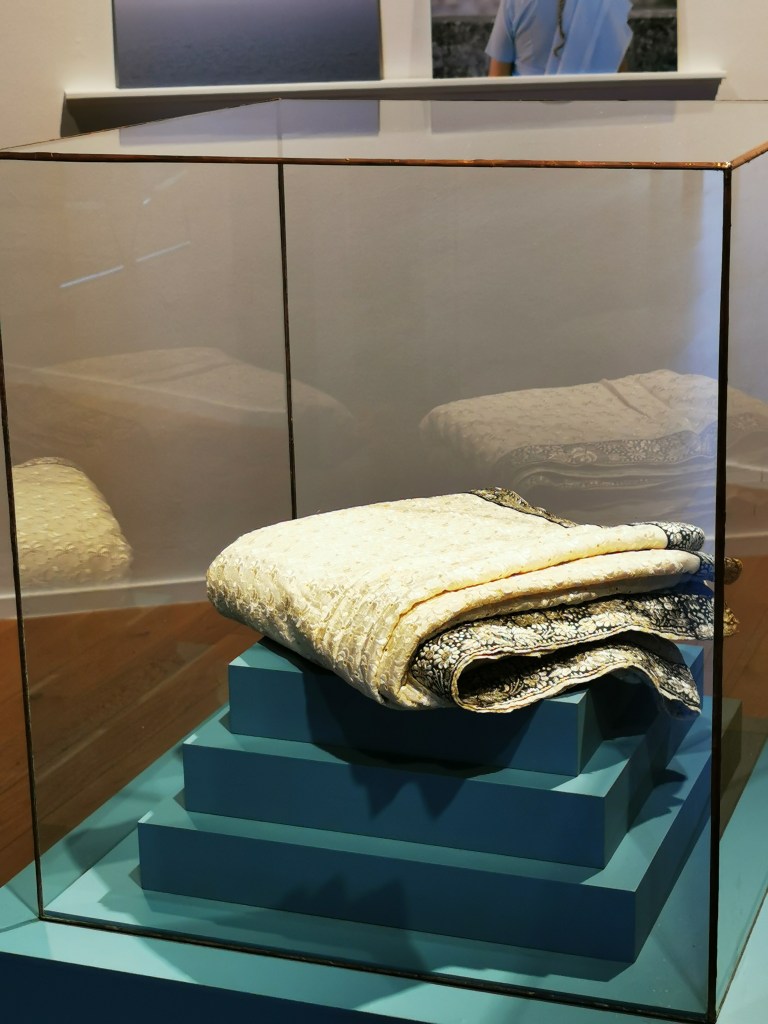
The sari that is almost 200 years old is on display, as well as an old suitcase used to move from India to Kenya, and a display case full of several artefacts that related to the images
This almost 200 year old sari is a wonderful example of connection, tradition and bonds. I think this display should have been next to the old image of Arpita’s grandmother who was wearing it so the connections can be more easily made
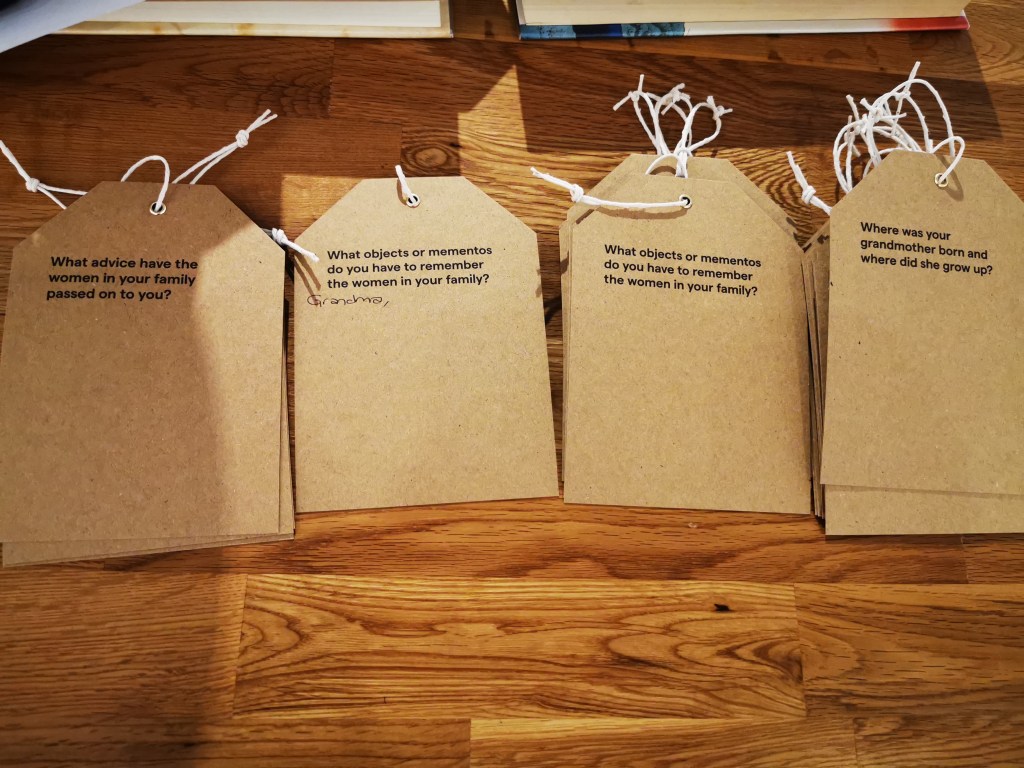
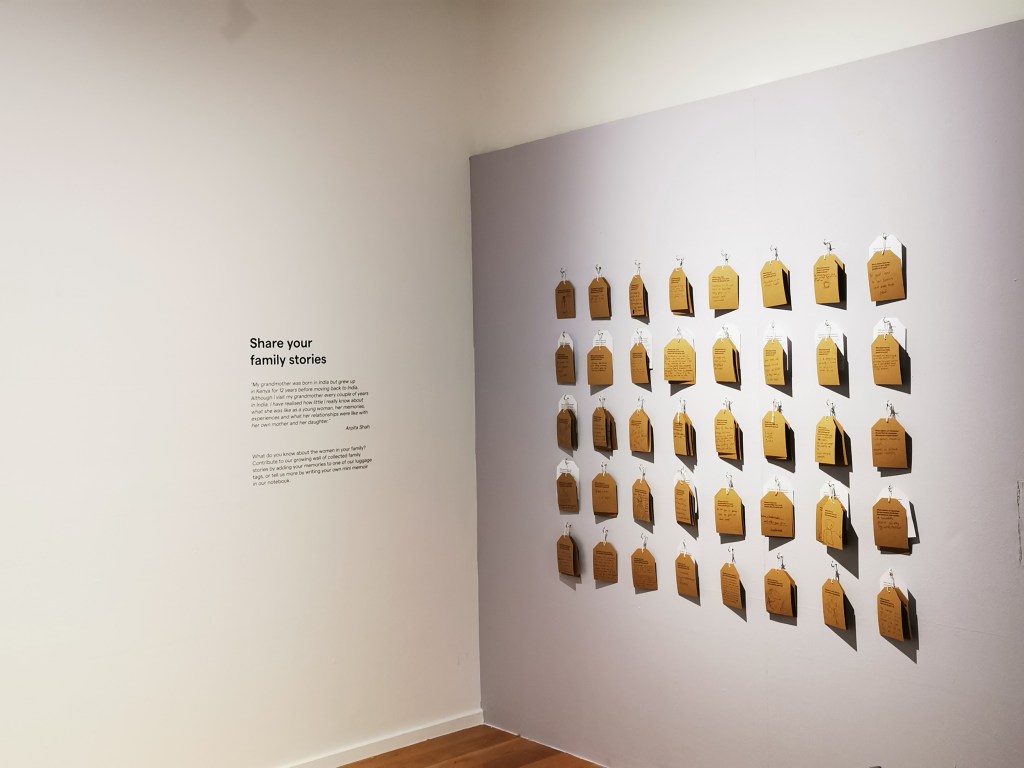
Four different cards for visitors to write about their own mother or grandmother and these are hung up on a wall
Another great idea to add richness to the experience of the visitorI think these cards are going to be used to create more work, I will have to make a note to find out what happens to these
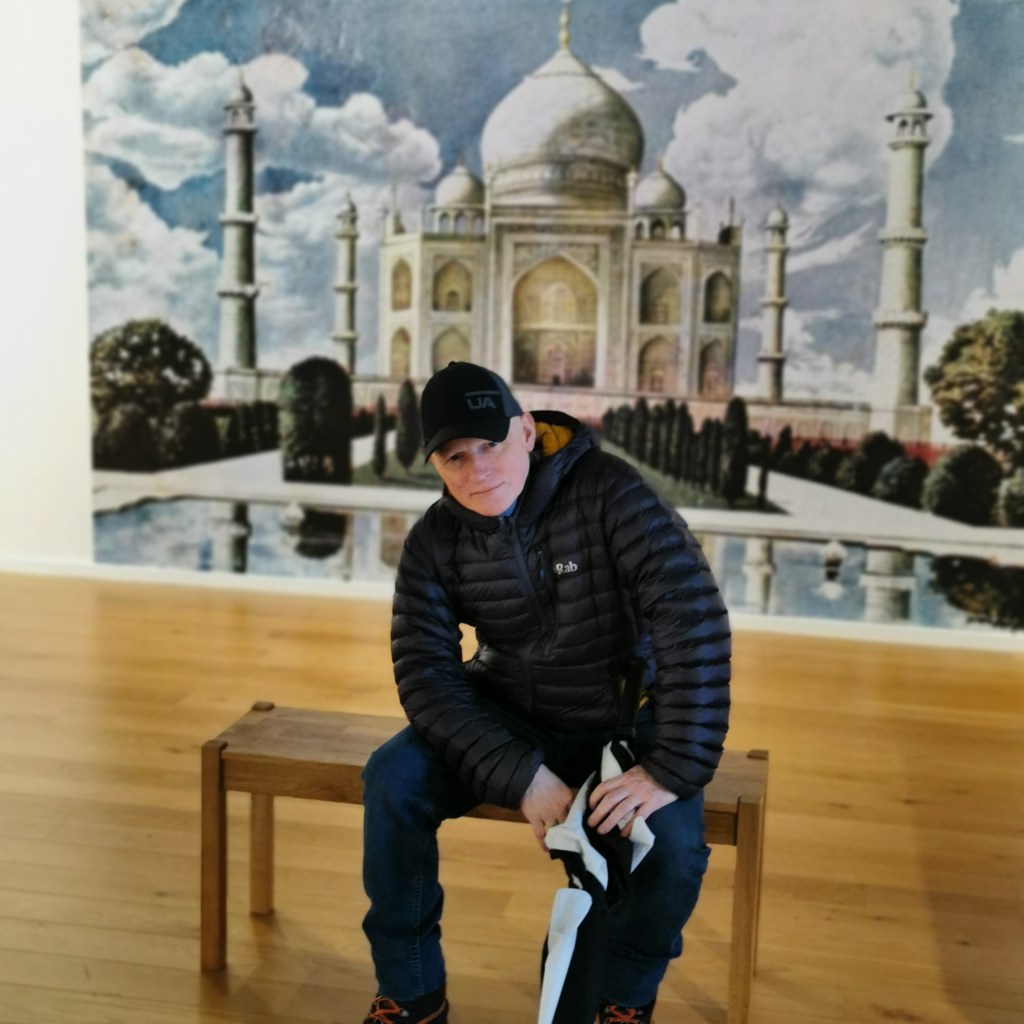
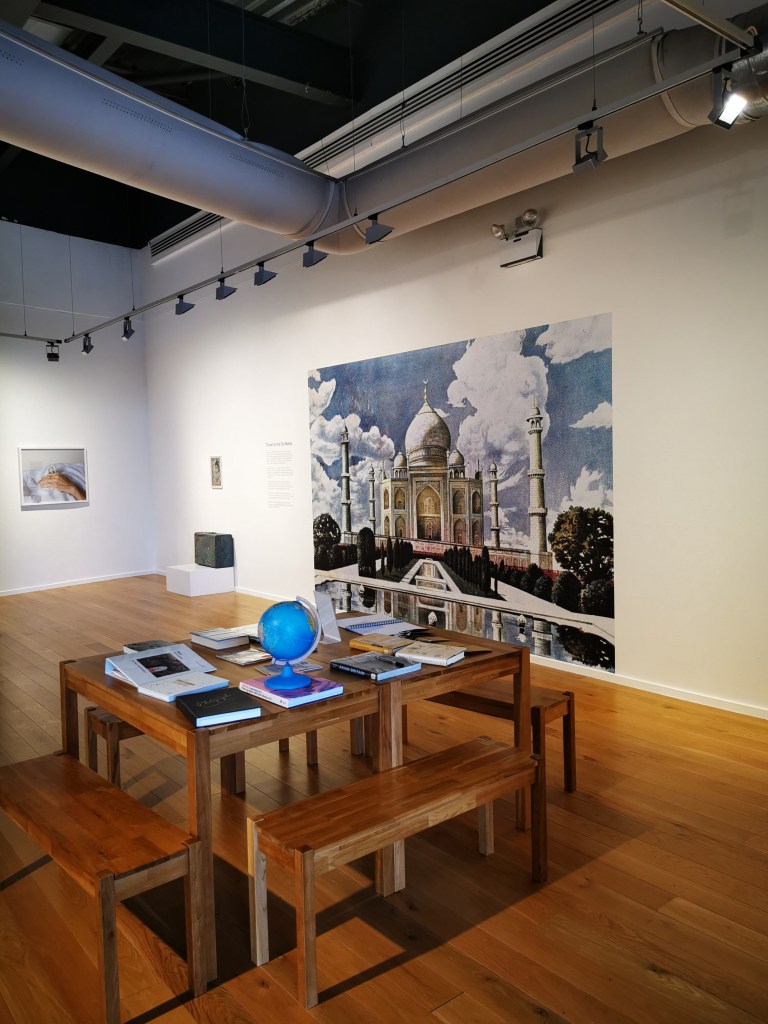
My favourite example of this is the large image of the Taj Mahal that she reproduced from an old tin the family have had for several generations, this is where people are encouraged to have their photograph taken.
The selfie wall, I think the exhibition details and Instagram info could be put on the image so the awareness is increased on social media Books relating to the subject of migration and families are there for visitors too. This is a great idea and if I had more time I would have loved to read these
One of my favourite images is the one with the dried lotus flowers around a printed image
Hand tinted image of Nalini and the lotus flower petals surrounding the portrait
My challenge is narrative in my work and this module will hopefully improve my skills. This work in my view is an excellent example of narrative, the story is told very well and the images tell a story that has deep meaning, several layers of meaning which is intelligent.
The transcript to the video at the start of the exhibition, gives an excellent account of what it’s all about.
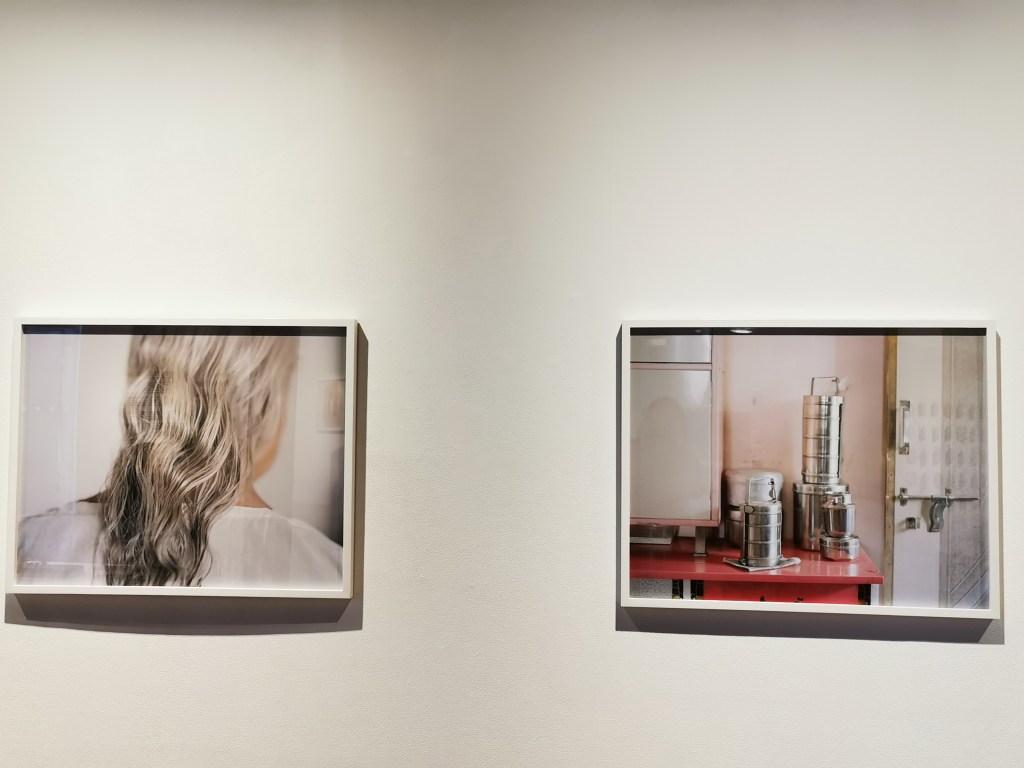
The visual connections between images is very well done too, something I also need to work on and improve.
The visual connection between the silver hair and the kitchen equipment was something I particularly liked.
Conclusion
The exhibition was yet another valuable learning experience for me and shows how much I still have to learn. I realise this exhibition took years to create and a team of people to work on the editing and creating everything I saw here, with this in mind I can’t be too hard on myself when I produce work for assignments. Editing work and choosing images that visually connect as well as the narrative is something I can learn from Arpita’s work. I realise the reasoning why the artist didn’t include any work that showed the face of her mother and grandmother, but for me it would have been nice to see an image of the three generations together to demonstrate the bond they have. With so much work put into developing the narrative, we would have bought a book about the exhibition, this is something I would have done and sold signed editions of a photobook to make more money out of it. This was one of the things my partner and I discussed, how to monetize this work? A photobook would be one way certainly, not sure about further ways or how the artist benefits financially from this work?



 Jenny Stork: Photography 1: Context & Narrative