Preparation Work : Ex 4: Analysing And Reflecting

This quick exercise is designed to introduce the idea of analysing and reflecting
on the work of others, and to give you some material for your first learning log
entry or blogpost.
Here’s a selection of creative practitioners that you will encounter during this
course unit:
● Elina Brotherus
● Gideon Mendel
● Hannah Starkey
● Nigel Shafran.

  1. Choose one of these names and find a piece of work they’ve produced.
    Remember to reference the works you have chosen using Harvard
    Referencing, so it’s clear what you are looking at, who made it, and when.
  2. Pick one of the pieces and briefly describe it. Consider its qualities by
    trying to describe it. What are the different elements within the work and
    how do these elements work together? What do you think the work is
    trying to communicate? Imagine you’re describing the work to somebody
    over the telephone. Try to do this in no more than 50 words.
    For image based work, what you’re doing here is analysing the formal
    visual language of an image. This is known as visual research or,
    sometimes visual analysis. Writing can be a useful tool in visual analysis,
    but you can also annotate images with notes.
  3. Using the same piece, briefly write about how you relate to this work. Do
    you like it or hate it, find it intriguing, influential or outdated, and if so,
    why? Does the work connect to wider ideas or other creative practitioners?
    In other words, what’s your opinion on this work. Don’t worry about
    ‘getting it wrong’ or ‘missing the point’. Perhaps your reflection raises more
    questions than answers. Again, try to do this in no more than 50 words.
  4. Use the text you’ve generated to create your first blog post or learning log
    entry. You may also want to be self-reflective by considering your
    experience of doing the exercise. Did you find it an easy or difficult task?
    Did it raise any interesting issues or areas you want to develop further?
    Write a sentence or two picking up on any of these points in your learning
    log.

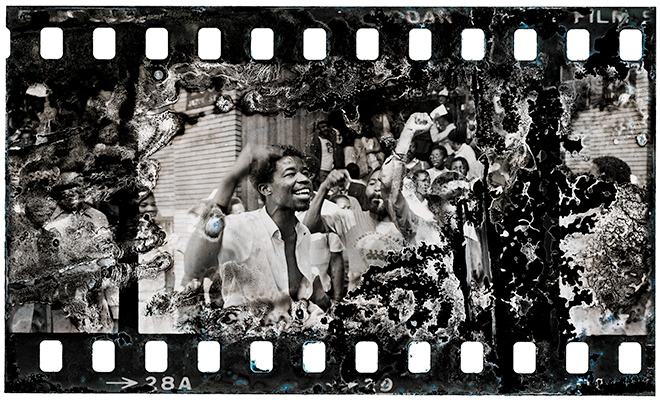
I have chosen Gideon Mendel and his work Freedom or Death

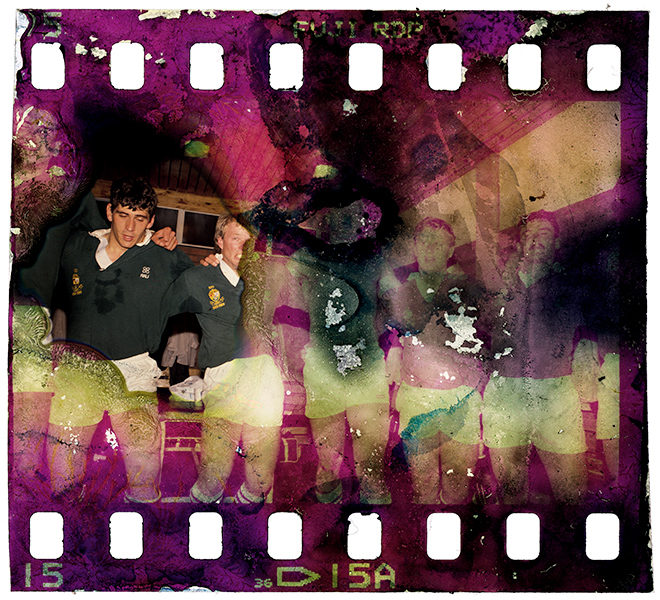
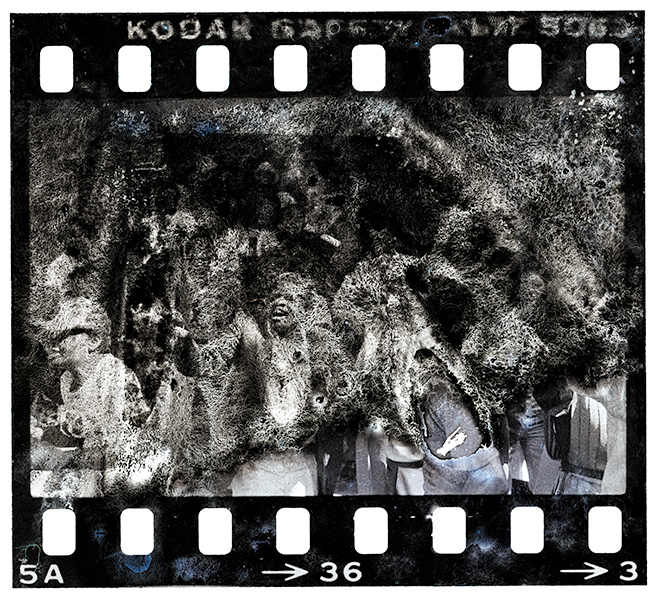
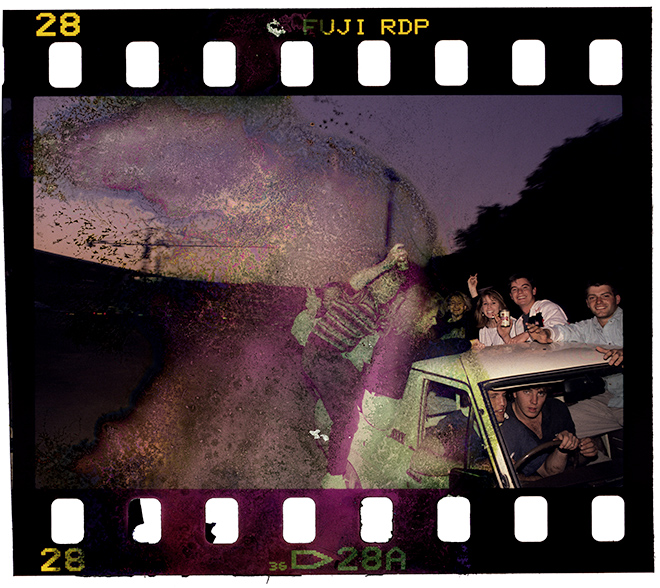
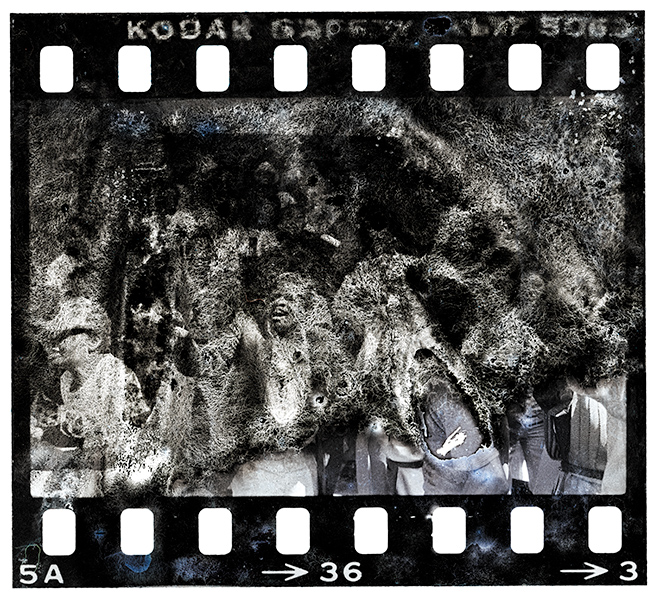
The images were taken during an intense period of war in South Africa from 1985 and 1989 at the start of Gideon Mendel’s photography career. The images depict a struggle for freedom by the indigenous people and the life of the white minority, this can still be visible by the subjects in these distorted images. The images appear abstract because the water damage has created distortions on the image, this adds to the aesthetic quality of the work. Mendel chose to include the negative borders in the images which connects it’s origins and ties in with the narrative about the damaged physical negatives over time.

I like this work because I am drawn the the material affectation of physical prints, this is just a variation on that theme. I like the abstract patterns created by chance to when the negatives were damaged, colourful quality where the damage occurred is attractive to me. I am drawn to this work on a deeper level, growing up in Rhodesia during a similar civil war and also witnessing this struggle first hand in the 1980’s whilst on holiday in South Africa, this work resonates with me on an emotional level. I was first drawn to the physical affectation of the printed image at my first student visit to the Blast festival in West Bromwich in 2019. Nilupa Yasmin takes images and cuts them into strips and weaves them together to create an abstract version as the final outcome. Nilupa Yasmin’s work “Where Can I Find This” was work taken at the Sandwell markets and then cut and woven together.

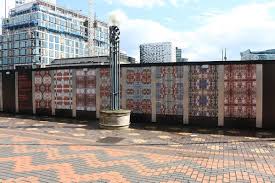
Nilupa Yasmin’s final outcome of work is physically affected through the process of weaving
Woven images are grouped together to form larger more abstract images which I really like

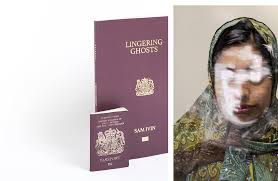
I was also drawn to the work of Sam Ivin, called “Lingering Ghosts” where he scratched out the faces of asylum seekers on printed images, as if to erase their identity, similar to what asylum seekers feel when in limbo, awaiting approval for residency. This work also represents a social struggle by a group of people and I am also drawn to social issues, which connects Gideon Mendel’s work to this I have previously enjoyed.

These scratched out prints produced by Sam Ivin for his work “Lingering Ghosts” are very moving and thought provoking

Sam Ivin’s Lingering Ghosts Work is also socially engaged and symbolises a struggle

Below are some images from Gideon Mendel’s Work “Freedom or Death” that I particularly liked. The captions are what accompanies the images on his website

Protestors outside the Congressof South African Trade Unions (COSATU) House, after a May Day rally in which COSATU demanded the day become a paid holiday and called for a nationwide ‘stay away’ protest by workers. One and a half million workers across the country, along with thousands of school pupils and students observed the call. —Johannesburg, May 1986
Members of the RAU rugby team have a moment of prayer and bonding after winning a gameat the RAU Stadium. —Johannesburg, July 1989
Protestors outside COSATU House. The first of May 1986, marked the 100th anniversary of International Labour Day, also known as May Day. —Johannesburg, May 1986
Students from the Rand Afrikaans University (RAU) celebrate at the end of their annual RAG parade during their first week of university. —Johannesburg, March 1989
Activists during a mass political funeral for youths slain in the so-called ‘grenade incident’ which took place in Duduza Township. Eight activists were killed when an undercover agent gave them booby-trapped hand grenades. —East Rand, Gauteng, July 1985

Their distortion speaking a deeper truth beyond the original documentary format.

Bibliography

Gideonmendel.com. (2020). Damage – Gideon Mendel. [online] Available at: http://gideonmendel.com/freedom-or-death/ [Accessed 13 Feb. 2020].

Blast!. (2020). Nilupa Yasmin — Blast!. [online] Available at: https://www.blastphotofestival.com/artists/nilupayasmin [Accessed 13 Feb. 2020].

SAM IVIN. (2020). Lingering Ghosts — SAM IVIN. [online] Available at: http://www.samivin.com/lingeringghosts [Accessed 13 Feb. 2020].

Preparation Work: Ex3: Identifying Resources

I have checked through the list of resources for this course and I have recently created an area for my studies at home, it has a wall I can use for images I want to live with and consider when making work, I have some temporary flip chart paper that sticks to the wall which I have found extremely useful.

Photoshop is something I need to get to grips with and so I am considering an evening class for this which starts in April.

I don’t currently have lots of space for a portraiture, ideally it would be great to have this space so I have a permanent backdrop set up for this purpose, I will have to think about how I can do this.

I need to sort out my printer as I find this really valuable when sequencing and deciding which photos go together as a seriex. The printer needs to be in this room ideally, it is currently in another room.

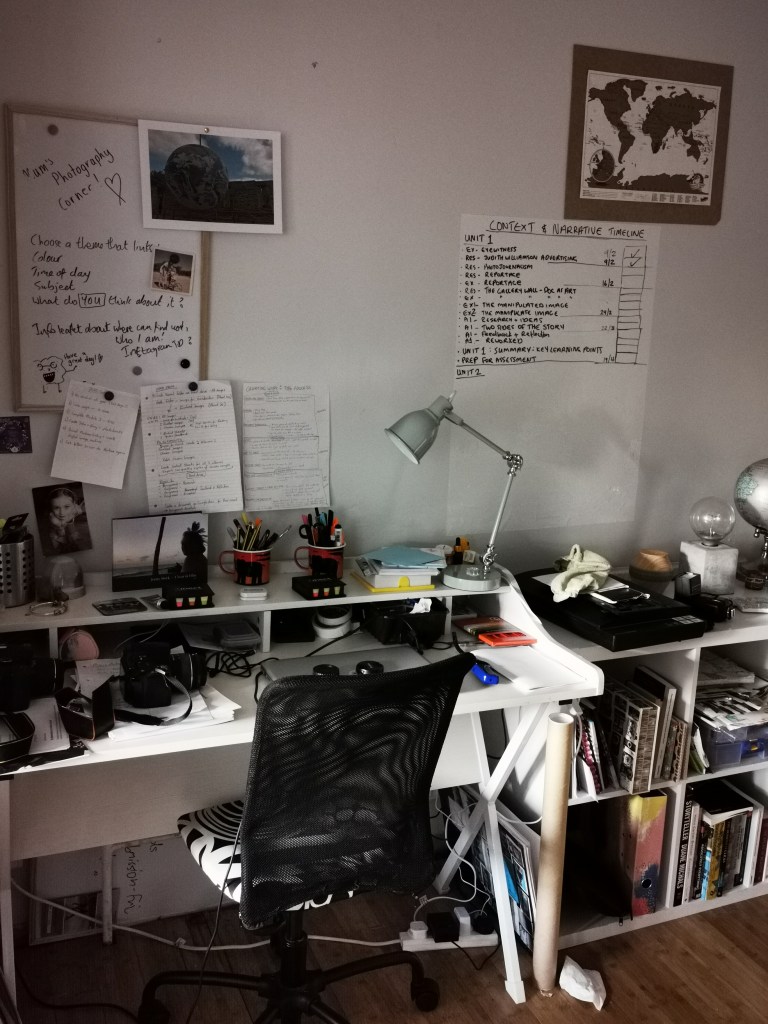
My work area for my studies, I have organised my books and equipment so I can find everything easily. I like the whiteboard plastic sheets I can write my work schedule on so I stay focused on completing work to the timescales I have set myself.

Reading List

Essential Reading
● Bate, D (2009) Photography: The Key Concepts. London: Berg.
● Curana, N. & Fox, A (2012) Behind the Image: Research in Photography.
Lausanne: AVA.
● Langford, M. et al (2010) Langford’s Basic Photography (9 th ed.) Oxford:
Focal Press.
● Short, M (2011) Creative Photography: Context and Narrative. Lausanne: AVA.
● Warner Marien, M (2014) Photography: A Cultural History (4th ed.) London:
Laurence King.


Further Reading
● Baker, S (2016) Performing for the Camera. Tate Publishing: London.
● Barthes, R (1977) Image – Music – Text. London: Fontana Press.
● Bate, D (2009) Photography: The Key Concepts. New York: Berg.
● Bate, D (2016) Art Photography. Harry H. Abrams.
● Berger, J (1972) Ways of Seeing. London: Penguin Books.
● Belsey, C (2002) A Very Short Introduction to Poststructuralism. Oxford:
Oxford University Press.
● Bright, S (2011) Art Photography Now (2nd revised edition). London: Thames
& Hudson.
● Bright, S (2010) Auto Focus: The Self-Portrait in Contemporary Photography.
London: Thames & Hudson.
● Brilliant, R (1991) Portraiture. London: Reaktion Books.
● Bull, S (2009) Photography. London: Routledge.
● Bussard, K (2006) So the Story Goes: Photographs by Tina Barney, Philip-Lorca
diCorcia, Nan Goldin, Sally Mann and Larry Sultan. New Haven, CT: Yale
University Press.
● Campany, D (2008) Photography and Cinema. London: Reaktion Books.
● Cotton, C (2009) The Photograph as Contemporary Art (2nd revised edition).
London: Thames & Hudson.
0 Photography 1: Context and Narrative
● Dexter, E. and Weski, T (2003) Cruel and Tender. London: Tate Publishing
● Eijkelboom, H (2014) People of the 21 st Century. Phaidon Press: London.
● Eskildsen, U (2008) Street & Studio: An Urban History of Photography.
London: Tate Publishing
● Eco, U (1989) The Open Work. Cambridge, MA: Harvard University Press.
● Fox, A. & Caruana, N (2012) Behind the Image. Lausanne: AVA Publishing.
● Howarth, S (2005) Singular Images: Essays on Remarkable Photographs.
London: Tate Publishing.
● Hurn, D. and Jay, B (1997) On Being a Photographer: A Practical Guide (3rd
edition). Anacortes, WA: LensWork.
● Jeffrey, I (1981) Photography: A Concise History.
● Jeffrey, I (2009) How to Read a Photograph. London: Thames & Hudson.
● Kozloff, M (2007) The Theatre of the Face: Portrait Photography Since 1900.
London: Phaidon Press.
● La Grange, A (2005) Basic Critical Theory for Photographers. Oxford: Focal
Press.
● Lowry, J, Green, D & Baetens, J (2009) Theatres of the Real. Brighton:
Photoworks.
● Sontag, S (1979) On Photography. London: Penguin.
● Szarkowski, J (1984) Mirrors and Windows: American Photography since 1960.
New York: MoMA.
● Short, M (2011) Context and Narrative. Lausanne: AVA Publishing.
● Williamson, J (2010) Decoding Advertisements: Ideology and Meaning in
Advertising (reissue edition). London: Marion Boyars.
● Wells, L. (2009) Photography: A Critical Introduction (4 th ed.) Abingdon: Routledge

Preparation Work : Ex 2: Managing My Time

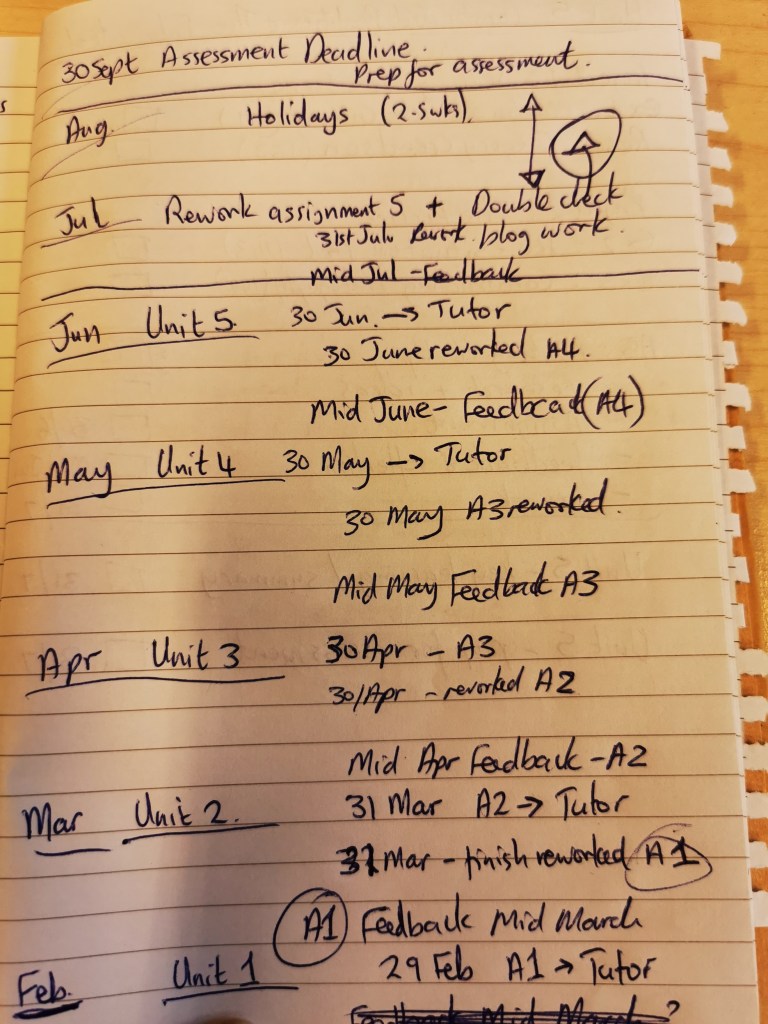
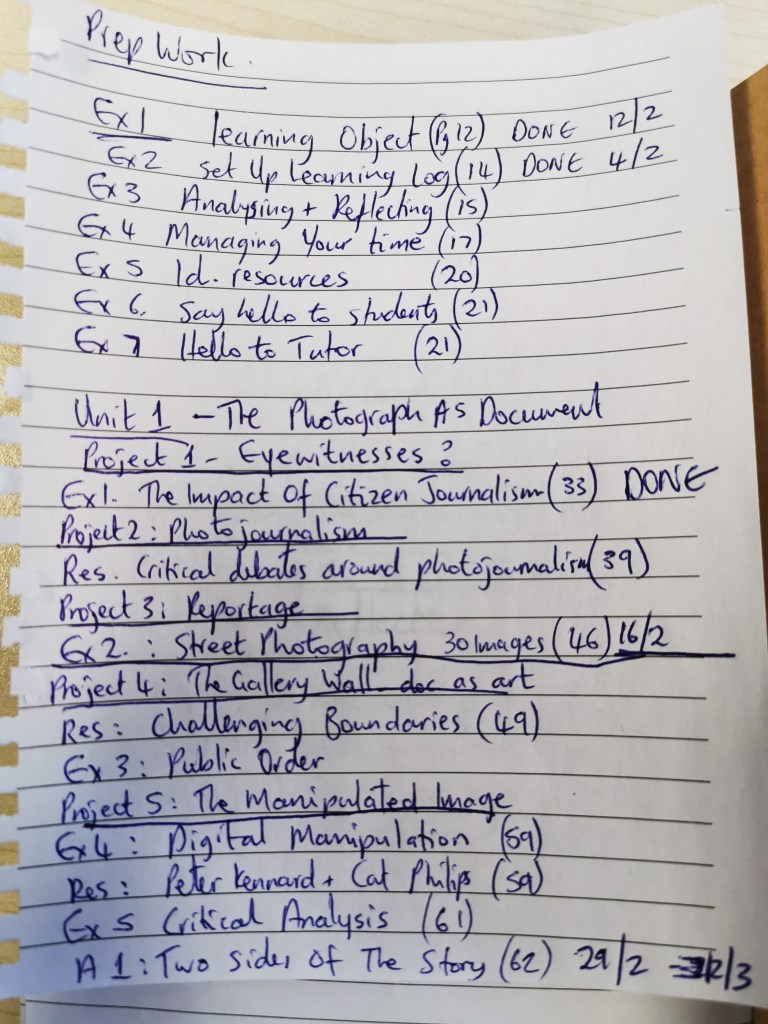
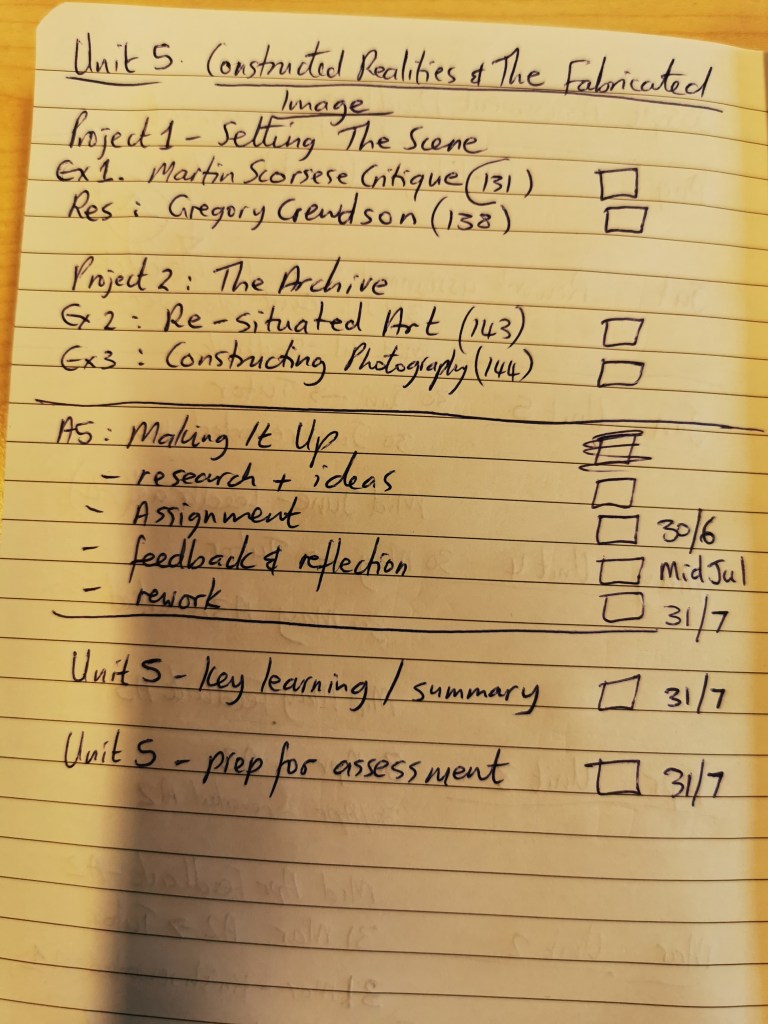
Balancing a job, a family and study needs careful planning to make sure the work gets done. With this in mind I created a list of all exercises, research, assignment work and reflective work for each unit so I can keep track of what needs to be done and tick it off as it is completed. I have put my list of work for my first unit above my desk at home to keep me focused on what needs to be done

Assessment deadline date for submission is 30th September for November and this is what I am aiming for. I have 5 units to complete so I have given myself a deadline for submitting the assignments and also when I should aim to get feedback, I have planned that each assignment it sent to my tutor at the end of the month, so A1 is with my tutor at end of Feb, A2 is at end of March – so A5 will be end of June. I have assumed that it will take two weeks to get feedback ( middle of the following month ) then I have another 2 weeks to rework based on tutor feedback, so the reworked A5 will be complete at the end of July 2020. I have a summer holiday for 2.5 weeks so I have about 6 weeks to prepare for my assessment submission at the end of September.

During a typical week I plan to work on shooting photos every day for practice of composition skills ( on my way to work in the mornings during the week ) Weekday evenings will be used for coursework (exercises and research and reading) and Sunday mornings and Mondays will be used for assignment work ( I don’t work on Mondays)

The photos below are extracts from the back of my notebook where I have planned my studies, I will tick off work once completed so I know I am on track and where I am in my studies to stay in control of time management.

Context And narrative Timeline to get work done for November Assessment

Prep work and Unit 1 Timeline – as each bit of work is done it will be ticked off the list – I will have a copy of this on my wall above my desk as well as my notebook. My notebook is with me all the time so I can review it any time I have a spare moment – it’ in the back of my notebook so it doesn’t get lost among other notes

Unit 2 list of work to be done with a tick box for when completed – it would be really handy if these were appendices to the coursework that could be used by students to manage their work instead of me having to write this down like this

I have created a process for producing my assignments that works for me, these headings are replicated in my blog so each stage is a separate blog, the “rework” blog is the final version of the assignment that gets sent to be assessed

Lesson learned from my first module, I will now write a summary of each unit before moving on to the next and will make sure all work for assessment is prepared before moving on
I need to aim to complete all work by the end of July to give me time to prepare for assessment to the standard I want to achieve, my first assessment was a rush and was stressful so I want to avoid this with this module

Unit 1 Ex5: The Photograph As Document: Project 5: The Manipulated Image: Critical Analysis

Read the section entitled ‘The Real and the Digital’ in Wells, Liz. (2009) Photography:
A Critical Introduction (4th edition). Abingdon: Routledge, pp.73–75. You’ll find this
on the student website.
Does digital technology change how we see photography as truth? Consider both
sides of the argument and make some notes in your learning log.

The Real And The Digital (Liz Wells – Photography, A Critical Introduction) 

The convergence between computing and audio-visual technologies has, as we all know, produced new kinds of digital media which are transforming the means of image-making together with its social, commercial and aesthetic practices.  Here, we need to note that digital media -with its ability to create, manipulate and edit images –   has given new prominence to arguments about the nature of photography and taken them into the popular domain.  These may briefly be summarised as: questions about the nature of the photographic image; about new ways of defining and understanding ‘the real’ that are brought about by processes of globalisation and postmodern philosophical positions, and, finally, questions about the relationship of photography to other media. It is now clear that images with all the  appearance of ‘real’ photographs may have been created from scratch on computer, montaged from many sources, altered in some respects, or radically transformed. Figures  may be added or removed and the main constituents of the picture rearranged to suggest new relationships or bizarre conjunctions. Does all this not destroy the claim of photography to have a  special ability to show things as they  are and raise serious doubts about those genres with a  particular investment in the ‘real’ -documentary and photojournalism? We can, of course, observe that, as we have already seen, the manipulation of images is nothing new and that photographs have been changed, touched-up or distorted since the earliest  days. But we are not looking here merely at a  technically sophisticated way of altering images, but at much more profound changes that challenge the ontological status of the photo-graph itself. If a photograph is not of something already existing in the world, how can we regard it as an accurate record of how things are? Roland Barthes’ influential conception of the nature of the photograph, is  that it is the result of an event in the world, evidence of the passing of  a moment of time that once was and is no more, which left a  kind of trace of the event on the photograph. It is this trace which has been  considered to give photographs their special relationship to the real. That is that they function, in the typology of signs offered by the American semiotician, C.S. Peirce, as indexical signs. The nature of the sign within semiological  systems is  important, but it is interesting to note that we have always known  that photographs are malleable, contrived and slippery, but have, simultaneously, been prepared to believe them to be evidential and more ‘real’ than  other kinds of images. It is possible to argue that the authenticity of the photograph was validated less by the nature of the image itself than through the structure of discursive, social  and professional practices which constituted photography. Any radical transformation in this structure makes us uneasy about the status of the photograph. Not only do we know that individual photographs could have been manipulated, but our reception and understanding of the world of signs may  have been transformed. Writing in the French newspaper Liberation, in 1991 the  social theorist, Jean Baudrillard famously remarked that ‘the gulf war  did no t  take place’ (Baudrillard 1995). He was commenting on the nature of the real and the authentic in our time and suggesting that .in  t he world of th e  spectacle,  it is pointless to posit an external reality that is then  pictured, described and represented. In his view everything is constructed and our sense of the world is mediated by complex technologies that  are themselves a  major constituent of our reality. What took place, then, was not t he  first Gulf War but  a whole sequence of political, social and military actions that  were acted out in a new 74

kind of social and technical space. While this  may be an extreme  way of formulating the argument, it is clear that a  complex of technical, political, social and cultural changes has transformed not just photography, but the whole of visual culture. For example, David Campany  points out that ‘almost a third of all  news “photographs” are frame grabs from video or digital sources’ and comments that: The definition of a  medium, particularly photography,  is not autonomous or self-governing, but heteronymous, dependent on other media. It  derives less from what  it is technologically than what it is culturally. Photography is what we do with it. And what we do with it depends  on what we do with other image technologies. (Campany 2003: 130; emphasis in original) One significant consequence of this has been a  new merging and lack of definition between photographic genres.  It is increasingly difficult to  distinguish one kind of photograph practice from another. As we shall see later, titles, such as ‘documentary’ are of little use as labels for the new kind of work that is  being  produced. Indeed, all descriptive titles have been freely appropriated and find themselves used in curious couplings, for example, one sub-genre of photography now well established in the USA is that of’wedding photojournalism’.

Notes taken that I found interesting :

The American philosopher and semiotician John Deely said that “objects” are dosed with human experience – when they are photographed they become “signs” – he believes that photographing objects can never be the truth because of this. As soon as we photograph somethng they become objects of our experience. The interpretation of all objects is affected by human experiences

David Campany has stated that a third of all news photographs are screen grabs from videos or a digital source

“Photography is what we do with it” – David Campany

A consequence of digital technology is a new merging of traditional photographic genres – documentary photography is of little use now as a label for the new kind of work that is now being produced – new terms such as wedding photojournalism and citizen photographer have emerged

Social networks are now acting as publishers of photographers, several informal photographs are taken and uploaded around the world rather than the tradtional way of days gone by – mainstream media are accessing them and using them as events unfold

Foreign news and hard news has been squeezed for resources and squeezed for space by cheaper and more advertising friendly features on lifestyle, products and celebrity – coupled with the fact that some governments restrict formal photographers in scenes of conflict, so the rise in demand for the amateur photographer is a result – to add to this, the photo that appears amateurish may come with more authenticity and credibility than a professional photo

There is still room for professional photos of conflict and hard news images of professional quality but even this changing to the storage and transport in a digital format rather than print

Thoughts and Reflection

I believe that photographs, whether in the digital age or when the first documentary work was made, there is always a version of the truth produced because the person making the work will be affected by his or her own life experiences and this will result in what they choose to photograph and what not to, what they decide to include in the frame and what to omit. These elements can alter the narrative drastically but can still be an image that has not been digitally manipulated.

I believe that eyewitness photojournalism can be a good thing because news is communicated almost instantly and in this world of instant gratification it has become an expectation. Fake news is on the rise and also the amount of time we spend reading short, sound bite news items, this can lead to misinformed paranoia and anxiety.

Mobile phone photography and the use of AI in phone photography will, I believe replace the large pro DSLR cameras in the next 10 years. Current phones can take night photos and bring deatil into an image that is not apparent to the human eye, AI will search millions of similar images and in 4 seconds will rectify the image being taken to produce the best version automatically. Mobile phone companies are currently competing is by the quality of their camera, there are hundreds of experts working to improve this phone feature and not anywhere near that much resource is being applied at Canon or Nikon to improve their product in the same way.

Photography is not about taking a technically perfect shot, it is in the words of David Campany “what we do with it” and this will become even more prominent when anyone can take a technically perfect shot because of the advancement in technology.

Bibliography

Contentstore.cla.co.uk. 2020. Openathens / Sign In. [online] Available at: <https://contentstore.cla.co.uk/EReader/Index?p=RDpcU2l0ZXNccHJvZHVjdGlvblxUZW1wXERDUy1kNzlkNjVkZC1lNjkzLTQ4OTUtOWQ0My04ZTg2Mjc1ZjIzNWUucGRm&o=JnB1Ymxpc2hlZENvbnRlbnRfSWQ9OTQ0ODA3JmNvbnRlbnRSZXF1ZXN0X0lkPTEwMjUxMDcmZG9jdW1lbnRMaW5rPWEyYjcyNDkxLTIzZWMtZTkxMS04MGNkLTAwNTA1NmFmNDA5OSZjb250ZW50SXRlbV9JZD0yODAwOTE=&id=a2b72491-23ec-e911-80cd-005056af4099&gt; [Accessed 12 May 2020].

Preparation Work : Ex1: Learning Objectives

The bullet points below explain my learning objectives for this module, I have also attached a link to an summary of key learning points from the first module I have completed, “Expressing Your Vision”

https://jennystorkphotography.wordpress.com/2020/01/28/overall-evaluation-expressing-your-vision/

This is my first experience learning about documentary photography so I am keen to learn as much about the subject as possible so is a wide open learning objective. I am interested in social displacement having grown up in Rhodesia and Zimbabwe then moving from Zimbabwe to the Uk at 21 years old, how different cultures settle in the UK and the preservation of heritage, of life and times gone by that need to be remembered for future generations. Preserving memories is very important to me.

Gaps in my knowledge is around narrative in my work, prominent documentary photographers, the use of photoshop to name a few, being relatively new to photography I have lots of gaps across the board

Areas to expand would be the ability to effectively store, retrieve and edit my work and to work better from contact sheets. I would like to improve how I select work and why, and what to look for to make a series coherent visually and in the narrative

I have never produced black and white work so I am looking forward to exploring this and understanding when is best to use it and in what context.

The preparation for my first assignment was stressful as I left everything to the end, I now have a structure in place for what I want to submit for each unit. I will make sure all work for assessment is prepared at the end of each unit to save time and make sure the quality of submission is the best it can be at the end, plus printing is expensive so it makes sense to do this as I go along after I have reworked assignments based on tutor feedback

Lastly, I started to use a photography sketchbook in my last module “Expressing Your Vision” and this was useful in formulating ideas for assignments. I would like to use this more in this module and from the outset rather than part way into the module. I also didn’t use a notebook as well as I could have in the previous module, this is something I have already started using, I carry this everywhere with me and it will be a very useful resource when I plan to summarise key learning points after each unit, it is also a place to store ideas and inspirational images ( I also have a swipe file on my website )

My first introductory call with my tutor was extremely useful today and these are the notes I took during the conversation which I will follow up on:

  • Photography (theory) is a new concept to me – don’t look on it as ‘theory’ as such more like articulating and summarising how and why images communicate. Functions: Terry Barrett.
  • Grids 
  • Social aspects of photography – the core of what we do. Do you mean documentary style or uses of photography i.e. family photos, giving voice to the subject? Photo-Voice? Socially Engaged Photography – Jim Goldberg, Julian Germain 
  • Pst colonial activities in Zimbabwe and preserving the cultural heritage of people who once lived there – you could follow this path even in level one (may not mean going to Zimbabe) but exploring cultural difference and the way power and representation work. 
  • First assignment at the end of February ? No rush. Make it diagnostic.
  • Plan complete this module by August to submit September for the November assessment if possible.  

Rose, G (2003), Visual Methodologies, Sage. – this book is quite heavy and designed for a second year degree student but is very useful to dip into – begin with this in preparation for the first assessment. If students don’t have a good grounding in analysing photo theory they will struggle in the later levels of degree. My tutor began studying photos as if peeling off the layers of an onion.

The meaning of a photograph is not already there, it is up to the photographer to put that meaning there – there will be some people who wont understand the meaning and so photos are for some viewers and not for others

Perfectly doable so long as you avoid – some students are fond of – ‘hoop jumping’ other than reflecting on your work and learning. I doubt that this will be you from just a cursory read of you blog. 

Put URL in any document at the header

Preparation Work : Ex1: Learning Objectives

This saves hunting through e-mails and my records and is a professional way to work. 

Bullet point main points to summarise (assessors love that) – my tutor was pleased with my writing style that it was to the point and concise which means he thinks I will do well in this module, I hope so!

Narrative the big issue! many types. Broadly the standard (Aristotle ) beginning middle and end or a more ‘associational’ (based on form) poetic links rather than cause and effect ‘picture essay’. 

The two are explored most succinctly in Jörg M. Colberg’s Conscientious Photography Magazine : https://cphmag.com/narrative-1/

My Blog on conventional v poetic/associational narrative: https://www.oca.ac.uk/weareoca/creative-arts/photography-that-gets-people-looking-thinking-and-talking/

He is the author of Understanding Photobooks: The Form and Content of the Photographic Book (Focal Press, 2016). Which is the best book to consider sequencing of photographs – I can send you a précis of his main points. 

Effectively store, retrieve and edit my work and to work better from contact sheets. Colberg software Lightroom or Capture One. Western Digital could be a hard drive to get

  • Workflow systems 
  • Zimbabwe_JS001 – make sure you have a good method of cataloguing from the start to save time and frustration in years to come
  • Photo Rescue 

Photographers Sketchbooks recommended

The viewer first sees a collection of shapes that go together well – visual first and then context and narrative follow

South West Student Group Study Day With Stephen Monger, 8th Feb 2020

Stephen Monger is a tutor and teaches at UWE – he is the programme leader for the MA – Graphic Arts programme and the BA(Hons) Graphic design https://people.uwe.ac.uk/Person/StephenMongerhttps://people.uwe.ac.uk/Person/StephenMonger

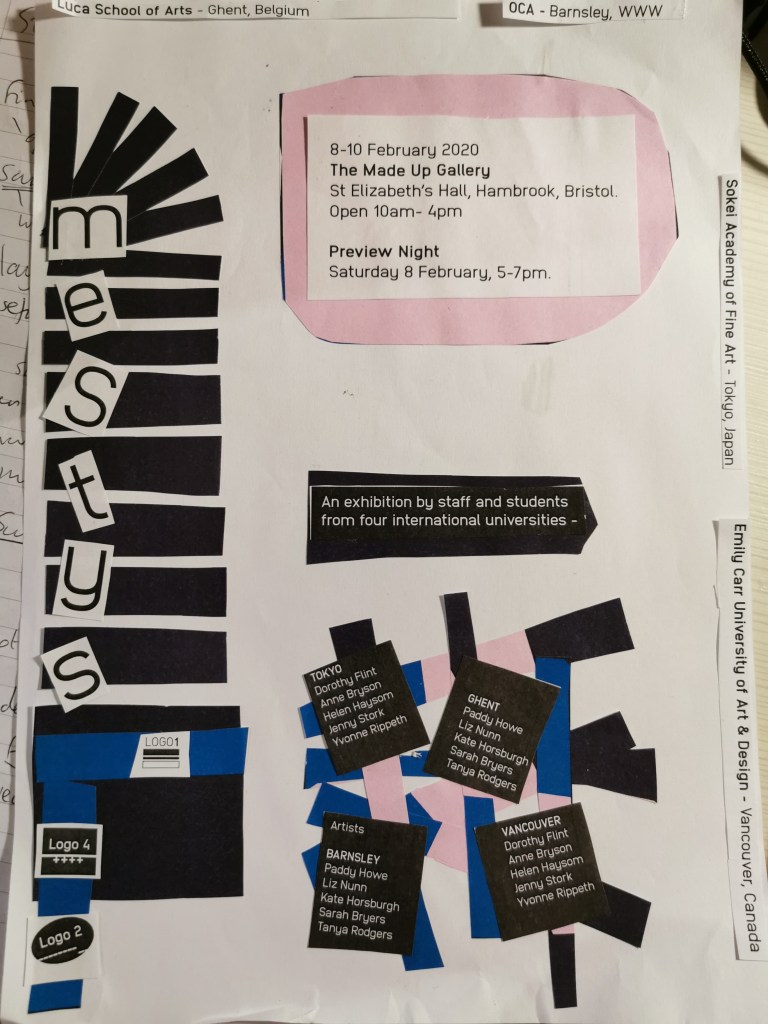
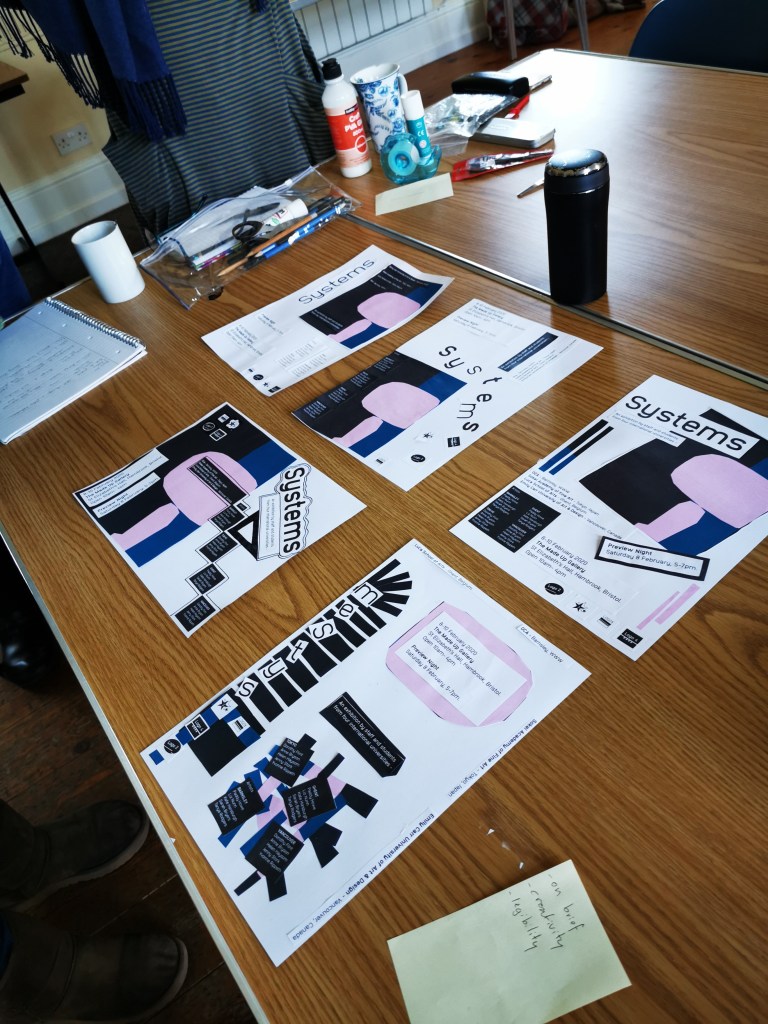
Poster Design Workshop : We had a design workshop in the morning where we were given sheets of paper with different font sizes of various pieces of information that we needed to cut out and create a poster. We needed to choose what we thought was the most appropriate size font that would be suitable. We were split into two groups and our brief was to be “non-conformist” and we had an hour to complete the exercise: This was my creation

My design for the poster creation workshop

Each group was asked to choose one design to represent the group based on the following criteria : 1) On Brief 2) Creativity 3) Legibility

My work was chosen to represent the group because it definitely was non conformist and creative, the mixing up of the wording of the name “Systems” was considered a negative by the group since it was the name of the organisation the poster was for so should have remained the same.

It is evident here that mine was the craziest design on the table!

Stephen Monger said that the bottom part where I put the artist information was very playful and exciting and he liked the creativity of my work which I was pleased about.

Some advice Stephen gave us when we create photobooks or anything that needs a design such as a poster or a flyer :

Find a good quality font that has about 5 different weights to it – sans serif means “without the flicks” and is less formal than the ones like Times Roman which has flicks

Design should be functional first then creative

Don’t ever just use 12 size because it shows a lack of effort

Creative Suite – Stephen uses InDesign – Drop the image in and the overlay with Text

Illustrator doesn’t have as much support with grids

Afternoon Feedback Session

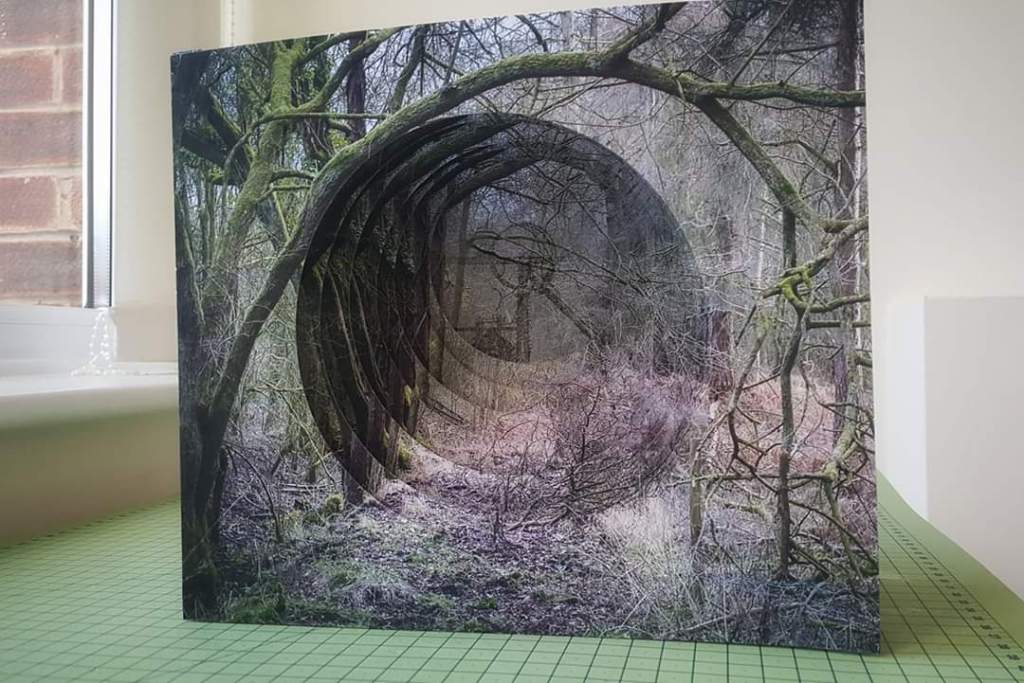
The Afternoon was a feedback session where students presented their work and asked the group for ideas and thoughts, Anne Bryson presented her work which was the idea of creating a tunnel book. She showed us an amazing piece of work where she printed 7 identical photos of an old coal mine in the forest of dean. Each photo had a circle cut out of it, starting with a large circle and progressing to a small circle that focused on the main subject in the image. The images would be fixed at their sides by a concertina system and it would have a front cover that when opened the book would create a 3d sculpture.

Anne Bryson’s Tunnel Photograph that she plans to put into a book format, she shared this with the group and asked for feedback about whether this should be a book or a sculpture or both

Anne mentioned she got some advice and support from Shona Grant who creates this work on a commercial basis, Shona has a website with good blogs for resource.

The cut out circles are created by using a tool that is a compass with a blade on the end of it and can be bought on Amazon for about £15. Rockingford watercolour inkjet paper was used – Photospeed ultra matt paper can also be used.

The question from Anne was – is this a book or a sculpture – and each one of these has a different way of presenting so the answer dictates how the work is finished

Stephen said that if it is a book then you need to interpret each part of the book into what you are making, so the two front covers can be used for explanatory text rather than text on the image itself.

If it is a sculpture then need to embrace what a sculpture is and make the text sculptural – think of the intentions and outcome while creating the work

Another student presented her finished photobook and some feedback from Stephen on it was:

Allow the viewer to explore – take risks – readers may pick up the book and may just want to read – next time they pick it up they may just want to look at the images and the book needs to be able to do this for the viewer and reader

Make each page a different format to keep interest – think about if you need page numbers at all or are these a distraction, think about where these numbers should be

Nice to put an artists statement at the beginning of the book and a small image of the artist so the reader knows the thoughts and intentions at the outset

Karl Blosfelt is a photographer that Steve said we should look into if interested in this genre – he studied nature and architecture and their relationship with each other

The process of producing work is something I have explored during my first module and will continue to evolve with experience, with this in mind I really liked the advice Stephen gave the group today, something I plan to use in this module when making work for assignments or exercises :

Write down lots of words of mine that I want the book (or body of work) to say – things I want to express – then edit these words to only a few that are the most meaningful – use these words to direct and produce work – then at the end ask yourself – does my work say this?

The benefit of meeting up on a day like this is that you get to share different tools that could be useful in our work, this time Procreate was mentioned, it is an app that you can use to draw or sketch, this was mentioned in a student discussion as well as a company called Snap Mad – a cost effective printing company to consider. These useful names and contacts are noted in my notebook so I can easily access them as and when needed

Conclusion

As always I learned a great deal from the day, it is also good to interact with other students and get support. I would encourage students of any level to get involved because student life gets easier the more support you have. The other point was that there were people studying different things, even music, but there were still things we could learn from each other despite these differences. Stephen Monger gave some excellent advice and feedback in the afternoon session. The morning workshop was very useful because text and imagery and how something is visually designed is really important in the “final outcome” part of my work and is a main criteria for assessment too.

Swipe File

This post contains any inspirational images I come across, each image will explain why I like the image and how I think I may use this in my work. The idea behind this file is that I should be able to identify an emerging theme in the type and style of images I collect. This should help me understand my personal style and approach and should inform my choice of work eventaully.

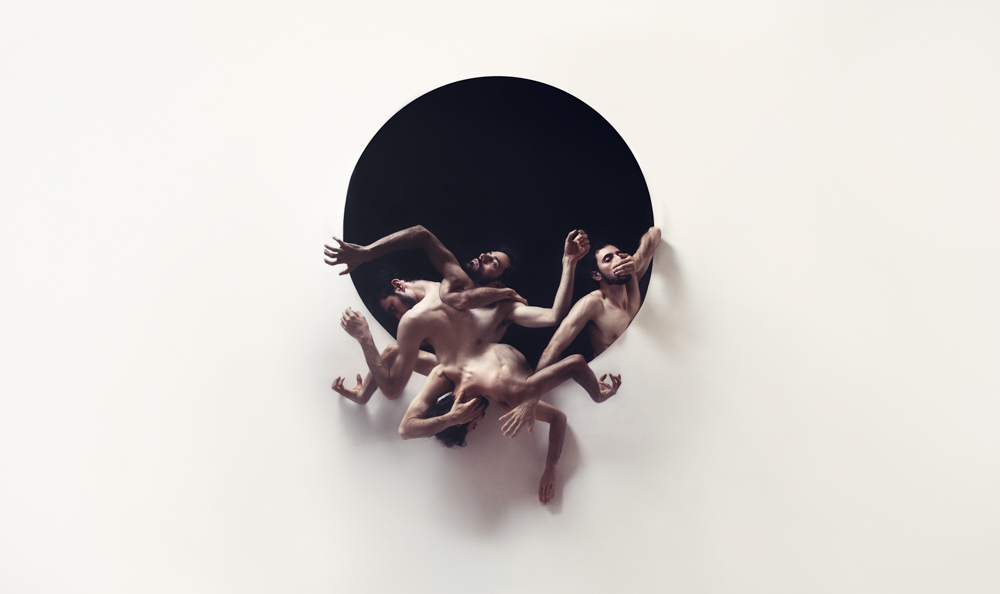
Pauline Goyard – Portrait Fine Art Photography, Creative Portraiture

I really like the simple geometric approach to this image, it is also very unusual with the circle cut out of the background, the body art also adds interest and an extra dimension to the shot
Gideon Mendel – Freedom Of Death – Social Struggle In South Africa, Damaged Negatives
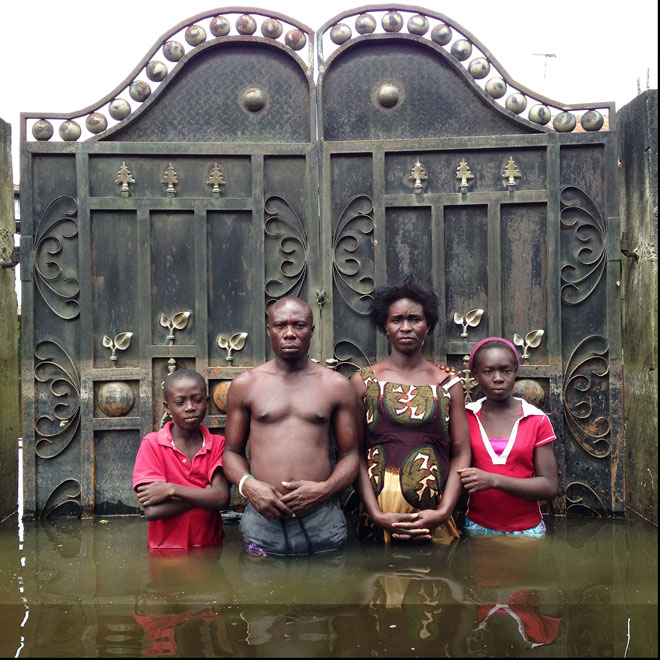
Gideon Mendel – Drowning World – highlighting the floods which are a a climate change effect
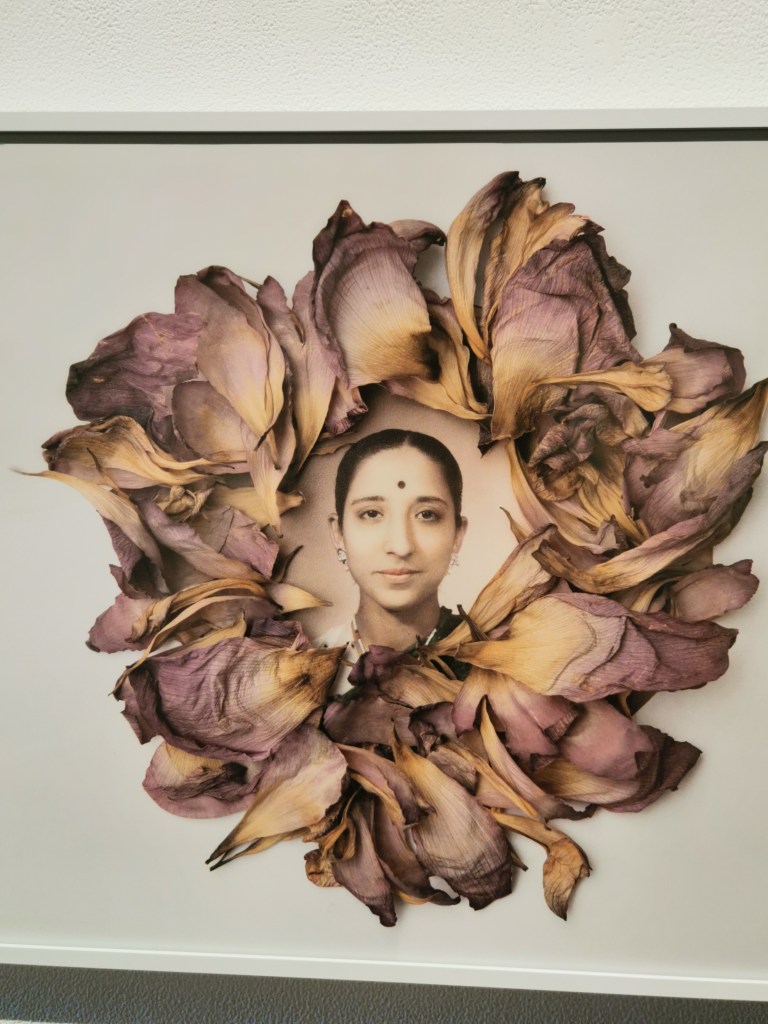
Nalini – Arpita Shah, the use of lotus flower petals arranged around a photo of her grandmother as a young woman has inspired me to the do the same with a photo of my mother and flame lily petals from Africa which I will collect when I next visit

Unit 1 Research: The Photograph As Document : Project 1: Judith Williamson’s ‘Advertising’ Articles

What is Source?

Extract from Source website : “Source is a quarterly photography magazine, available in print and as a digital edition, published in Belfast, Northern Ireland. We publish emerging photographic work and engage with the latest in contemporary photography through news, thoughtful features and reviews of the latest exhibitions and books from Ireland and the UK. Our website brings together an archive of writing and pictures from the magazine alongside current features”.

I have subscribed to the printed version of this magazine, I think this will be a useful reference for me during this module and continued study. I am trying to get my sources of reference and information from a variety of sources rather than just the internet so this will be one of them.

Tiffany Advert Comments, Key Points For me

These are points I found interesting about Judith Williamson’s observations on the image in the Tiffany advert ( image is below)

A new concept for me is that black and white or sepia images are used to show something that is timeless or classic. The reason B&W imagery has been used in this advert for example.

Black and white gives the impression of more classy, less transient than colour – so is often used in high end watches and luxury goods advertising – has come to represent something more serious, more aesthetic than colour – it also has a timeless connotation

This image of a couple in the pouring rain signifies spontaneity and very much like Cartier-Bresson’s “Decisive Moment” – and this also translates across into the decisive moment of proposing or deciding to be in a relationship – he also used to shoot in black and white.

It is also interesting how the narrative on the side (the short poem) and the ending question “will you” ties in with the narrative of the image. ‘Will you know that you’re more fun on/ a bad day than most people are on good ones/ and that I wouldn’t mind if it rained/ every day for the rest of my life if it meant/ I could spend it with you?’ The ‘Will you?’ in larger print, above the close-up image of the diamond rings, leads the romantic narrative to its culmination in a proposal.

Bibliography

Hull, S. (2020). Source Magazine: Thinking Through Photography – About Source. [online] Source.ie. Available at: https://www.source.ie/main/about.php [Accessed 7 Feb. 2020].